

Women’s basketball went from a restricted college gym class in 1892 to a major U.S. and global sport with millions of viewers, pro leagues, and bigger player pay. If you want the short version, here it is: rules made the game easier to spread, Title IX opened school access, the Olympics and FIBA gave it world reach, and the WNBA turned top players into pro stars.
Here’s the full path at a glance:
- 1892: Senda Berenson brought basketball to women at Smith College
- 1893: Smith hosted the first women’s college game
- Early 1900s: published rules gave schools one way to play
- June 23, 1972: Title IX changed access to teams, money, and scholarships
- 1972: the AIAW built a national college championship path
- 1976: women’s basketball joined the Olympic Games
- 1953 and after: FIBA world play grew into a major international event
- 1978 and 1996: early U.S. pro leagues tested the market
- 1996–1997: the WNBA launched with NBA backing
- 2020s: TV, streaming, NIL, and new labor deals pushed the sport into the mainstream
A few numbers show how far the game has come:
- 17 million viewers for Iowa vs. UConn in April 2024 on ESPN
- 18.9 million viewers for the 2024 NCAA title game
- 215,486 women played college sports in 2020–21, up from 29,977 in 1971–72
- More than 2.5 million fans attended WNBA games in the 2025 season
- The WNBA signed an $3.1 billion media deal in 2024
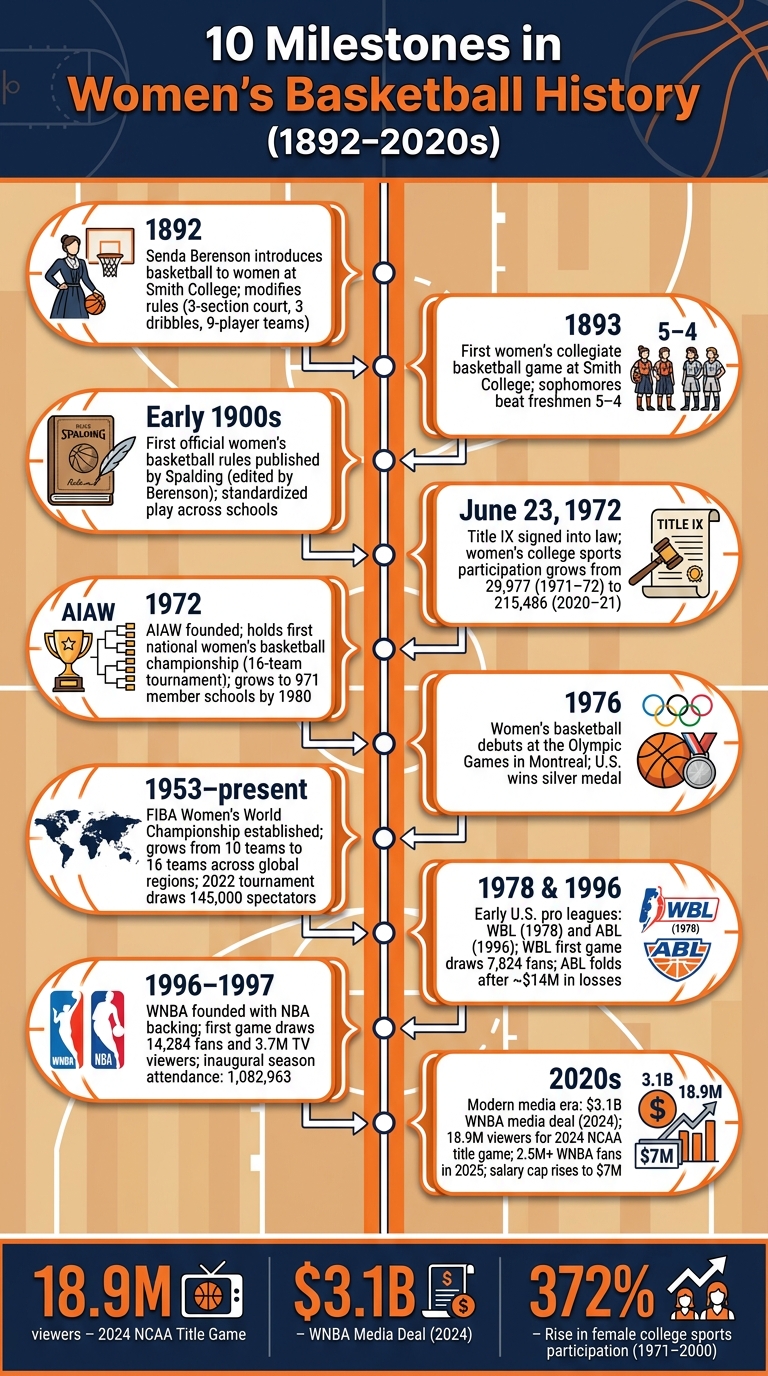
10 Milestones in Women’s Basketball History (1892–2020s)
History of Women’s Basketball (Before WNBA)
sbb-itb-4d95ad3
Quick Comparison
| Milestone | What changed | Main level |
|---|---|---|
| Berenson at Smith (1892) | Women got an early version of the game schools would allow | College |
| First college game (1893) | Women competed in organized play | College |
| Published rules (early 1900s) | Schools used one rule set | High school / college |
| Title IX (1972) | Access to teams, scholarships, and school support grew | High school / college |
| AIAW (1972) | Women’s college basketball got national championships | College |
| Olympics (1976) | The sport reached a world audience | International |
| FIBA world event | Regular global title play took shape | International |
| WBL and ABL | Early pro paths opened in the U.S. | Professional |
| WNBA (1996–1997) | A stable U.S. pro league began | Professional |
| Modern media era (2020s) | TV, streaming, attendance, and salaries climbed | College / pro |
In short: this history is about more than games. It’s about who could play, who could watch, and who could make a career from the sport.
1. Senda Berenson Brings Basketball to Women at Smith College (1892)
Historical Significance
In 1892, Senda Berenson introduced basketball at Smith College and reshaped the game for women. The Naismith Memorial Basketball Hall of Fame later named her the "Mother of Women’s Basketball". She didn’t just copy James Naismith’s game as-is, even using different custom game basketballs. She changed it to match the social expectations of the time.
Impact on Participation
Berenson made several rule changes. She split the court into three sections, limited players to three dribbles and three seconds, and used nine-player teams. She also banned ball-snatching and batting.
Those changes made the game more acceptable in women’s schools at the time, and the sport spread fast through YMCAs and elite women’s colleges such as Vassar, Wellesley, and Bryn Mawr.
Impact on Visibility
Her 1899 Basketball Guide for Women gave schools a shared set of rules and shaped the sport for decades. That gave women’s basketball a common framework as it moved beyond Smith.
In 1985, Berenson became the first woman inducted into the Naismith Memorial Basketball Hall of Fame.
That shared rulebook helped women’s basketball travel from campus to campus and also set the stage for the first collegiate game in 1893.
2. The First Women’s Collegiate Basketball Game at Smith College (1893)
Historical Significance
Using Berenson’s modified rules, Smith College held the first women’s collegiate basketball game on March 22, 1893. The sophomores beat the freshmen 5-4 in two 15-minute halves, using a soccer ball (rather than game basketballs) and peach baskets.
That game mattered for a plain reason: women were competing in public at a time when many people still argued that hard physical activity was unsafe for them. On the court, the players weren’t just trying to win. They were pushing back against a common belief about what women should and shouldn’t do.
Impact on Participation
The game caught on fast. By 1895, schools such as Mount Holyoke, Vassar, Wellesley, and Bryn Mawr had taken up the sport. That kind of spread says a lot. Once one campus showed it could be done, others followed.
Three years later, in April 1896, Stanford and UC Berkeley played the first intercollegiate women’s basketball game. Stanford won 2-1 in a 9-on-9 format. In that sense, the Smith game didn’t stay a one-off event. It became the early blueprint for women’s college basketball.
Impact on Visibility
The event drew unusual attention for its time. Men were kept out of the gym to fit Victorian decorum norms, while female students lined the running track and cheered. That detail paints a clear picture: interest was there, even if the rules around public behavior were tight.
At the same time, some outside reactions were skeptical, which shows just how unusual women’s basketball still seemed to many people. The game was visible, but not yet normal in the public mind.
Contribution to Professionalization
Berenson tied women’s basketball to health, endurance, and economic opportunity. That link gave the sport more weight than simple campus recreation. It helped move women’s basketball toward formal rulemaking, as schools needed a clearer structure for a game that was spreading from one college to another.
3. The First Official Women’s Basketball Rules Are Published (Early 1900s)
Historical Significance
Once the first games showed that women’s basketball could be played in an organized way, the sport needed one thing badly: a shared rulebook. Before 1901, teams often played under different sets of rules, which made intercollegiate games hard to arrange. In 1899, the Conference of Physical Training created a rules committee, and in 1901 Spalding published the first official Basket Ball for Women, edited by Berenson.
That gave schools a common set of rules to work from. It also made it much easier to set up games between colleges instead of treating each matchup like its own separate version of the sport, often played in custom V-neck basketball jerseys or other early athletic attire.
Impact on Participation
With one rule system in place, schools had a clear framework for scheduling games and officiating them the same way from one court to the next. The rulebook divided the court into three zones, limited players to three dribbles and three seconds, and made snatching or batting the ball a foul.
By modern standards, those rules sound strict. At the time, though, they helped schools feel more comfortable supporting the game. That structure stuck for a long time too – Berenson’s framework stayed in use until the 1960s.
Impact on Visibility
A shared rulebook also gave women’s basketball more public standing. It looked less like a campus experiment and more like a sport people could follow with some confidence. By October 1906, women’s basketball appeared on the cover of the Saturday Evening Post.
That momentum carried into officiating as well. Guides for officials were published in 1913, and the Women’s National Officials Rating Committee was formed in 1928 to bring more consistency to officiating.
Contribution to Professionalization
Berenson tied organized sport to women’s health, stamina, and access to better wages. That idea mattered. When rules are clear, a game becomes easier to teach, easier to schedule, and easier to grow.
In plain terms, the sport could move past isolated college gyms and start building a path toward something bigger.
4. Title IX Opens Doors for Girls’ and Women’s Basketball (June 23, 1972)
Historical Significance
On June 23, 1972, President Richard Nixon signed Title IX, which banned sex discrimination in federally funded education. By that point, women’s basketball already existed and had spent decades working toward shared rules. What Title IX changed was access. It gave girls and women a better shot at funding, teams, and room to grow.
Before Title IX, many women’s basketball programs at major universities ran on almost no money. Players shared uniforms, covered their own travel costs, and often had no trainers or medical care. At Indiana University, the situation was so bare-bones that players made handmade fliers to find teammates and wrote numbers on physical education shirts to make makeshift jerseys.
Impact on Participation
The numbers show just how much changed. In the 1971–72 academic year, 29,977 women played college sports nationwide. By 2020–21, that total had jumped to 215,486.
For women’s basketball, Title IX helped move the sport out of the club and extramural world and into varsity programs with coaches, recruiting support, and more stable backing. That shift mattered. It meant players were no longer piecing things together on their own.
Ann Meyers became the first woman to receive a four-year athletic scholarship when she enrolled at UCLA. That moment felt like a line in the sand: less scraping by, more direct investment.
Impact on Visibility
In February 1975, Queens College played Immaculata University in the first women’s basketball game held at Madison Square Garden. The game drew 11,969 fans. That wasn’t a small footnote. It showed there was an audience for women’s basketball, and a big one at that.
Contribution to Professionalization
Title IX also gave coaches and administrators a legal basis to push back against pay gaps and uneven funding. Even 20 years after the law passed, men still received 70% of scholarship money, 77% of operating budgets, and 83% of recruiting funds.
As Scott Dolson, Vice President and Director of Intercollegiate Athletics at Indiana University, put it:
"The path forward has not always been fast, and it has not always been easy. We have come a very long way during these last 50 years, but there’s still plenty of work that needs to be done."
That stronger college pipeline helped set the stage for Olympic inclusion in 1976 and, later, the professional game.
5. The AIAW Forms and Launches National Women’s College Championships (1972)
Historical Significance
In 1972, women’s college basketball finally got a national championship setup of its own. The Association for Intercollegiate Athletics for Women (AIAW) had been established in 1971, replacing the earlier Commission on Intercollegiate Athletics for Women (CIAW).
That shift mattered right away. In March 1972, the AIAW held its first national basketball championship in Normal, Illinois: a 16-team tournament that ended with Immaculata College beating West Chester State 52–48. Immaculata did it on a shoestring budget. Players sold toothbrushes to cover travel costs. Today, teams often wear custom pro basketball jerseys that reflect their professional status. What had been scattered college competition now had a national route.
Impact on Participation
The AIAW didn’t stay small for long. It grew from 280 member schools in 1971 to 971 by 1980. In 1975, it added a three-division setup, which gave smaller schools their own path to national play instead of forcing them to go head-to-head with bigger programs from the start.
Money started to shift too. Women’s-sports funding went from under 1% of athletic budgets in the early 1970s to more than 16% by 1980. That’s a huge jump, and it changed what schools could offer.
Impact on Visibility
The AIAW turned women’s basketball into a national event, not just a campus one. In January 1975, Immaculata vs. Maryland became the first women’s college basketball game shown on national TV.
That same year, the 1975 AIAW championship game drew 11,969 fans at Madison Square Garden. A few years later, in 1978, the AIAW moved to a "Final Four" format, and the title game at UCLA’s Pauley Pavilion drew 9,531 fans and got a partial NBC broadcast. Then, in 1980, the AIAW signed a four-year television rights deal with NBC.
You can see the pattern: more schools, more fans, more TV, more attention.
Contribution to Professionalization
At first, the AIAW banned athletic scholarships. Then it changed course in 1973 after a legal challenge, opening the door for schools to offer women full athletic aid. That was a big step, because it pushed the women’s game closer to the kind of support men’s programs already had.
The AIAW also helped shape elite coaches such as Pat Summitt and Tara VanDerveer, who later became central figures in the modern game.
Its run ended in 1982, when the NCAA started sponsoring its own women’s championships and put up $3 million to cover all expenses for teams competing in national championships, something the AIAW couldn’t match. Even so, the AIAW had already built the path: national championships, TV deals, and scholarship rules that gave women’s college basketball a stronger base. That national pipeline also helped set up Olympic inclusion in 1976.
6. Women’s Basketball Enters the Olympic Games (1976)
Historical Significance
By 1976, women’s basketball had built enough momentum to make the jump to the Olympic stage. The sport made its Olympic debut at the 1976 Montreal Games, just four years after Title IX. That timing mattered. It showed how fast the U.S. system was growing, from college programs to scholarship support to a team ready to compete on the world stage.
The U.S. secured its Olympic spot by winning a qualifying tournament in Ontario. In Montreal, the team opened with an 84–71 loss to Japan. Then it bounced back and finished with the silver medal.
Impact on Visibility
The Olympics gave women’s basketball something it had never had before: a global stage. Lusia Harris scored the first Olympic basket in women’s basketball history. That single play became a landmark moment for the sport.
The tournament also showed U.S. fans how strong the rest of the world already was. Soviet center Uljana Semjonova dominated the gold-medal game, making the level of international competition impossible to ignore. For women’s basketball, the message was plain: this sport belonged on the world stage, and people were ready to watch it.
Contribution to Professionalization
The 1976 U.S. roster included Ann Meyers, Nancy Lieberman, Lusia Harris, and Pat Summitt. Those names would matter for years to come. They didn’t just play in Montreal. They helped shape what women’s basketball became next.
That silver-medal run also helped push the game toward the pro ranks. In 1978, the Women’s Basketball League (WBL) launched as the first U.S. pro women’s league. Decades later, the impact of that Olympic team was still being recognized. In 2023, the team was inducted into the Naismith Memorial Basketball Hall of Fame.
That Olympic exposure set the stage for the sport’s next step: a larger global championship circuit.
7. The FIBA Women’s World Championship Grows Into a Global Event
Historical Significance
The Olympics gave women’s basketball a huge stage. But FIBA gave the sport something different: a regular world title.
That mattered a lot. The FIBA Women’s World Championship became the first recurring global championship in women’s basketball, years before the sport joined the Olympics in 1976. The first tournament took place in Santiago, Chile, in 1953. It featured 10 teams, and games were played in two 16-minute halves.
For a long stretch, the Soviet Union was the team everyone had to chase. It won five straight titles from 1959 to 1975 and did it without losing a single game across 40 contests. Even more striking, every one of those wins came by at least 10 points.
That streak finally ended in 1986, at the championship held in the Soviet Union. In the final, the United States beat the Soviets and ended their 56-game winning streak. At that point, the World Championship had become more than a side piece to the Olympics. It stood on its own as a major international event.
Impact on Participation
The tournament’s reach changed in a big way over time.
The first field leaned heavily toward the Americas, with 8 of the 10 teams coming from that region. By 2026, the event will feature 16 teams from Africa, Asia, the Americas, and Europe.
That shift says a lot. What started as a tournament with a strong regional tilt grew into a world event in the plainest sense of the term.
Impact on Visibility
The event people see today barely resembles its early version.
At the 2022 tournament in Sydney, the Women’s Basketball World Cup drew 145,000 spectators. FIBA also changed the name after 2014, moving from the Women’s World Championship to the Women’s Basketball World Cup so it lined up with other major world titles.
Global Competition Deepens
The 1994 tournament changed the story in a major way.
Brazil became the first team outside the United States or Soviet Union to win the title. That ended a 41-year duopoly and showed that top-level women’s basketball was no longer centered on just two powers. The sport had moved past a U.S.-Soviet showdown and into a much broader global contest.
Since 1986, FIBA has held the tournament in even-numbered non-Olympic years.
That deeper international field helped set up the first U.S. pro leagues.
8. Early U.S. Pro Leagues: The WBL and ABL
Historical Significance
As women’s basketball picked up steam around the world, the next big test was simple: could the U.S. support a lasting pro league? College basketball had become a launchpad, but players still needed a clear path after graduation.
The Women’s Professional Basketball League (WBL) launched in 1978, founded by Bill Byrne. It was the first professional women’s basketball league in U.S. history. On December 9, 1978, the Chicago Hustle beat the Milwaukee Does 92–87 in the first game, in front of 7,824 fans at Milwaukee Arena. Milwaukee Mayor Henry Maier compared the night to the birth of professional football, and the game received four minutes of coverage on the CBS Evening News with Walter Cronkite.
The American Basketball League (ABL) arrived in 1996. It folded in December 1998 after about $14 million in losses.
Impact on Participation
The WBL gave the first wave of Title IX graduates somewhere to keep playing at a high level. In just three years, the league featured 17 future Hall of Famers and 9 Olympians. Molly Bolin Kazmer also became the first player to sign a pro contract on June 30, 1978, a clear sign of the league’s trailblazing role.
Years later, the ABL pulled in players with stronger pay and a chance to share in the league’s future. It offered a 10% ownership stake through a stock option plan, along with solid salaries. In April 1997, Stanford’s Naismith Player of the Year Kate Starbird picked the ABL’s Seattle franchise over the WNBA and earned about $150,000.
"The thing I liked about the ABL and what was happening was they made us part of the process. I see now, working for the Aces, the players have to be part of what you do on the business side." – Jennifer Azzi, Former ABL Player and Las Vegas Aces Chief Business Development Officer
Impact on Visibility
The WBL’s 1979 All-Star Game at Madison Square Garden put women’s pro basketball on a national stage.
Contribution to Professionalization
The WBL also helped make the 28.5-inch (size 6) basketball the standard in women’s play. The ABL’s impact showed up in another way after it shut down: 35 of the 50 players selected in the 1999 WNBA draft came straight from the ABL.
Together, the WBL and ABL showed there was both talent and fan interest for women’s pro basketball in the United States. They helped clear the path for the WNBA.
9. The WNBA Is Founded and Plays Its First Season (1996–1997)
Historical Significance
On April 24, 1996, the NBA approved the WNBA, creating the first NBA-backed women’s league. That move came right after the 1996 U.S. Olympic gold medal run, which showed there was a strong audience for women’s basketball.
For years, elite women players had the talent but not a steady U.S. pro league built to match it. The WNBA changed that. It turned top college stars and Olympic players into part of a clear American pro path.
"We’re in the women’s basketball business now." – Russ Granik, NBA Deputy Commissioner
Impact on Participation
Before 1997, players like Cynthia Cooper and Kym Hampton often had to go overseas to keep playing at a high level. The picture shifted on October 23, 1996, when Sheryl Swoopes became the first player signed by the WNBA. Soon after, Rebecca Lobo, Lisa Leslie, and Ruthie Bolton-Holifield joined her.
That gave American players something they hadn’t had in a steady way before: a home-based pro league they could build a career around. It also rested on years of work that came before, including Title IX, Olympic play, and earlier women’s pro leagues.
Just as important, fans now had a league they could follow every summer instead of watching stars disappear overseas.
Impact on Visibility
The WNBA didn’t ease into the spotlight. It launched with national TV deals on NBC, ESPN, and Lifetime, and the "We Got Next" campaign helped frame it as a major summer sports event.
On June 21, 1997, the New York Liberty beat the Los Angeles Sparks 67–57 in front of 14,284 fans. Penny Toler scored the first basket in league history. NBC’s broadcast of that first game drew 3.7 million viewers, and by the end of the inaugural season, total attendance reached 1,082,963.
Those numbers mattered. They showed women’s basketball could draw a national crowd on TV and in the arena at the same time.
Contribution to Professionalization
From the start, the WNBA looked and operated like a major pro league. It used NBA arenas, NBA marketing support, a new game ball, and an official player draft. Teams also began utilizing professional gear, including custom team basketball backpacks, to unify their branding.
A few early moments made that clear:
- Tina Thompson was selected first overall in the inaugural WNBA Draft on April 28, 1997.
- The Houston Comets won the first WNBA Championship on August 30, 1997, beating the New York Liberty 65–51 behind Finals MVP Cynthia Cooper.
- In its first year, the league brought in about $30 million in sponsorships.
This gave women’s basketball a firmer pro setup in the United States and set the stage for the sport’s next jump in media attention and global reach.
10. Modern Media Coverage and the Rise of the Global Pro Game
Historical Significance
Once the WNBA showed that women’s basketball could work as a pro business, media rights changed the picture. They turned the sport into its own media property, not just an add-on to the NBA. That shift is easy to see in the league’s TV path. In 2024, the WNBA signed an 11-year media rights deal worth $3.1 billion with Disney, NBC, and Amazon.
Impact on Visibility
Big audiences helped push women’s basketball into the center of the sports conversation. The 2024 NCAA Championship between South Carolina and Iowa drew 18.9 million viewers. At the same time, putting marquee games on broadcast networks like ABC, NBC, and CBS, instead of leaving them on cable-only channels, put the sport in front of many more people.
Amazon added another layer. With a global streaming platform in the mix, fans far beyond the United States can now watch the game more easily. And the audience data backs that up. The 2025 WNBA season set a single-season attendance record with more than 2.5 million fans across 226 games. Regular-season games also averaged 1.3 million viewers across ESPN networks. By 2026, WNBA TV ratings had moved past the NHL’s.
That matters because these aren’t niche numbers anymore. They show that women’s basketball is now a mainstream sports property.
Impact on Participation
That visibility now starts before players even reach the pros. NIL rules and social media helped college stars build their names and earn power while still in school. So by the time they enter the draft, many already have a fan base, public profile, and business pull.
New league options also changed the path. Unrivaled gave top players a U.S.-based way to play and earn year-round instead of needing to leave the country in the offseason.
Contribution to Professionalization
More attention has led straight to bigger money. Under the 2026 Collective Bargaining Agreement, the salary cap rose to $7 million, with supermax salaries reaching $1.4 million and minimum salaries set at $300,000. In April 2026, Las Vegas Aces guard Jackie Young became the first WNBA player to finalize a million-dollar contract under the new CBA, signing for $1.19 million.
The league also made changes that players had pushed for over many years. In 2024, the WNBA mandated full-time charter flights for all teams, ending 28 seasons of commercial travel. Team values show the same upward move. The Golden State Valkyries, which debuted in 2025, became the first WNBA franchise valued at nearly $1 billion.
"We all knew that this was possible. Anybody that laced up a shoe knew that the WNBA had a place… this was possible; it was just about the investment and the visibility." – Candace Parker, WNBA Legend
Milestone Snapshot Table
This table gives you a quick read on what each milestone changed, where that change hit hardest, and the kind of growth it pushed forward.
| Milestone | Primary Impact | Level Affected | Growth Type |
|---|---|---|---|
| 1. Berenson Adapts Rules (1892) | Created a socially accepted version of the game for women | College | Participation |
| 2. First Collegiate Game (1893) | Proved women could compete in organized team sports | College | Participation |
| 3. Official Rules Published (Early 1900s) | Standardized play across institutions via Spalding Athletic Library | High School / College | Participation |
| 4. Title IX (June 23, 1972) | Legally mandated equitable funding, driving scholarships and team growth | High School / College | Participation |
| 5. AIAW Forms (1972) | Built the first national championship structure for women’s college basketball | College | Visibility |
| 6. Olympic Debut (1976) | Validated women’s basketball as an elite international sport | International | Visibility |
| 7. FIBA World Championship Growth (from 1953) | Established recurring global competition for national teams | International | Visibility |
| 8. Early Pro Leagues – WBL & ABL | First real tests of paid professional play for women in the U.S. | Professional | Professionalization |
| 9. WNBA Founded (1996–1997) | Created a stable, NBA-backed professional career path | Professional | Professionalization |
| 10. Modern Media Coverage and the Global Pro Game (2020s) | Drove record viewership and individual player commercial value | College / Pro | Visibility / Professionalization |
Put simply, these shifts did more than change the game itself. They changed who got to play, who got to watch, who got paid, and how women’s basketball was treated at every level.
How Women’s Basketball Grew Beyond the Court
Women’s basketball didn’t just change through new rules and new leagues. It changed in the day-to-day details too: how players trained, what they wore, and how teams showed up in public. You can see that shift most clearly in uniforms, facilities, and team branding.
In the 1890s, players wore floor-length dresses with heavy, awkward layers. That gear made movement hard. By the late 1890s, bloomers started to replace those outfits, which gave players more freedom on the court. From there, uniforms kept changing, moving from bloomers to long-sleeved tops and then to standardized jersey numbers by 1947.
As the sport became more professional, uniforms started to do more than cover the body. They became part of a team’s image. When the WNBA launched in 1997, Champion designed the first official league uniforms for the eight founding teams, pushing the game toward more performance-focused designs.
By the 2020s, that growth had spread to shoes and training spaces as well. In September 2023, Nike released the Sabrina 1, a signature shoe for New York Liberty guard Sabrina Ionescu. It was also the first signature shoe made as a unisex product. By the 2024–25 season, the Sabrina 2 had become the second-most popular shoe worn by players across the NBA.
Training spaces changed too. After Mark Davis bought the Las Vegas Aces in January 2021, the team built the first WNBA-specific practice facility, which opened in 2023. That move showed a deeper level of investment in players, not just during games, but in how they prepare every day.
That same attention now shows up in custom team gear. Fully sublimated jerseys, shorts, warmups, and accessories from providers like Wooter Apparel help teams connect performance with identity. Today, team gear isn’t just about looks. It’s part of how a team plays, presents itself, and builds its name.
Conclusion
Women’s basketball started as a tightly restricted campus game and grew into a global sport. These milestones show how that change took place. Each one moved the game ahead: Berenson standardized play, Title IX opened the door to more access, the AIAW and NCAA built national championships, the Olympics gave the sport global standing, and the WNBA gave players a professional home.
Female college sports participation rose 372% from 1971 to 2000. That growth came from better rules, more funding, and league support. And a lot of this progress is still new. The WNBA launched in 1996, NIL arrived in 2021, and league expansion is still in motion. That base continues to shape the sport’s next era.
FAQs
Why was Title IX such a turning point for women’s basketball?
Passed in 1972, Title IX banned gender discrimination in federally funded education programs. For women’s basketball, that changed the game. Schools had to offer fairer access, support, and resources to girls’ and women’s teams.
That shift helped more college programs grow and gave female athletes more chances to play, develop, and compete. As those doors opened, the sport grew with them, and more players saw a path to higher levels of basketball.
What made the WNBA more stable than earlier pro leagues?
The WNBA was more stable in large part because it had full NBA backing.
That support gave the league access to an existing system: arenas, marketing, support staff, and local media and fan ties. Instead of building everything from scratch, teams could plug into a setup that was already in place.
Teams could also share resources and tap into national sponsorship deals. On top of that, the summer schedule helped the league avoid going head-to-head with established men’s pro sports.
How did the Olympics and FIBA grow women’s basketball globally?
The Olympics and FIBA helped grow women’s basketball around the world by giving the sport a clear stage for top-level international play.
FIBA launched the FIBA World Championship for Women, and the Olympics added women’s basketball in 1976. Together, these events put elite players in front of a global audience, gave the sport more attention, and helped women’s basketball earn stronger recognition worldwide.