
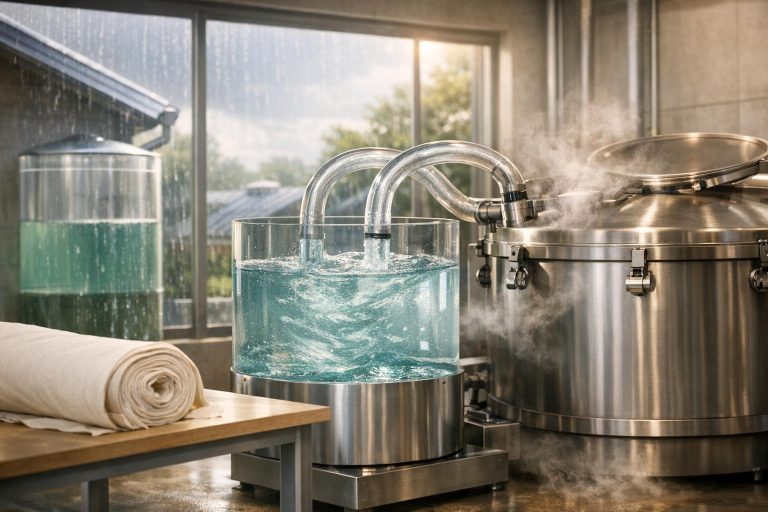
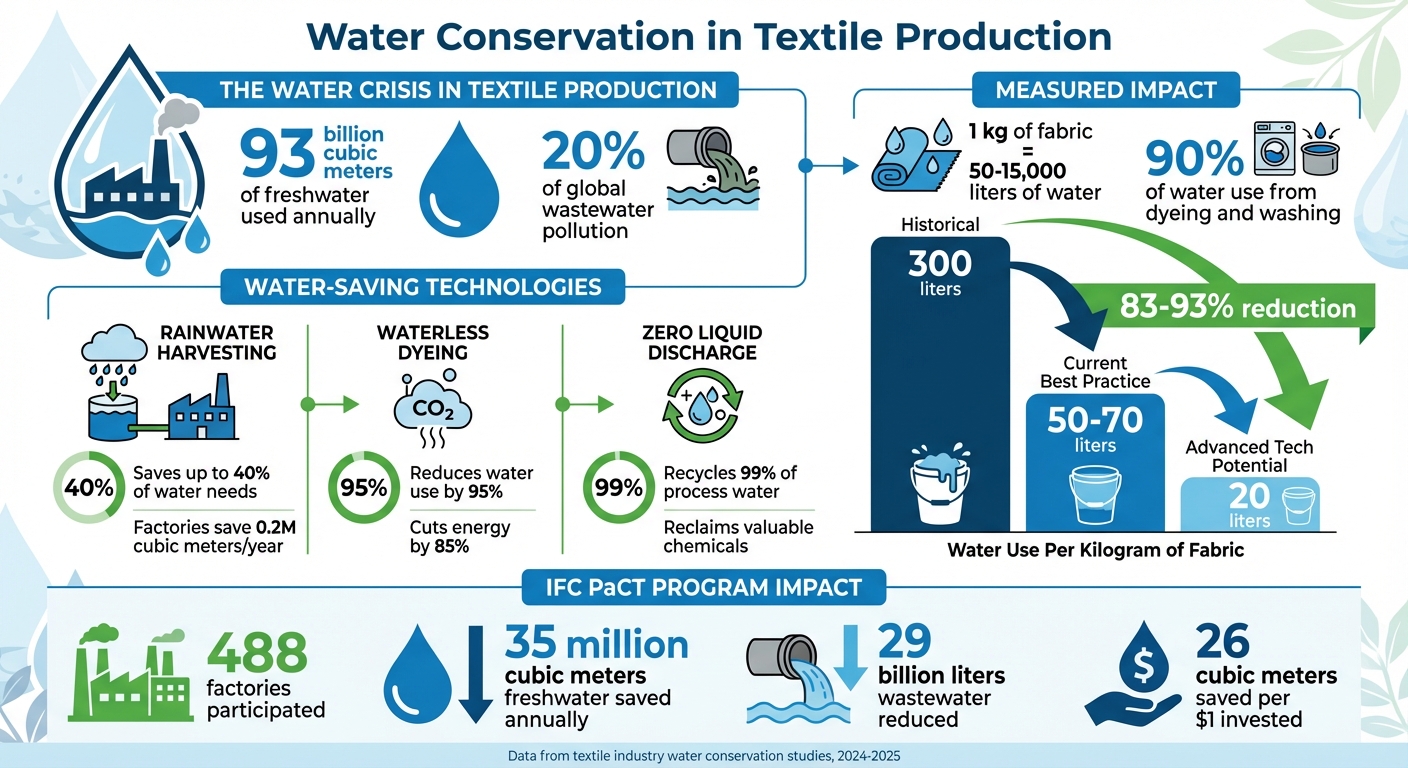
The textile industry is one of the largest water consumers globally, using 93 billion cubic meters of freshwater annually, with processes like dyeing and washing accounting for up to 90% of water use. Producing 1 kilogram of fabric can require anywhere from 50 to 15,000 liters of water, depending on the material and method. This extensive water usage contributes to 20% of global wastewater pollution, harming ecosystems and depleting groundwater reserves.
To address these challenges, manufacturers are adopting solutions such as:
- Rainwater Harvesting: Factories like Fakir Apparels and Plummy Fashions in Bangladesh use rainwater to meet up to 40% of their water needs, saving millions of liters annually.
- Waterless Dyeing Methods: Technologies like supercritical CO2 dyeing and foam dyeing reduce water use by up to 95%.
- Recycling Systems: Zero Liquid Discharge (ZLD) systems recycle wastewater entirely, reclaiming up to 99% of process water.
- Sustainability Programs: Initiatives like IFC’s PaCT have helped factories reduce freshwater use by 35 million cubic meters annually.
Despite progress, barriers like high costs, infrastructure needs, and seasonal rainfall limit widespread adoption. However, advancements in low-water technologies and closed-loop systems are reshaping the industry’s water footprint, with some factories reducing water use to as little as 20 liters per kilogram of fabric.
Key Takeaways:
- Rainwater harvesting, waterless dyeing, and recycling systems are reducing water consumption.
- Factories have cut water use per kilogram of fabric from 300 liters to as low as 50 liters.
- Programs like PaCT and advanced systems are driving further reductions, but challenges remain in scaling these solutions.
These methods show that reducing water use in textile production is achievable and necessary to protect global water resources.
Water Conservation in Textile Production: Key Statistics and Reduction Methods
Alchemie Endeavour™ : Waterless Smart Dyeing
sbb-itb-4d95ad3
Rainwater Harvesting Systems in Textile Factories
Rainwater harvesting is gaining traction as a smart way for textile manufacturers to conserve water and reduce reliance on shrinking groundwater reserves. The concept is simple: collect rainwater from factory rooftops, store it in tanks, and use it in daily operations. For perspective, a 9,000-ft² factory roof can gather around 15 million liters of rainwater annually, significantly cutting groundwater usage.
One of the standout advantages of rainwater is its superior quality compared to groundwater. Rainwater has much lower hardness levels (19–31 ppm) compared to groundwater (912–1,100 ppm) and contains significantly less iron. This makes it ideal for textile production, where water quality directly affects fabric results. For instance, fabric treated with rainwater achieved a whiteness index of 95, compared to 90 for fabric processed with groundwater. These results highlight the potential of rainwater harvesting in improving both sustainability and product quality.
Factory Implementation Examples
Several textile factories in Bangladesh showcase the practical benefits of rainwater harvesting systems.
Fakir Apparels Ltd, based in Narayanganj, reported in September 2025 that rainwater harvesting fulfills about 30% of its total water needs. According to Chief Operating Officer Bakhtiar Uddin Ahmed, combining rainwater harvesting with advanced washing technology has lowered water consumption to 65–68 liters per kilogram of fabric.
Plummy Fashions Ltd, widely regarded as one of the greenest factories globally, has achieved 40% water savings through its rainwater harvesting system. Managing Director Fazlul Hoque mentioned that while the collected rainwater is primarily used for non-critical purposes like toilet flushing and floor cleaning, the company is exploring advanced methods to reduce water use to as little as 20 liters per kilogram of fabric. Similarly, Square Textiles has cut water consumption at its Habiganj facility from 120–150 liters to just 53 liters per kilogram of fabric, thanks to a combination of rainwater harvesting and water recycling, according to Director of Operations Sayeed Ahmad Chowdhury.
The impact of rainwater harvesting extends beyond individual factories. By February 2022, 45% of H&M’s 105 sourcing factories in Bangladesh had implemented rainwater harvesting systems, collectively saving 0.2 million cubic meters of water in just one year. On average, green garment factories in Bangladesh report saving around 40% on water costs through these systems. Despite these achievements, challenges remain that slow broader adoption.
Barriers to Rainwater Harvesting Adoption
Several obstacles make it difficult for factories to implement rainwater harvesting on a larger scale. The most immediate challenge is the high upfront cost, which can run into millions of dollars for large-scale systems. This is particularly daunting for smaller factories, even though the long-term savings are considerable.
Infrastructure needs further complicate the process. Factories require large storage tanks and expansive catchment areas to ensure a reliable water supply during dry spells, especially since rainfall in many regions is concentrated within a five-month monsoon season. Additionally, ongoing maintenance is essential to prevent contamination and maintain water quality.
"The water level in and around Dhaka City… is falling by 1.5 to 3 percent annually because of the overuse of groundwater in the RMG sector."
– Hasin Jahan, Country Director, WaterAid
Another challenge lies in water quality. While rainwater works well for non-critical uses, using it in sensitive processes like dyeing often requires advanced treatment systems to meet strict quality standards. This adds both cost and complexity. Moreover, the seasonal nature of rainfall doesn’t align with the constant water demands of textile production, making significant storage capacity and careful planning essential to bridge dry periods.
Water Reduction Technologies in Textile Manufacturing
Textile manufacturers are adopting cutting-edge technologies to drastically cut water use during production, complementing efforts like rainwater harvesting. Traditional textile processes rely heavily on water, which has driven the search for methods that either minimize or completely eliminate its use. For context, producing just one pair of blue jeans can require around 1,500 gallons of water.
Waterless Dyeing Methods
Waterless dyeing is revolutionizing how fabrics are colored. One standout method is Supercritical Carbon Dioxide (scCO2) dyeing, which uses pressurized CO2 in a closed-loop system. This system recaptures 95% of the CO2, reducing water usage by 95% and energy consumption by 85%. While it’s particularly effective for synthetic fibers like polyester and nylon, it’s not yet widely applicable to natural fibers.
Another approach, AirDye technology, eliminates liquid dye baths altogether. It uses high-pressure airflow and heat to transfer dye from paper to fabric, achieving reductions of 95% in water use, 84% in greenhouse gas emissions, and 86% in energy consumption. Major brands like Nike, Adidas, and IKEA are already incorporating this method to meet their environmental goals.
For natural fibers like cotton, ColorZen technology offers a pretreatment process that makes the fibers more dye-absorbent. This innovation cuts water use by up to 90% and reduces chemical usage by 95% compared to conventional methods. Meanwhile, foam dyeing replaces water with foam to carry dye, slashing water use by 80% and significantly lowering the energy required for drying.
These advancements, paired with water recycling systems, are reshaping water management in the textile industry.
Water Recycling and Closed-Loop Systems
Water recycling systems are another game-changer, enabling factories to reuse water multiple times and reduce their reliance on freshwater. Zero Liquid Discharge (ZLD) systems, for example, recycle wastewater entirely, converting contaminants into solid waste. These systems combine technologies like membrane filtration, reverse osmosis, and evaporation to reclaim all water from the wastewater stream.
A 2021 study highlighted the success of Galeb d.d., a cotton clothing manufacturer in Croatia, which used Ultrafiltration (UF) membranes to treat textile wastewater. This system reduced water use for washing dyed cotton fabric by 80%, achieving over 99.3% turbidity removal and 93.1% sulfate removal. The treated water met the quality standards needed for industrial washing.
Wet processing – covering dyeing, printing, and finishing – accounts for 72% of the textile industry’s water demand. Of that, 60–90% is used for rinsing and washing, which is relatively easy to clean and recycle. Water from final rinses, which contains fewer contaminants, can often be reused in earlier rinsing stages. Even wastewater from more intensive processes like scouring and bleaching can be recycled up to three times. Beyond water recovery, these systems also allow manufacturers to reclaim valuable materials like caustic soda, synthetic sizes, and salts.
Measured Results of Water Conservation Programs
Textile manufacturers have made strides in reducing water consumption. The Partnership for Cleaner Textile (PaCT), a decade-long advisory initiative led by the International Finance Corporation (IFC), has worked with over 450 factories in the textile supply chain. The focus has been on adopting cleaner production methods, particularly in water-heavy processes like dyeing, finishing, and washing.
Results from IFC’s PaCT Program
By 2024, 338 factories participating in PaCT collectively reduced their annual freshwater use by 25 million cubic meters. When the program expanded to 488 factories, yearly water savings jumped to 35 million cubic meters, while wastewater reduction reached 29 billion liters. On average, factories saved 26 cubic meters of water annually for every $1 invested.
Take Evince Textiles Limited (ETL) as an example. By implementing countercurrent flow technology and recovering blanket cooling water in its sanforizing machines, the company achieved a 14% water use reduction. Their investments – $3,899 for countercurrent flow and $475 for cooling water recovery – resulted in annual savings of 169,920 and 56,640 cubic meters of water, respectively.
"By adopting these two recommendations [countercurrent flow and cooling water recovery], we have reduced 14 percent water consumption."
Other innovations further highlight the potential for scaling such efforts. Fakir Knitwears Ltd installed a tertiary wastewater treatment system that combines disc filtration, ultrafiltration, and reverse osmosis. This system processes up to 2,400 cubic meters of water daily, recovering half (1,200 m³/day) for reuse. Over six years, the project could recycle 1.29 million cubic meters of treated water. If just 25% of Bangladesh’s textile mills adopted similar systems, the industry could save 43.6 million cubic meters of groundwater annually. These examples show how advanced water-saving technologies can revolutionize textile production.
Water Usage Comparison Data
The industry has also made progress in reducing water use per kilogram of fabric. For example, washing 1 kilogram of denim used to require nearly 200 liters of water. Today, that figure has dropped to about 50–53 liters.
| Fabric/Process Type | Historical Water Use (L/kg) | Current/Best Practice Use (L/kg) | Potential with Advanced Tech (L/kg) |
|---|---|---|---|
| Denim Washing | ~200 | 50–53 | 25–30 |
| General Textile Processing | 300 | 100–150 | 50–70 |
| Square Textiles (Specific) | 120–150 | 53 | N/A |
| Fakir Apparels Ltd (Specific) | N/A | 65–68 | N/A |
Historically, textile production in Bangladesh averaged 300 liters of water per kilogram of fabric. However, best-practice factories now report usage between 50 and 70 liters per kilogram. Industry leaders believe there’s room for further improvement. Fazlul Hoque, Managing Director of Plummy Fashions Ltd, shared:
"With advanced systems, water use could be brought down to as little as 20 litres per kg of fabric."
Future Developments and Market Forecasts
The textile industry is gearing up for a wave of advancements in water-saving technologies. By 2030, many competitive export mills are expected to standardize the use of next-generation low-liquor-ratio machines and heat recovery systems. These machines operate with water ratios of 1:4 to 1:6, compared to the older equipment’s 1:10 to 1:12, cutting water usage by an impressive 30–50%. By 2035, textile hubs aim to achieve near-zero liquid discharge while maximizing heat reuse, setting a new benchmark for sustainable operations.
Rainwater Harvesting and LEED Certification Growth

Integrated water management systems are becoming the backbone of green textile factories. Rainwater harvesting already supplies 30–40% of water needs in such facilities. As of September 2025, Bangladesh boasted 263 LEED-certified factories, with 68 of them ranked among the world’s top 100 highest-rated LEED facilities. This trend is fueled by increasing pressure from global retailers who demand sustainable supply chains. To meet these expectations, factories are heavily investing in systems that combine rainwater harvesting, recycling, and advanced treatment technologies.
New Technologies for Groundwater Reduction
Technological breakthroughs in dyeing are making significant strides in reducing water use. Foam dyeing and supercritical CO₂ systems, for instance, have already proven their potential. While waterless dyeing platforms currently account for just 5–8% of production in key Asian markets, long-term contracts are accelerating their adoption. Ananta Ahmed, Managing Director of 360 Solution Ltd, highlighted this progress:
"Advanced technology can enable reductions of up to 90 percent in groundwater consumption for washing and dyeing".
Looking ahead, Energy Solutions Intelligence predicts that by 2030, waterless technologies will claim a substantial share of high-volume segments like polyester sportswear.
One remarkable example comes from a knit dyeing cluster in Gazipur, which between 2022 and 2024 slashed its water consumption from 95 to 55 liters per kilogram. This 42% reduction was achieved through a $2.1 million investment, which had a payback period of just 5.1 years.
Conclusion
The water crisis tied to textile production calls for immediate action. Strategies like rainwater harvesting, waterless dyeing, and closed-loop recycling systems are reshaping how factories operate. The global textile industry consumes an estimated 830 million cubic meters of freshwater annually, while many major textile hubs face dwindling groundwater reserves.
New conservation methods are replacing outdated practices. For example, rainwater harvesting and waterless dyeing have significantly cut water usage per kilogram of fabric. In Bangladesh, the International Finance Corporation’s PaCT program has enabled 338 factories to collectively reduce freshwater consumption by 25 million cubic meters each year. These changes benefit not only the environment but also the bottom line.
On top of these efforts, advanced technologies are pushing water recovery to new heights. Systems like ASEC reclaim all process water, purifying it to levels safe for human use. Meanwhile, supercritical CO₂ dyeing eliminates water use entirely during the dyeing process, avoiding the creation of hazardous waste. As Estefanía Bonnail from the Coastal Research Centre at the University of Atacama highlights:
"The installation of ASEC technology in different phases or at the end of industrial textile processing lines could change the paradigm of water consumption to a minimum, thus reducing consumption and resulting in the complete recycling of water".
Combining multiple approaches – such as replacing groundwater with harvested rainwater, adopting waterless techniques, and implementing Zero Liquid Discharge systems – can drive the industry toward a circular water economy. With 60–90% of process water used for rinsing and washing, the potential for immediate water recycling is massive. These solutions prove that environmental responsibility and profitability can coexist.
FAQs
Which textile steps use the most water?
The textile production process involves several steps that consume significant amounts of water, especially during wet processing operations. These include dyeing, printing, finishing, desizing, scouring, bleaching, and mercerizing. Of these, dyeing stands out as one of the most water-demanding stages.
How practical is rainwater harvesting year-round?
Rainwater harvesting can play a crucial role in textile production, especially in places like Bangladesh, where some factories manage to cover up to 60% of their water needs using this method. This approach not only helps conserve water but also reduces dependency on external water sources. However, setting up such a system involves a significant initial investment and works best in regions with reliable and consistent rainfall patterns.
What’s the payback time for recycling or ZLD systems?
The time it takes to recover the investment in recycling or Zero Liquid Discharge (ZLD) systems in textile manufacturing depends on the specific technology and how it’s implemented. Despite the variation, these systems offer clear advantages, such as reducing water and wastewater treatment expenses, reclaiming valuable resources, and ensuring compliance with regulations. Over time, these benefits contribute to notable cost savings.