

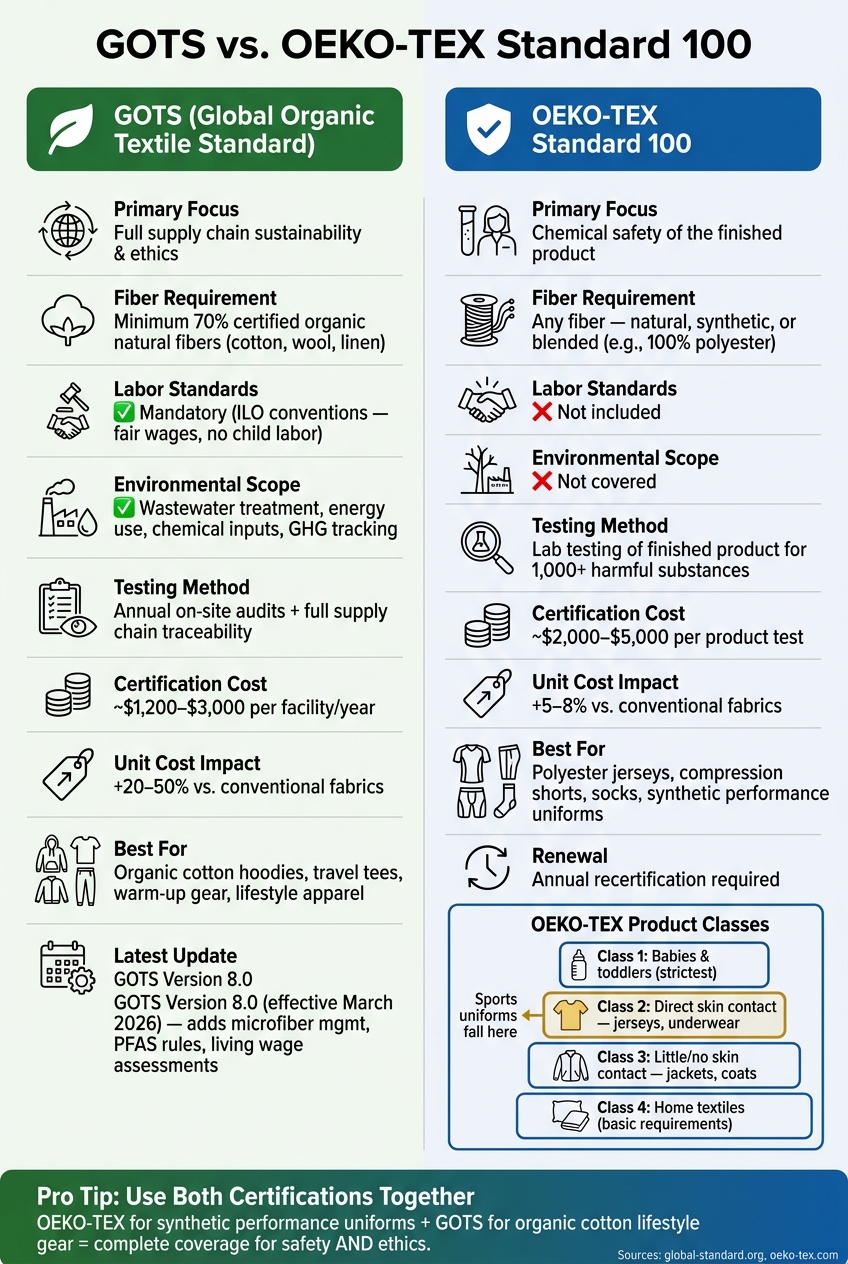
When choosing certifications for sportswear, GOTS (Global Organic Textile Standard) and OEKO-TEX Standard 100 serve different purposes. GOTS ensures responsible production, focusing on organic fibers, fair labor, and environmental standards. OEKO-TEX guarantees chemical safety, testing finished products for over 1,000 harmful substances.
Here’s the key takeaway:
- GOTS: Best for natural fiber apparel (e.g., organic cotton hoodies) with ethical sourcing.
- OEKO-TEX: Ideal for synthetic performance gear (e.g., polyester jerseys) to ensure safety during skin contact.
Quick Comparison
| Feature | GOTS | OEKO-TEX Standard 100 |
|---|---|---|
| Focus | Supply chain responsibility | Chemical safety of finished goods |
| Fiber Requirements | Minimum 70% organic fibers | Any fiber (natural or synthetic) |
| Labor Standards | Yes (based on ILO standards) | No |
| Testing Scope | Entire supply chain | Finished product only |
| Best For | Organic cotton lifestyle gear | Synthetic sports uniforms |
For teams, combining both certifications can balance safety and ethical sourcing, ensuring quality across all types of apparel.
GOTS vs. OEKO-TEX Standard 100: Which Certification Is Right for Your Sportswear?
GOTS Certification Overview
What Is GOTS?
The Global Organic Textile Standard (GOTS) is recognized worldwide as the top certification for organic textiles. It ensures full traceability of a product, starting from the farm where the fiber is grown, through processing, manufacturing, and wholesale trade.
What sets GOTS apart is that it doesn’t just test the final product – it evaluates every stage of the supply chain. GOTS issues two main types of certifications: Scope Certificates (SCs), which confirm a supplier’s ability to produce GOTS-compliant goods, and Transaction Certificates (TCs), which verify that specific shipments meet the standard. Together, these certifications ensure a thorough and transparent process.
Key Requirements and Standards
GOTS certification addresses a wide range of criteria, including fiber content, chemical use, environmental practices, and labor conditions.
| Requirement | Description |
|---|---|
| Organic fiber content | Products must contain at least 95% organic fibers for the "organic" label or 70% for "made with organic" labels. |
| Chemical restrictions | Enforces a strict Manufacturing Restricted Substance List (MRSL), banning PFAS and harmful dyes. |
| Environmental standards | Includes wastewater treatment requirements and monitoring of water and energy usage. |
| Social criteria | Ensures fair wages, safe workplaces, and compliance with International Labor Organization (ILO) conventions. |
| Technical quality | Final products must meet standards for colorfastness and shrinkage resistance. |
The latest update, GOTS Version 8.0 (effective March 2026), introduces new measures like microfiber management, greenhouse gas tracking (Scope 1 & 2), and stricter PFAS regulations, with enforcement starting March 1, 2027.
"The updated Standard strengthens requirements for air emissions and waste management, as well as criteria for product safety. It introduces new provisions on circularity, microfibre management and updates in residue testing." – Rahul Bhajekar, Managing Director, Global Standard
Relevance to U.S. Sports Apparel
For U.S. sports teams and organizations aiming to blend performance with sustainability, GOTS certification offers a clear advantage. Its stringent supply chain standards ensure garments are responsibly made, with mandatory on-site audits at every stage providing strong verification.
The technical quality requirements, like colorfastness and resistance to shrinkage, are particularly valuable for sports uniforms that endure frequent washing and intense wear. Additionally, the inclusion of microfiber release management in Version 8.0 makes GOTS even more relevant for performance apparel crafted from natural fibers. This combination of durability, performance, and eco-consciousness aligns perfectly with the needs of the sportswear industry.
sbb-itb-4d95ad3
OEKO-TEX Standard 100 Overview
What Is OEKO-TEX Standard 100?
OEKO-TEX Standard 100 is a globally recognized certification designed to ensure textile safety. Unlike GOTS, which monitors the entire supply chain and mandates a minimum organic fiber content, OEKO-TEX Standard 100 zeroes in on the chemical safety of finished products. This applies to all fabrics – whether they’re organic cotton, synthetic polyester, or other materials – and guarantees that the final textile is safe for use by testing for harmful chemicals.
"STANDARD 100 means textiles you can trust." – OEKO-TEX
Products bearing the OEKO-TEX label undergo testing for over 1,000 harmful substances. Certification must be renewed annually to remain valid, emphasizing the program’s commitment to ongoing safety. This focus on chemical compliance makes it distinct from GOTS, which emphasizes supply chain transparency.
Scope of Testing and Requirements
OEKO-TEX Standard 100 takes a comprehensive approach by testing every part of a garment – not just the outer fabric. This includes components like threads, buttons, zippers, rivets, linings, prints, and coatings, all of which must meet stringent safety limits. For instance, a product may fail certification if a zipper pull contains heavy metals above the allowable threshold.
The testing process evaluates substances such as formaldehyde, heavy metals, volatile organic compounds (VOCs), pesticide residues, and PFAS, which are often found in dyes, finishes, and water-repellent treatments. To keep up with scientific advancements and regulatory updates, the criteria are reviewed and updated at least once a year.
Products are classified into four categories based on their intended use and level of skin contact. Here’s a breakdown of these classifications:
| Product Class | Intended Use | Strictness Level |
|---|---|---|
| Class 1 | Babies and children up to 3 years (e.g., diapers, rompers) | Strictest requirements |
| Class 2 | Direct skin contact (e.g., shirts, underwear, jerseys or custom crew neck T-shirts) | High skin-safety requirements |
| Class 3 | Little or no direct skin contact (e.g., jackets, coats) | Standard requirements |
| Class 4 | Home textiles and decoration (e.g., curtains, tablecloths) | Basic requirements |
"The more intensive the skin contact, the stricter the human ecology requirements and laboratory tests." – OEKO-TEX Association
Relevance to U.S. Sports Apparel
OEKO-TEX Standard 100’s rigorous testing standards are particularly relevant for sportswear, where safety and comfort are critical.
Sports uniforms, often made from synthetic blends with features like dyeing and moisture-wicking treatments, typically fall under Product Class 2 due to their direct skin contact during physical activity. This ensures that the fabrics used in these garments meet high safety standards.
Ben Mead, Managing Director of Hohenstein Americas, highlights the certification’s importance:
"The main goal is to make sure that if a product has the label on it, it’s been vetted, to make sure that every component, every material that’s going into it has been tested at some point along the way and is going to meet these chemical requirements."
For U.S. buyers and team organizations, OEKO-TEX certification simplifies compliance with safety regulations like the Consumer Product Safety Improvement Act (CPSIA) and REACH. Additionally, the certification’s authenticity can be verified by scanning the QR code on the label or entering the certificate number into the OEKO-TEX Label Check tool, offering an easy way to confirm the product’s safety credentials. For organizations looking to source certified gear, you can get a quote for high-performance team apparel.
Key Differences Between GOTS and OEKO-TEX
Focus and Purpose
The main distinction between GOTS and OEKO-TEX lies in their core questions. GOTS asks, "Was this product made responsibly from start to finish?" OEKO-TEX Standard 100, on the other hand, focuses on, "Is this finished item safe for the wearer?"
GOTS is all about the journey of a garment – from organic farming to the final label. Meanwhile, OEKO-TEX zeroes in on the finished product, ensuring it’s free from harmful chemical residues.
Material and Fiber Requirements
These certifications also differ when it comes to materials. GOTS demands at least 70% certified organic natural fibers, such as organic cotton, wool, or linen. This means synthetic materials don’t qualify under GOTS. In contrast, OEKO-TEX Standard 100 has no restrictions on fiber types, making it suitable for materials like 100% polyester or blended fabrics. This flexibility is particularly useful for items like team uniforms that often rely on synthetic, moisture-wicking materials.
Supply Chain and Certification Scope
GOTS takes a comprehensive approach, conducting annual on-site audits that span the entire supply chain. This includes everything from post-harvest processing to spinning, dyeing, and finishing. Wastewater treatment is required at every wet-processing facility. Notably, GOTS Version 8.0 (effective March 2026) introduced unannounced audits and a six-step due diligence process aligned with OECD standards.
OEKO-TEX, however, focuses solely on testing the finished product in a lab. It examines every component – threads, zippers, coatings, and more – for over 1,000 harmful substances. Unlike GOTS, it doesn’t audit the production process.
Environmental and Social Impact
GOTS goes beyond chemical safety, addressing labor conditions and environmental concerns. It enforces labor standards based on International Labour Organization (ILO) conventions, including fair wages, safe working environments, and a ban on child labor. The March 2026 update also requires living wage gap assessments and greenhouse gas emissions management.
OEKO-TEX Standard 100, in contrast, is solely concerned with consumer safety. Its goal is to ensure that finished garments are free from harmful chemical residues, but it doesn’t cover labor practices or the environmental aspects of production.
Comparison Table
Here’s a quick breakdown of the key differences:
| Feature | GOTS | OEKO-TEX Standard 100 |
|---|---|---|
| Primary Focus | Full supply chain sustainability and ethics | Chemical safety of the finished product |
| Fiber Requirements | Minimum 70% certified organic natural fibers | Any fiber – natural, synthetic, or blended |
| Labor Standards | Mandatory (based on ILO standards) | Not included |
| Environmental Scope | Covers wastewater treatment, energy use, and chemical inputs | Not covered |
| Testing Method | Annual on-site audits and traceability | Laboratory testing of finished product samples |
| Best for Sports Gear | Organic cotton/wool base layers and lifestyle wear | synthetic jerseys, leggings, and performance uniforms |
| Certification Cost | Approximately $1,200–$3,000 per facility/year | Approximately $2,000–$5,000 per product test |
For U.S. sports teams, understanding these differences is key when balancing performance needs with ethical production values. These certifications offer clear pathways for choosing the right option based on priorities like sustainability or material safety.
How These Certifications Apply to Sports Apparel and Team Uniforms
Performance Materials in Sportswear
When it comes to competitive sports uniforms like custom football uniforms or soccer kits, synthetic fabrics such as polyester and nylon are the go-to materials. These fabrics are favored for their moisture-wicking properties and durability. However, the Global Organic Textile Standard (GOTS) excludes synthetic blends, making it less suitable for performance-focused apparel. On the other hand, OEKO-TEX Standard 100 is a better fit for certifying items like jerseys, compression shorts, and socks made from polyester blends. This certification ensures the chemical safety of finished products.
GOTS, however, shines in a different area: off-field apparel. Items like team hoodies, organic cotton travel tees, and warm-up gear benefit from GOTS certification, as it emphasizes full supply chain oversight. This distinction helps clarify how these certifications apply to various categories of sportswear.
Skin Safety and Player Comfort
On-field safety isn’t just about performance; it’s also about protecting athletes from potential chemical exposure. During play, chemical residues from dyes and finishes can be absorbed through the skin. OEKO-TEX Standard 100 addresses this issue with its product class system, which sets chemical safety standards based on an item’s level of skin contact. For example, Class II applies to products like jerseys, socks, and compression wear, which are in close contact with the skin.
That said, even with OEKO-TEX-certified fabrics, the use of uncertified printing inks can undermine safety. To enhance skin protection, water-based inks that carry OEKO-TEX certification are a smarter choice.
Sustainability and Ethical Sourcing
Each certification targets different priorities: GOTS focuses on ethical sourcing and supply chain transparency, while OEKO-TEX prioritizes chemical safety. For teams that value the origins of their gear, GOTS certification is a meaningful choice. It ensures ethical production practices and supply chain accountability. The March 2026 release of GOTS Version 8.0 elevated these standards, introducing mandatory living wage gap assessments and a detailed six-step due diligence process aligned with OECD guidelines. Claudia Kersten, Managing Director of Global Standard, highlighted the significance of these updates:
"GOTS Version 8.0 marks an important milestone… It governs how a textile is produced, how it is verified, what may be claimed and how it is labelled, creating traceability and integrity."
For organic cotton warm-ups and travel apparel, GOTS certification provides teams with confidence in their commitment to ethical sourcing and transparency.
Picking the Right Certification for Custom Team Gear
Factors to Consider
Choosing the right certification boils down to your team’s specific needs. Whether you prioritize chemical safety or ethical sourcing will guide your decision. Start by considering the fabric. If your uniforms use polyester or nylon blends for their moisture-wicking properties, OEKO-TEX Standard 100 is a smart choice. This certification tests the finished garment for over 1,000 harmful substances, ensuring safety for players and fans alike. On the other hand, if your team opts for organic cotton hoodies, travel tees, or warm-up gear and wants to highlight ethical sourcing, GOTS (Global Organic Textile Standard) is the better fit.
Cost is another key factor. GOTS-certified materials can cost 20–50% more than conventional fabrics, with annual certification fees ranging from $1,200 to $3,000. Meanwhile, OEKO-TEX certification adds approximately 5–8% to unit costs, with annual fees between $500 and $2,000. For youth sports programs, it’s important to ensure that OEKO-TEX certification meets Product Class I standards (for infants and toddlers) or Class II standards (for direct skin contact items like jerseys and socks).
These factors often lead teams to consider combining certifications for maximum impact.
Using Both Certifications Together
Instead of competing, these certifications complement each other by addressing different priorities. By 2026, more apparel programs are adopting a hybrid strategy: using OEKO-TEX for performance uniforms made from synthetic fabrics and GOTS for lifestyle and fan gear crafted from organic cotton. This approach ensures chemical safety for on-field gear while promoting an ethical sourcing story for off-field apparel.
Even when using OEKO-TEX-certified base fabrics, uncertified inks can introduce harmful residues. To avoid this, opt for independently OEKO-TEX-certified inks, such as DuPont Artistri, to maintain safety across the entire garment.
This combined strategy aligns well with how Wooter Apparel approaches certification.
How Wooter Apparel Approaches These Certifications

At Wooter Apparel, fabric sourcing for custom team uniforms reflects the demands of performance sportswear. Their fully sublimated jerseys, shorts, and warm-up gear are made with technical synthetic fabrics, making OEKO-TEX Standard 100 the go-to certification for ensuring chemical safety and skin comfort during intense play.
For teams venturing into GOTS-certified items like travel hoodies or sideline apparel, it’s important to define your goals. As Abhijat Paliwal, Founder of Abhi Home, puts it:
"If you’re not making organic claims at retail, you don’t need GOTS – OEKO-TEX is sufficient."
To maintain transparency, always verify certification numbers through public databases. Both GOTS and OEKO-TEX offer searchable platforms (global-standard.org and oeko-tex.com) where you can confirm the validity of certifications. This simple step helps protect against greenwashing and ensures your team’s gear claims remain credible.
Why OEKO-TEX & GOTS Certifications Matter in Sustainable Fashion | Eco-Friendly Clothing Explained
Conclusion
GOTS ensures organic integrity and ethical practices throughout the supply chain, while OEKO-TEX Standard 100 focuses on testing finished products for over 1,000 harmful substances.
When it comes to high-performance sportswear, OEKO-TEX Standard 100 is often the preferred choice. Synthetic fabrics like polyester and spandex, commonly used in uniforms, align well with its requirements. On the other hand, GOTS is ideal for products made from natural fibers – like organic cotton apparel – where ethical sourcing and sustainability are key priorities.
As apparel manufacturing expert Viken Cai explains:
"The real differentiator isn’t the label itself – it’s the manufacturing partner who masters all three [GOTS, OCS, OEKO-TEX] without inflating your costs."
This highlights the importance of balancing certifications with cost efficiency. GOTS certification can increase unit costs by 20–50%, compared to OEKO-TEX, which adds only 5–8%. For brands aiming to combine chemical safety with an ethical sourcing story, a hybrid strategy – using OEKO-TEX for performance gear and GOTS for lifestyle pieces – can deliver well-rounded benefits.
No matter which certification you choose, always verify its authenticity. Use the GOTS database at global-standard.org or the OEKO-TEX Label Check tool at oeko-tex.com to ensure your claims remain credible.
FAQs
Can a team uniform be both GOTS and OEKO-TEX certified?
Yes, a team uniform can hold both GOTS and OEKO-TEX certifications. The Global Organic Textile Standard (GOTS) ensures that at least 70% of the fibers used are organic and that production meets strict environmental and labor criteria. Meanwhile, OEKO-TEX Standard 100 verifies that the uniform is free from harmful levels of over 350 regulated chemicals. Together, these certifications ensure the uniform is ethically produced and safe for consumers, offering a reliable choice for high-quality, custom performance gear.
Does OEKO-TEX cover custom logos, prints, and inks too?
OEKO-TEX Standard 100 goes beyond just testing fabrics – it examines every component of a finished textile product. This includes prints, inks, threads, buttons, zippers, and fabric, ensuring that each element is free from harmful levels of regulated chemicals like heavy metals, phthalates, and allergenic dyes.
For companies like Wooter Apparel, this level of scrutiny is essential. It ensures the safety of their garments, especially when producing high-quality custom team uniforms. Safety isn’t just a feature – it’s a commitment woven into every stitch.
How can I verify a GOTS or OEKO-TEX certificate is real?
To check the authenticity of a GOTS or OEKO-TEX certificate, start by asking the supplier for the complete certificate. Carefully compare the company name, address, and license number on the document with your records. Then, use the official GOTS Certified Suppliers Database or the OEKO-TEX label check tool to verify details like the certificate number, expiration date, and product scope. Make sure the certificate is up-to-date and applies to the product categories you’re reviewing. If you have any doubts, reach out directly to the certification body for confirmation.