
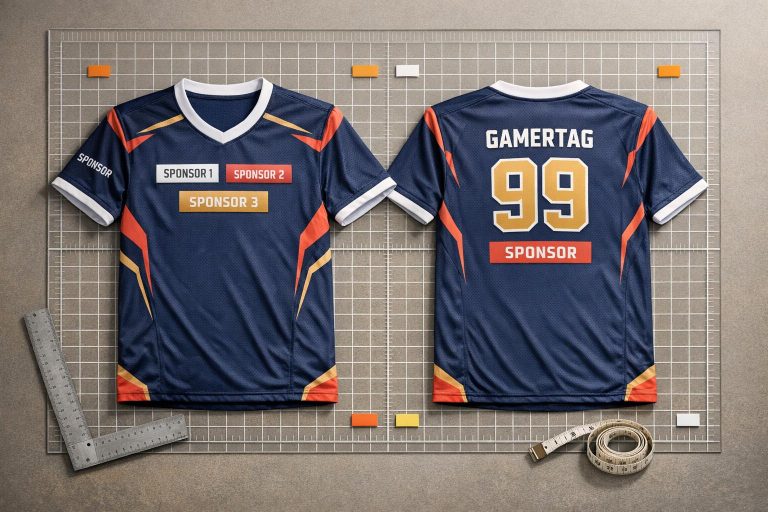
Esports jerseys are more than just uniforms – they’re designed for broadcast clarity, player comfort, and sponsor visibility. Unlike traditional sports jerseys, esports jerseys prioritize features like high-resolution graphics, breathable fabrics, and strategic logo placement to stand out on camera during tournaments. Key highlights include:
- Broadcast-Ready Design: Logos, player names, and sponsors are strategically placed for maximum visibility across various camera angles.
- Sublimation Printing: Ensures vibrant, durable designs that won’t peel or fade, even after frequent washes.
- Comfort and Fit: Made with lightweight, breathable polyester to support long gaming sessions.
- Sponsor-Focused Layout: Zones like the center chest, upper back, and sleeves are optimized for sponsor branding.
- Compliance: Designs must meet tournament and sponsorship standards to avoid penalties.
Esports jerseys combine functionality and style, making them a critical part of a team’s identity during competitions. Whether you’re designing for a pro team or a local squad, following these standards ensures your jerseys are camera-ready and impactful.
Core Design Principles for Esports Jerseys
Design Aesthetics and Functional Norms
Esports jerseys are all about making an impression, especially on-screen. Designers often use sharp geometric patterns, bold gradients, and neon accents to create a futuristic look that pops during live streams. To add depth, layered textures like carbon fiber or camo patterns are common.
For these designs to look sharp on camera, high-detail patterns need to be at least 300 DPI to avoid pixelation or digital noise. Color consistency is also crucial – this is where Pantone Solid Coated standards and precise CMYK mixes come into play. For instance, a deep black might use a mix like C:60 M:40 Y:40 K:100 to ensure the jersey aligns perfectly with the team’s digital branding.
"Designing for pro Orgs? Master bleed margins, vector standards, and Twitch-optimized contrast." – MAVYQ Team
Another essential detail is the seamless transition of graphics across jersey seams. For example, a 2-inch (about 5 cm) overlap at the shoulders ensures the design flows smoothly, avoiding any awkward gaps that could look unpolished on stage or during streams.
These design principles set the foundation for choosing fabrics that keep the visuals sharp while meeting the demands of competitive gaming.
Fabric and Fit Considerations
The right fabric is critical – not just for comfort, but also for maintaining the jersey’s design over time. Most professional esports jerseys use 160 GSM Air-Mesh polyester. This material strikes a balance between being breathable and having a dense enough surface for clear sublimation printing. For designs with intricate details or photographic elements, Birdseye mesh is ideal because of its excellent ink absorption. On the other hand, Micro-Interlock fabric is better for crisp text and logos.
Fit is just as important as fabric. Since players spend most of their time seated, a tapered athletic fit – often referred to as a "Technical Fit Block" – helps the jersey stay in place and keeps the design looking sharp during long gaming sessions. Companies like Wooter Apparel use 100% breathable performance polyester to ensure the jerseys are durable and maintain their sublimated designs without peeling, cracking, or fading, even after regular use.
These choices in material and fit ensure that the jerseys are ready for the spotlight, which ties directly into broadcast-focused design.
Broadcast-Driven Design Standards
Every detail on an esports jersey must be visible and clear during broadcasts. Key elements like sponsor logos, player names, and team branding need to be placed in specific areas to remain prominent across different camera angles.
Here’s a quick breakdown of the main broadcast zones and their requirements:
| Jersey Zone | Camera Type | Technical Requirement |
|---|---|---|
| Center Chest | Main stage cam | Vector logo; 3 cm (≈1.2 in) from the collar |
| Upper Sleeve | Headshot/face cam | Top 1/3 of the sleeve for social handles/branding |
| Upper Back | Observer/overhead cam | 15 cm (≈6 in) centered width for player ID |
| Lower Front | Standing/award shots | Sponsor bar; 10 cm (≈4 in) from the bottom hem |
Specifications sourced from
To ensure text remains legible on all streams, bold sans-serif fonts are recommended for player names and other text elements. Text clusters should be kept to three words or fewer, with each element at least 0.5 inches tall to prevent ink-bleed on mesh fabrics.
"If your design has ‘white gaps’ at the seams or the sponsor logo looks like a blurry pixel-blob on Twitch, you’ve failed your Org." – Khan, MAVYQ Team
sbb-itb-4d95ad3
PROFESSIONAL ESPORTS JERSEY DESIGN COURSE
Name, Number, and Logo Placement Standards
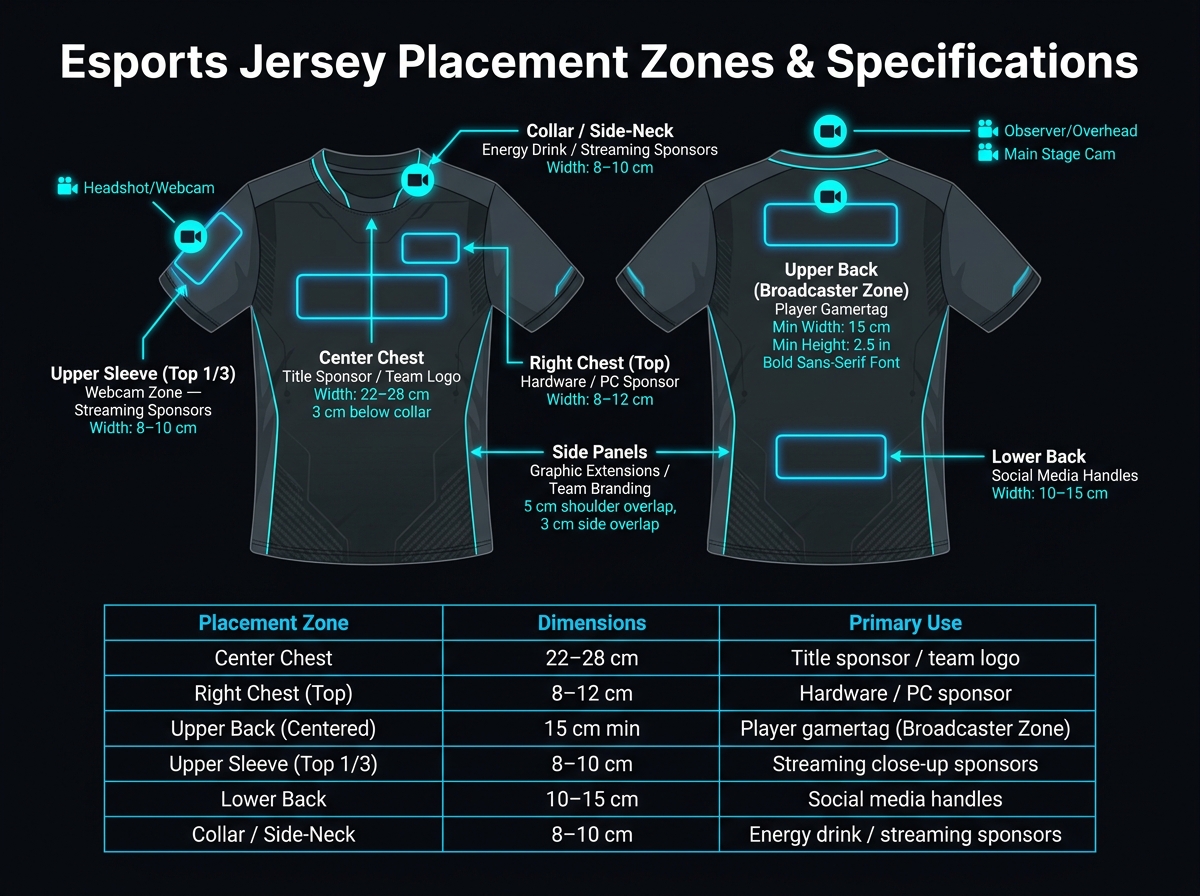
Esports Jersey Placement Zones & Specs
Front of Jersey Layout
The front of an esports jersey is prime real estate, where every detail is carefully planned to grab attention. The primary team logo takes center stage, positioned 1.2 inches (3 cm) below the collar to ensure it stays in view during main stage camera shots. Title sponsors dominate the center chest, spanning 22 cm to 28 cm in width. This placement emphasizes the hierarchy of names and logos in this area. Meanwhile, secondary sponsors – like PC or hardware brands – are strategically placed on the top right chest, sized between 8 cm and 12 cm to maintain a clean and organized look.
"A jersey is a billboard. If it’s crowded, it’s worthless for the sponsors paying the bills." – MAVYQ Team
The back of the jersey, or even custom esports hoodies, prioritizes quick player identification while integrating sponsor visibility.
Back of Jersey Layout
The back layout is all about making players easy to recognize. The upper back, also called the Broadcaster Zone, features the player’s gamertag centered within a minimum width of 15 cm (about 6 inches). Gamertags are bolded in sans-serif fonts with a minimum height of 2.5 inches for clarity. Below this, social media handles are positioned on the lower back, with a width of 10–15 cm, ensuring they’re visible but not overpowering.
Additional sponsor placements are reserved for the sleeves, collars, and side panels, which play a key role in close-up shots.
Sleeves, Collars, and Side Panels
Like the front and back, the sleeves, collars, and side panels are designed to maximize visibility during broadcasts. The top third of each sleeve, known as the Webcam Zone, is a prime spot for sponsor logos that remain visible during headshot camera angles while players are seated. Logos here are typically sized between 8 and 10 cm.
The collar and side-neck areas are also high-visibility zones, ideal for energy drink or streaming sponsor logos during tight close-ups. Side panels, on the other hand, are used for graphic extensions and team branding. These standards also apply to custom esports polos used for more formal team appearances. To ensure a polished look, manufacturing standards require a 5 cm top overlap at the shoulders and a 3 cm side overlap on the panels.
| Placement Zone | Dimensions | Primary Use |
|---|---|---|
| Center Chest | 22–28 cm | Title sponsor / team logo |
| Right Chest (Top) | 8–12 cm | Hardware / PC sponsor |
| Upper Back (Centered) | 15 cm min | Player gamertag (Broadcaster Zone) |
| Upper Sleeve (Top 1/3) | 8–10 cm | Streaming close-up sponsors |
| Lower Back | 10–15 cm | Social media handles |
| Collar / Side-Neck | 8–10 cm | Energy drink / streaming sponsors |
Step-by-Step Workflow for Designing Esports Jerseys
Planning and Layout Development
Before diving into the design process, it’s crucial to map out Safe Zones for key elements. These include the center chest (3 cm from the collar), the upper back (15 cm width centered), and the top third of the sleeves for sponsor logos that need to remain visible on webcams. These zones are essential for ensuring clarity during broadcasts, as discussed in earlier sections.
When creating logos and patterns, always use vector formats like .AI, .EPS, or .SVG. These formats ensure the designs scale perfectly without any quality loss during high-heat sublimation. Keep in mind that Photoshop-based mockups often fall short under sublimation, making vector formats the go-to choice. For textures or background patterns that can’t be vectorized, aim for a resolution of at least 300 DPI to prevent blurriness on screen.
Switch your color mode from RGB to Pantone Solid Coated to maintain accurate sponsor branding. For deep black tones, use these CMYK values: C:60, M:40, Y:40, K:100. This ensures rich saturation on polyester fabrics.
Once you’ve nailed down the layout and color settings, you’re ready to manage the critical details for players and sponsors.
Managing Name, Number, and Sponsor Data
Gather all player-specific details – such as gamertags, jersey numbers, and sponsor logos – well in advance to avoid production delays. Always request sponsor logos in vector formats to eliminate the need for redrawing, which can incur extra costs. Proper data management not only ensures accuracy but also enhances the jersey’s overall clarity during broadcasts.
Companies like Wooter Apparel include player names and numbers in their standard pricing. They also handle the entire design process in-house, ensuring seamless integration of these elements. As they explain:
"Numbers, names and logos that won’t peel, crack, fade or come out in the wash." – Wooter Apparel
To keep everything organized, create a shared folder sorted by player name, jersey number, and sponsor tier. This system ensures quick and easy access throughout the production process.
Sizing and Comfort Standards
Once the design is finalized, shift your focus to fit and material to guarantee both on-screen appeal and player comfort. Jerseys should be designed for seated comfort, avoiding issues like bunching or restricted arm movement. Opt for a tapered athletic fit and use 160 GSM Air-Mesh fabric for breathability. If sharp text and logos are a priority, consider Micro-Interlock fabric.
Wooter Apparel offers fully customized fits tailored to the team’s specific needs, typically delivering orders within 3 to 4 weeks. Their dedication to precision has earned them an impressive 4.9/5 rating from reviewers. One satisfied customer shared:
"Sizing was a tight fit like we requested, thanks." – Wooter A., Verified Reviewer
Compliance and Brand Consistency
Tournament and Sponsor Compliance
When it comes to esports jerseys, meeting league and sponsorship standards is non-negotiable. Each tournament operates under its own set of rules, and missing even a minor detail can lead to penalties or disqualification. At a bare minimum, jerseys must prominently feature the team logo, player name, player number, and any contracted sponsor logos – all positioned for clear visibility on broadcasts and for live audiences. Sponsor logos, in particular, require careful attention to placement and size, as outlined in sponsorship agreements. These compliance measures align with the broadcast-focused design standards discussed earlier. Before sending files to production, it’s crucial to double-check every sponsor element against both the league’s rulebook and the sponsorship contract.
Here’s a quick pre-production compliance checklist:
- Team logo: Correct placement and meets minimum size requirements.
- Player name and number: Clearly visible, legible, and in the approved font.
- Sponsor logos: Positioned in the correct zones with accurate colors.
- Design elements: Ensure nothing overlaps required identification areas.
- Jersey colors: Confirm they are distinct from the opponent’s kit (a common league requirement).
Care and Durability of Esports Jerseys
Esports jerseys are designed to withstand the demands of a full season, but proper care is essential to maintain their quality. Sublimated jerseys, which have ink infused directly into the fabric, are particularly durable. This method ensures that branding won’t crack, fade, or peel, even with regular washing.
"Sublimation infuses ink into the fabric, ensuring durable, fade-resistant designs." – Affordable Uniforms Online
To keep jerseys looking their best, wash them inside out in cold water and avoid using high heat when drying. This simple routine can significantly extend the life of your team’s gear while keeping sponsor logos crisp and visible.
Keeping Team Kits Consistent
Consistency isn’t just about the jersey – it’s about the entire team kit. From warmup gear to accessories, every item should align with the same design language. The best way to achieve this is by creating a master brand file that locks in color codes, logo variations, and font choices. This file serves as the ultimate reference point for all production.
"Every inch of our premium, sublimated E-Sports uniforms is fully customizable… designed according to your exact requirements and best suited to match your team’s brand image." – Wooter Apparel
Using a single vendor, like Wooter Apparel, for the entire kit ensures uniformity across all items. Their in-house production process eliminates the inconsistencies that can arise when orders are split between multiple manufacturers – a common issue that often results in mismatched colors under broadcast lighting. By centralizing production, teams can maintain a polished and cohesive look both on and off the stage.
Conclusion
Creating an outstanding esports jersey comes down to three key factors: using breathable, high-quality 100% polyester fabric; opting for sublimation printing to ensure names, logos, and numbers remain vibrant and intact through countless washes; and designing a layout that complies with professional tournament standards to enhance broadcast visibility. Nail these elements, and your jersey becomes a powerful extension of your team’s brand.
Personalization is just as important. A jersey customized with your team’s exact colors, logo placement, and design style makes your squad instantly recognizable – both on-screen and in person. Precision in design not only boosts visual appeal but strengthens team identity. As one satisfied customer shared:
"The players loved the uniforms. Everywhere we play people talk about our uniforms. We love them." – Feazel L., Verified Buyer
If you’re ready to take your team’s look to the next level, consider Wooter Apparel. Their fully sublimated esports jerseys are 100% customizable, including player names and numbers in the base price with no hidden costs. With a standard production time of just 3 to 4 weeks and a 4.9-star rating from 1,366 reviews, they’re a dependable choice for teams needing quality and efficiency.
FAQs
What file format should I send for logos and artwork?
When it comes to logos and artwork, the best file format to use is PNG. This format supports transparency and delivers high-quality images, making it perfect for digital applications. However, if you need designs that can be easily scaled or edited, go for vector formats like AI or EPS. These formats are ideal for precise adjustments and ensure top-notch results for high-resolution printing. Whether you’re working on esports jersey designs or other projects, using PNG or vector files guarantees smooth integration and professional-quality outcomes.
How do I keep names and sponsors readable on stream?
To make names and sponsors easy to read on stream, place names about 4–6 inches below the collar and use letters that are 2–3 inches tall. For numbers, choose sizes that stand out: around 4 inches for front numbers and 8 inches for back numbers. Keep at least 1 inch of space between names and numbers for clarity. Materials like tackle twill or sublimation are ideal – they resist fading and ensure text remains sharp for viewers.
How do I avoid seam gaps and misaligned graphics?
To avoid seam gaps and misaligned graphics on esports jerseys, it’s crucial to include proper bleed margins in your design and stick to vector file standards, particularly for sublimation printing. Always work with high-resolution artwork (300 DPI) and ensure accurate sizing to keep the graphics sharp and well-aligned. By carefully following these technical steps, you can create jerseys that look seamless and polished.