
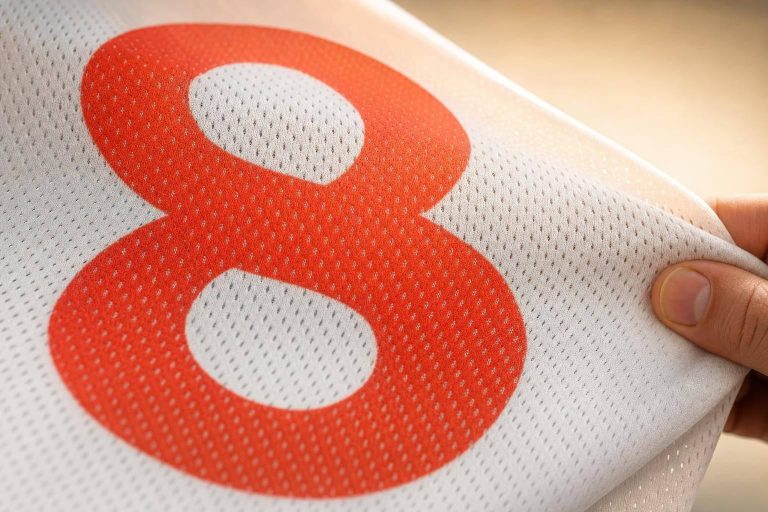
If you want volleyball jerseys that stay light, hold color, and don’t peel, sublimation on polyester is the best fit.
I’d sum it up like this: sublimation uses heat – about 380°F to 420°F – to turn dye into gas so it bonds with polyester fibers. That means the design sits in the fabric, not on it. The result is a jersey that stays smooth, breathable, and easier to wear through dives, sweat, and repeated washes.
Here’s the short version:
- Best fabric: 100% polyester, especially 150 gsm interlock
- Stretch option: Polyester-spandex blends with 5% to 15% spandex
- Main gain: no cracking, peeling, or stiff print layers
- Comfort point: fabric stays lighter and more breathable
- Color result: names, numbers, and team colors hold up longer in the wash
- Care basics: cold wash, mild detergent, low heat or air dry
If I were choosing for a team, I’d keep my focus on three things: polyester content, fit and stretch, and simple wash care. That’s what shapes how the jersey feels on the court and how long the print keeps its sharp look.
How to Choose Volleyball Jersey Fabrics for Sublimation
Sublimation works best on polyester-rich fabrics. That’s what helps colors stay sharp and keeps the jersey ready for play. After that, things like knit weight and stretch shape how the jersey feels and moves on the court.
Best fabric types: polyester and polyester-spandex blends
100% polyester interlock knit, often around 150 gsm, is light, durable, and keeps sublimated graphics crisp.
Polyester-spandex blends – usually 85–95% polyester with 5–15% spandex – add four-way stretch. That makes them a smart pick for close-fitting athletic jerseys where players need full range of motion. Shoulder movement matters a lot in volleyball, so the cut should allow players to swing and reach without the fabric fighting back.
Skip 100% cotton. Sublimation dye won’t bond to it. If print clarity is the top goal, 100% polyester is the safer bet.
Once you’ve picked the fabric type, the next layer is construction. That’s what affects how the jersey holds up during a match.
What to look for in match-ready jersey construction
Look for moisture-wicking fabric that breathes well. A 150 gsm interlock knit hits a good middle ground between light feel and long wear for match-day use.
Stretch plays a big role too. Polyester-spandex blends work well for fitted styles, while 100% polyester interlock still has some give from the knit itself, which suits standard cuts. The goal is simple: the jersey should move with the player and stay comfortable from first serve to last point.
That also helps the sublimated design stay smooth and even during play.
Comparison table: common volleyball jersey materials
| Feature | 100% Polyester (150 gsm Interlock) | Polyester-Spandex Blend (85%–95% / 5%–15%) |
|---|---|---|
| Stretch | Moderate; stretch built into the knit | High; 4-way stretch from spandex |
| Breathability | Excellent; lightweight and airy | Good; depends on knit density |
| Moisture Control | High; moisture-wicking | High; designed for performance |
| Print Sharpness | Superior; ideal for sublimated graphics | Very good; slightly less vibrant than 100% polyester |
| Durability | Very high; resists shrinking and fading | High; maintains shape after many washes |
| Best Fit | Standard team jerseys | Close-fitting, high-motion jerseys |
sbb-itb-4d95ad3
How Sublimation Affects Durability and Comfort
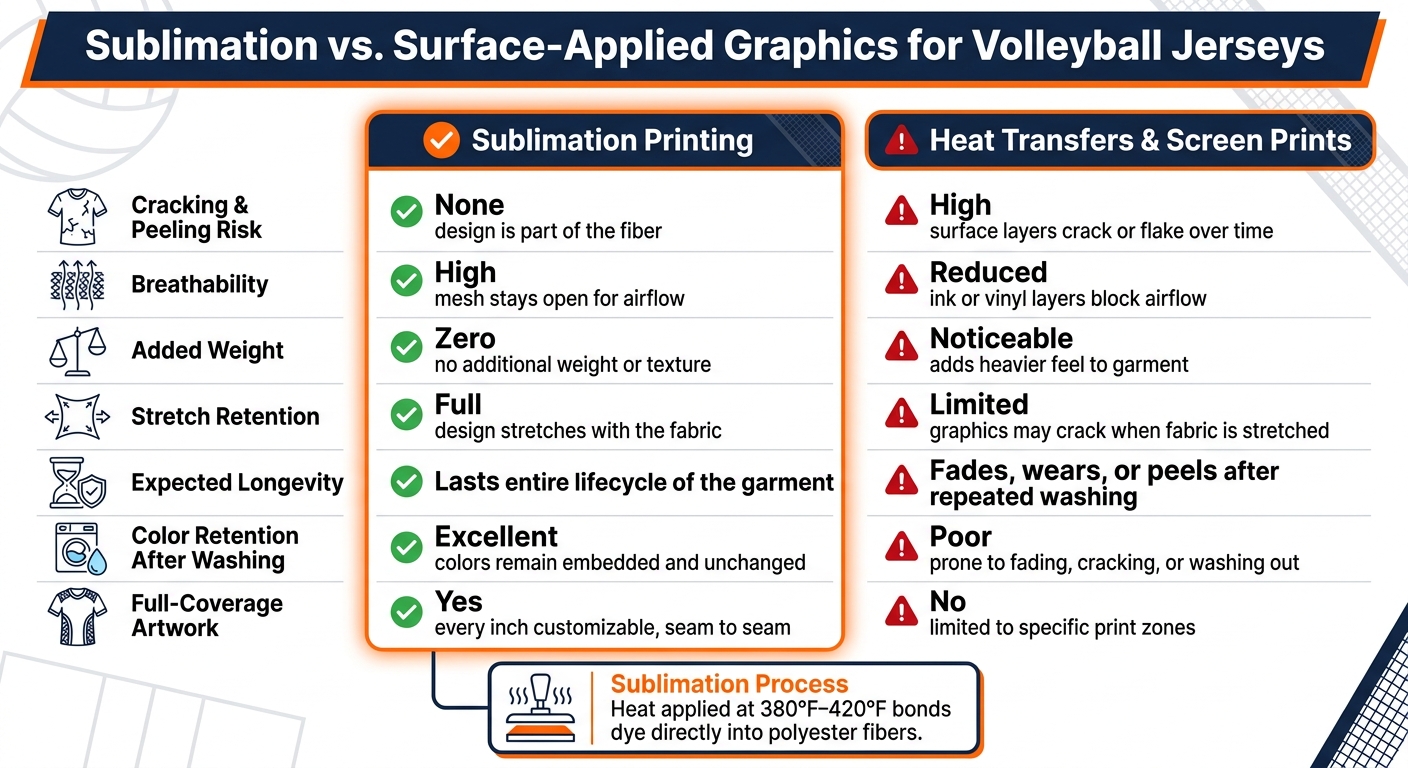
Sublimation vs. Surface Printing: Volleyball Jersey Performance Comparison
Once you’ve picked the right polyester fabric, the print method has a big say in how the jersey feels and how well it holds up. Fabric sets the base, but sublimation is what helps a short sleeve volleyball jersey stay light, flexible, and durable through a full season of play.
Why sublimated designs resist cracking, peeling, and flaking
Sublimation uses heat to bond dye directly into polyester fibers. So the design becomes part of the jersey instead of sitting on top as a separate layer. That’s why sublimated numbers and logos don’t crack or peel when the fabric stretches during dives, serves, and spikes.
How sublimation keeps jerseys light and breathable
Because sublimation doesn’t add a surface coating, the jersey stays light, breathable, and soft to the touch. The fabric can still move the way it’s supposed to, which matters when players are in constant motion.
Comparison table: sublimation vs surface-applied graphics
The difference is easiest to see when you compare sublimation with surface-applied graphics.
| Feature | Sublimation Printing | Heat Transfers and Screen Prints |
|---|---|---|
| Cracking & Peeling Risk | None; design is part of the fiber | High; surface layers can crack or flake over time |
| Breathability | High; mesh stays open for airflow | Reduced; ink or vinyl layers block airflow |
| Added Weight | Zero; no additional weight or texture | Noticeable; adds a heavier feel to the garment |
| Stretch Retention | Full; design stretches with the fabric | Limited; graphics may crack when fabric is stretched |
| Expected Longevity | Lasts the entire lifecycle of the garment | Fades, wears, or peels after repeated washing |
How Sublimation Produces Bright, Long-Lasting Team Designs
Sublimation helps team colors stay bold and details stay clear all season. That matters most when numbers, names, and team colors need to be easy to read from match to match.
Why colors stay bright through repeated washing
With sublimation, the color becomes part of the fabric itself. So even after repeated washing, the jersey keeps its color and detail. Numbers, names, sleeve accents, and multi-color layouts stay sharp through a full season of frequent laundering.
Wooter Apparel notes that sublimated prints stay sharp for the garment’s full life.
Surface-applied graphics work differently. They sit on top of the fabric, so color detail can wear down over time. Sublimated jerseys keep that contrast and clarity throughout the season.
How all-over graphics improve volleyball uniform design
Sublimation does more than help color last. It also gives teams more freedom across the full jersey. Because the print can cover the entire garment, the design isn’t boxed into small print areas. Gradients, side-panel patterns, short sleeve volleyball jerseys, logos, player names, and numbers can all be built into one design without extra layers.
Wooter Apparel’s free custom design support helps teams build gradients and all-over graphics for sublimation. The table below shows how that changes performance with repeated use.
Comparison table: color performance under repeated use
| Feature | Sublimated Jerseys | Surface-applied graphics |
|---|---|---|
| Color retention after repeated washing | Excellent; colors remain embedded and unchanged | Poor; prone to fading, cracking, or washing out |
| Detail Accuracy | Sharp; supports unlimited logos, fine lines, and gradients | Moderate; fine lines may bleed or peel over time |
| Full-Coverage Artwork | Yes; every inch is customizable, seam to seam | No; limited to specific print zones |
Care Steps and Final Takeaways for Teams Ordering Jerseys
How to wash and dry sublimated volleyball jerseys
Once a jersey is printed, the way you care for it has a big effect on how long it keeps its look and feel. Good aftercare helps sublimated jerseys perform through the full season. It also helps the color, stretch, and fit stay in shape from match to match.
Wash jerseys inside out in cold water with mild detergent. Skip bleach and fabric softeners. Air drying is the best option, and tumble dry on low only if you need to. Keep jerseys away from items with Velcro or heavy zippers, since those can snag the interlock knit and lead to pilling.
The table below turns those rules into a simple match-day checklist.
Quick reference table: what to do and what to avoid
| Do This | Avoid This | Why It Matters |
|---|---|---|
| Wash inside out in cold water | Hot water wash | Helps preserve the fabric’s structure |
| Use mild detergent | Bleach or fabric softeners | Helps maintain color and fabric performance |
| Air dry or tumble dry on low heat | High dryer heat | Helps maintain stretch and reduce shrinkage |
| Wash with similar synthetic fabrics | Washing with Velcro or heavy zippers | Helps prevent snags, pilling, and fabric tears |
Conclusion: What sublimation improves most
Sublimation works best when you pair it with the right base material. 100% polyester or high-polyester blends – especially 150gsm interlock polyester – give the dye the polymer structure it needs to bond well. Another big plus: the graphics stay light because the design becomes part of the fabric.
Sublimation performs best on polyester-rich fabrics and lasts longer with proper care. Put the focus on fabric quality, proper fit, and consistent care, and a sublimated volleyball jersey can hold up from the first practice to the final match of the season. For teams, the goal is simple: protect the fabric, and the print stays sharp.
FAQs
Can sublimation work on mesh volleyball jerseys?
Yes – sublimation works well on mesh volleyball jerseys if the fabric is polyester. Polyester mesh lets the dye bond to the material, which gives you bright, permanent designs that won’t crack, peel, or fade.
It also helps the jersey keep its breathability and moisture-wicking performance, so it holds up well during intense matches.
Will sublimated jerseys feel different after many washes?
No. Sublimated jerseys shouldn’t feel different after many washes.
The reason is simple: the dye is built right into the polyester fibers. There isn’t a thick top layer sitting on the fabric, so nothing is there to crack, peel, or wear off over time.
That helps the jersey stay soft, smooth, breathable, and lightweight, so it keeps much of the same feel it had at the start.
How do I choose between polyester and polyester-spandex?
Choose based on how your team plays. 100% polyester is the go-to pick when you want top durability and bright color. It works especially well with sublimation dyes, which helps produce sharp prints that last.
For sports with heavy movement, like sliding or diving, polyester-spandex gives players more flexibility and four-way stretch. It can still deliver strong sublimation results, as long as the fabric is at least 70% polyester.