
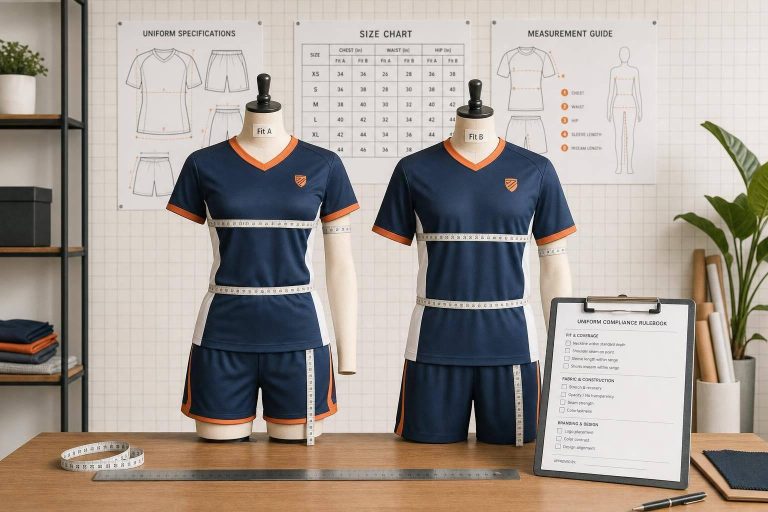
If I get the rulebook wrong, the uniform can fail before the first game starts. A custom football uniform has to match the rules for the sport, level, and gender category before I think about colors, logos, or style.
Here’s the short version:
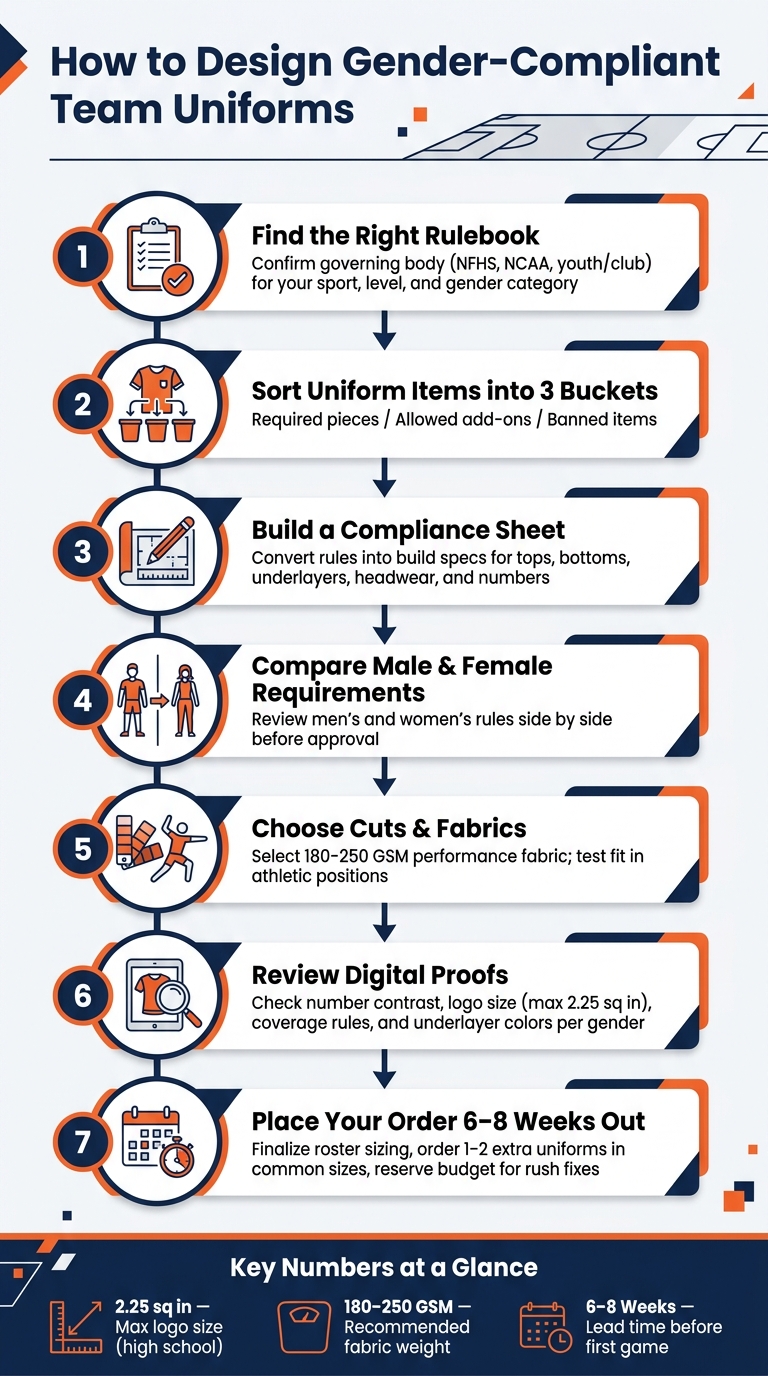
- I start with the current rulebook for the league, school, or governing body.
- I sort items into required pieces, allowed add-ons, and banned items.
- I turn rules into build specs for tops, bottoms, underlayers, headwear, and numbers.
- I check male, female, and coed rules side by side when they differ.
- I test for fit, coverage, movement, opacity, and number/logo placement.
- I review proofs before production and order 6–8 weeks before the first game.
- I keep extra room in the budget for rush fixes and replacement pieces.
A few details can decide whether a uniform passes or fails:
- Visible underlayers often need to match team color
- Logos in many high school sports are limited to about 2.25 square inches
- Performance fabric in the 180–250 GSM range can help with coverage when stretched or wet
- Teams should order 1–2 extra uniforms in common sizes
This article shows me how to turn rulebook language into a clean order plan, avoid game-day issues, and give athletes uniforms that fit the rules and the sport.
How to Design Gender-Compliant Team Uniforms: Step-by-Step Process
Find the Right Rules for Your Sport, Level, and Gender Category
Start with the exact rule source for your sport, team level, and gender category. That part matters more than a lot of people think. Rules can shift by league, age group, and division, so two teams playing the same sport may still have different uniform standards. A girls’ high school soccer team and a women’s college soccer team, for example, can end up following different rules.
A simple way to make sense of it is to sort everything into three buckets: required pieces, optional items, and restricted items.
Identify the Governing Rules That Apply to Your Team
The governing body decides what your team can and can’t wear. For high school teams, that usually means the National Federation of State High School Associations (NFHS), along with your state association. State groups can add rules or change parts of the national standard.
For college programs, the NCAA puts out sport-specific rulebooks. Those rules don’t always match NFHS. Small details can change, like logo size, number placement, and undergarment colors.
Youth and club leagues often follow a national body or league standard. In soccer, for instance, that may mean U.S. Soccer or the FIFA Laws of the Game. But local leagues may add stricter safety or modesty rules, especially for younger players. Adult rec leagues are often looser on appearance, though they still tend to enforce basic safety and coverage rules.
| Level | Primary Rule Source | Notes |
|---|---|---|
| High school | NFHS + state association | State may modify national rules |
| College | NCAA sport-specific rulebook | May differ from NFHS on logos, numbers |
| Youth/club | National body or league rules | Local leagues may add restrictions |
| Adult rec | National body or house rules | Often more flexible on appearance |
After you know the governing body, check the current rule year. That’s a step people skip, and it can bite them. NFHS volleyball, for instance, updated its undergarment color rules for the 2025–26 season. The safest move is to download the current-year rulebook or uniform bulletin straight from the official website.
From there, look at the sport rules that deal with coverage, markings, and underlayers. Some sports spell this out in detail. Softball has direct rules for caps and visors and treats exposed undergarments as part of the official uniform, including which colors are allowed. Soccer says undershirts and undershorts must match the main color of the jersey sleeve or shorts, and every player wearing them has to use the same color. Basketball also regulates visible compression shorts and T-shirts worn under the uniform.
List Required and Optional Uniform Pieces
Once you’ve confirmed the rule source, turn it into a clean uniform checklist or get a custom quote for your specific needs. Most rulebooks break uniform items into the same three groups: required pieces, optional accessories treated as part of the uniform, and prohibited or restricted items.
Required pieces are the must-haves. That usually means a jersey or top with the right numbers, shorts or pants, socks, and, in some sports, a cap or helmet.
Optional items can include:
- Compression shorts
- Undershirts
- Tights
- Visors
- Headbands
These pieces may be allowed, but if they’re visible during play, they often need to meet color and logo rules.
Prohibited items depend on the sport. Common examples include certain jewelry, reflective accessories, and headwear parts that could create a safety issue.
sbb-itb-4d95ad3
Convert Rules Into Uniform Design Specifications
Once you know the rules, turn them into plain, build-ready specs. That means measurements, materials, and placement limits that everyone can sign off on before artwork begins.
The goal is simple: every person involved should be looking at the same requirements, not guessing what the rulebook meant.
Build a Compliance Sheet for Tops, Bottoms, and Accessories
Set up the compliance sheet in clear buckets: tops, bottoms, underlayers, headwear, and accessories. For each bucket, convert the rulebook wording into a direct production requirement.
For tops, note the required length, neckline, sleeve style, number placement zone, and whether the fabric must stay nontransparent when wet. If the rule calls for that, write it down in plain terms. For performance fabrics, 180–250 GSM is a useful benchmark when opacity under stretch and moisture matters.
For bottoms, spell out the allowed garment types, minimum inseam, waistband style, and rise. Waistband security matters a lot for female athletes. A spec like 2–3 in. wide elastic, an internal drawstring, and a mid-rise cut sized for women’s or girls’ uniforms gives the manufacturer exact targets. It also helps keep coverage steady during jumping, sliding, and side-to-side movement.
For underlayers and accessories, note whether visible base layers are allowed, what color they must be, and whether the team has to match. For headwear, list the permitted items, any color limits, and whether hard brims or exposed metal are banned.
Compare Male and Female Requirements Before Approval
If men’s and women’s rules are different, review them side by side before approval. A simple comparison table can catch gaps that are easy to miss when you check one category at a time.
Here’s an example for high school basketball:
| Gender Category | Top | Bottom | Headwear | Accessories |
|---|---|---|---|---|
| Boys Varsity | Sleeveless, full-length jersey; must cover waistband when arms raised; same primary color for all players | Loose shorts, 7–9 in. inseam; matching team color | Soft headbands permitted; no hats or caps; no hard or metallic parts | Arm sleeves and leg sleeves must match uniform color; knee pads allowed if solid team color |
| Girls Varsity | Sleeveless or capped-sleeve jersey; must cover waistband and sides; same primary color for all players | Shorts or skorts allowed; minimum 5 in. inseam; matching team color; optional matching compression shorts | Headbands and approved religious head coverings allowed; no hard or metallic parts | Undershirts must be same color as jersey; sports bras cannot serve as the outer top |
Use the table for final approval.
Balance Fit, Coverage, Performance, and Team Branding
Once your compliance sheet and gender-category comparison table are set, the job shifts from rules on paper to uniforms athletes can actually play in. The compliance sheet should drive your fit, fabric, and branding calls. Then you turn those rules into cuts, seams, and color choices that still work once the game starts.
Choose Cuts and Fabrics That Hold Up During Play
Fabric needs to breathe, stretch, bounce back, and stay opaque during play. For warm-weather teams, go with lighter moisture-wicking materials. For cold conditions, add warmer layers only if they still fit team rules.
Seam placement has a bigger effect than many teams expect. Flat or reinforced seams can cut down friction and help the uniform stay in place during contact, sliding, or repeated side-to-side movement. Test tops with overhead motion. Test bottoms in lunges, cuts, and other game-like positions. Something that looks fine while an athlete is standing still can fall apart once they start moving, so judge the design in athletic positions, not just upright.
Female athletes in a national study reported preferences for fabrics that hide sweat, stretchy construction, and darker colorways for bottoms. Those preferences can help guide the design, but the rulebook still comes first.
Compare Bottom Options for Comfort and Rule Compliance
Use the table below to line up comfort, coverage, and rule limits before signing off on the final cut.
| Bottom Style | Coverage | Mobility | Comfort | Key Compliance Consideration |
|---|---|---|---|---|
| Compression shorts | High | High | Secure fit | Must match team color if visible under outer uniform |
| Boxer-style shorts | Moderate | Moderate | Looser feel | Check the sport’s coverage and bottom-style rules |
| Skirts/skorts | Moderate | High | Sport-specific | Often require an approved short underneath |
| Full-length tights | High | High | Warm and secure | Color must match team standards if visible |
| Minimal-cut bottoms | Low | High | Varies | Only appropriate where rules explicitly allow them |
If the rulebook allows it, mixed bottom styles can be a smart move. That gives athletes more choice around body type and comfort while keeping the team look consistent.
Apply Numbers, Colors, Logos, and Underlayer Rules Correctly
After fit, do one more compliance check for markings, contrast, and visible layers.
Number placement and contrast are not optional. Block out the front and back number zones before adding anything else. Logos, stripes, and patterns should never crowd or overlap those spaces.
For logos, in high school sports, manufacturer marks are usually capped at 2¼ square inches, with no side longer than 2¼ inches. If you want to add text beyond the team name or number, check the current rules from the sport’s governing body first.
Bring the underlayer colors from the compliance sheet into the mockup too. That way, what looks good in the design file also lines up with what athletes can wear on game day.
A custom provider like Wooter Apparel can turn the compliance sheet into a sublimated mockup across jerseys, shorts, warmups, and accessories.
Work With a Custom Uniform Provider and Place Your Order
Once your specs are set, it’s time to move from design into proof review. Send your provider the approved specs and artwork, including gender-specific cuts, required coverage, number placement rules, logo size limits, and approved underlayer colors.
Ask for front, back, and side digital proofs for each gender category and each uniform piece. Then review them closely. Zoom in on number size and contrast, make sure logo sizes stay within the allowed limits, and confirm that men’s and women’s cuts follow coverage rules. It also helps to bring in coaches, compliance staff, and at least one athlete from each gender group during review. They often spot fit problems that a 2D proof won’t show.
Once the proofs are approved, use the checklist as the last gate before production.
Run a Final Checklist Before Production
Before you approve production, check these points:
- Rules verified: Current rulebook confirmed for each gender category.
- Garment list confirmed: Required and allowed pieces match the rulebook.
- Numbers locked: Size, placement, and contrast are confirmed.
- Colors and logos approved: All marks stay within limits.
- Roster sizing finalized: Match every athlete to a size and order 1–2 extras in the most common sizes.
Set aside a small budget reserve for replacement pieces and rush fixes. Place the order 6–8 weeks before the first game to allow time for design, approval, production, and shipping.
After approval, submit the order and keep a copy of the final specs for reorders.
Conclusion: Build Uniforms That Meet the Rules and Support the Team
Follow this process and your uniforms will meet the rules, protect eligibility, and support team performance.
FAQs
How do I know which rulebook applies to my team?
Identify the governing body for your sport and level of play, whether that’s the NFHS, NCAA, or an international federation. Their official rulebooks spell out the rules for name and number placement, size, color contrast, and logo use.
Rules can change over time, so make sure you check the latest version. Wooter Apparel can help with that by including a compliance review as part of its custom design services.
What uniform details are most likely to cause compliance issues?
Common problems include wrong logo placement or sizing. This usually shows up when a logo sits too high, too low, or too close to seams and collars.
Poor contrast is another issue. If text or graphics blend into the jersey background, the design can look weak and be hard to read.
There are also rule-based risks. Teams and brands can run into trouble by missing federation requirements for sponsor logo dimensions, using reflective materials or colors that don’t meet safety rules, or skipping gender-specific torso length adjustments.
How can I balance athlete comfort with gender-specific uniform rules?
Balance comfort with compliance by choosing high-quality, moisture-wicking, stretchy fabrics. It also helps to offer adjustable features and a broad size range so more people get a better fit.
For gender-specific cuts, tweak logo placement when needed. For example, on women’s uniforms, you may need to move logos up by about 1 inch. Before you lock in the final design, test prototypes on a mix of body types in day-to-day wear.