
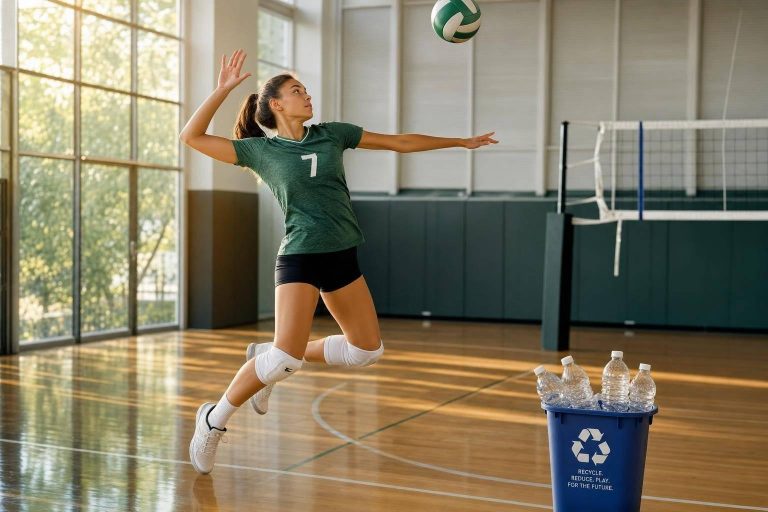
If your team orders new jerseys often, switching to recycled-fiber jerseys can cut waste, lower emissions, and still give you the fit, stretch, and print quality players expect.
I’d sum it up like this: standard polyester jerseys use new petroleum, shed microfibers, and often end up in landfills for years. Recycled polyester jerseys can lower CO₂ output, use less energy, and keep plastic in use longer. The main thing to check is not just the fabric claim, but also the build, print method, wash care, and reorder support.
Here’s what matters most if I’m picking between the two:
- Lower impact: Virgin polyester can produce about 9.5 kg CO₂e per kg of fiber, while recycled polyester is closer to 4.1 kg CO₂e.
- Less resource use: Recycled polyester can use up to 59% less energy than virgin polyester.
- Same on-court needs: Teams still need breathability, moisture control, stretch, and strong seams.
- Microfiber issue still exists: Recycled polyester is still synthetic, so it can still shed in the wash.
- Cost needs a long view: A jersey that costs $55 and lasts 4 seasons may cost less per season than a $40 jersey that lasts only 2 seasons.
- Reorders matter: Saved artwork, color matching, and repeat sizing can save time and cut replacement waste.
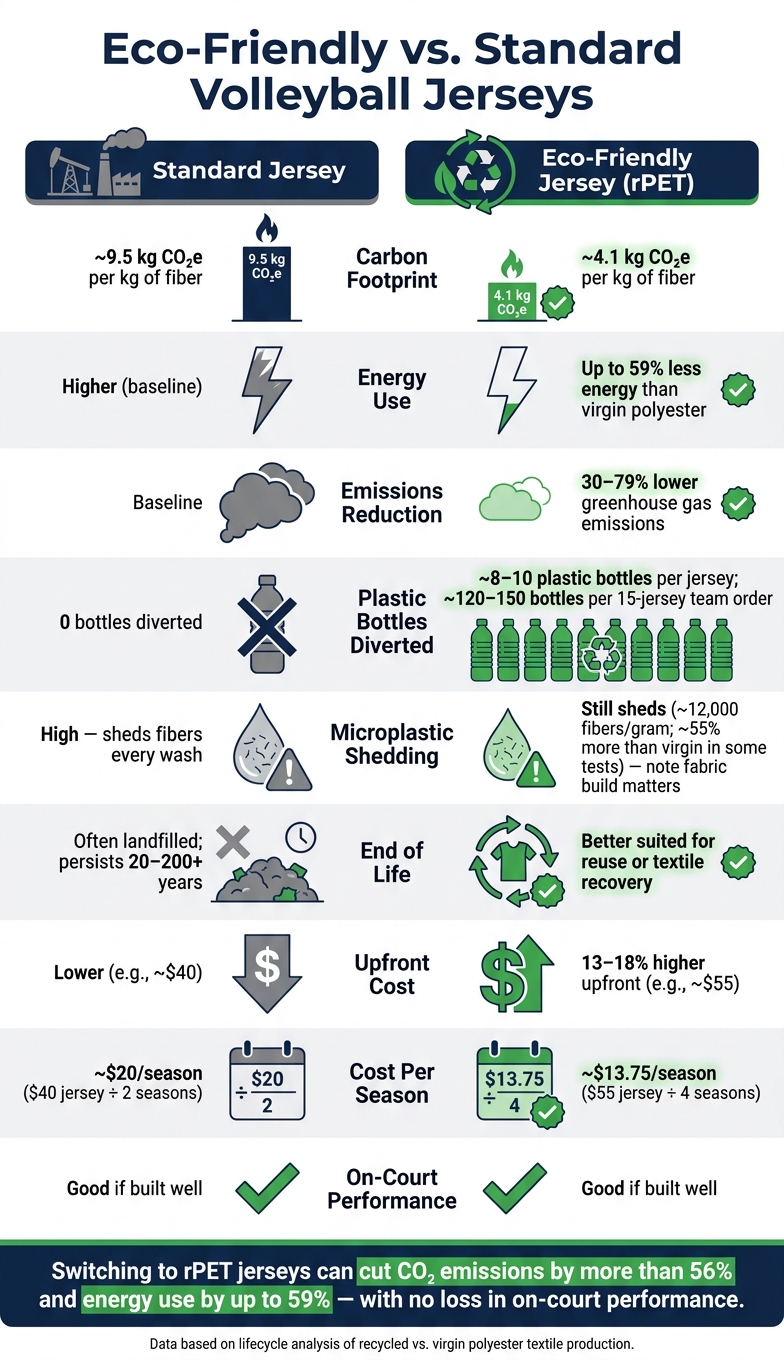
Eco-Friendly vs. Standard Volleyball Jerseys: Environmental & Cost Comparison
Quick Comparison
| What to check | Standard jersey | Eco-friendly jersey |
|---|---|---|
| Fiber source | Virgin polyester | Recycled polyester or other lower-impact fibers |
| Emissions | Higher | Lower |
| Energy use | Higher | Lower |
| On-court feel | Good if built well | Good if built well |
| Microfiber shedding | Yes | Yes |
| End of life | Often landfill | Better fit for reuse or recovery |
| Upfront price | Often lower | Often 13%–18% higher |
If I were buying for a school or club team, I’d look for verified recycled content, sublimated graphics, reinforced seams, clear care instructions, and reliable reorder support before placing the order.
sbb-itb-4d95ad3
The Environmental Cost of Standard Volleyball Jerseys
Standard volleyball jerseys often use virgin polyester, and that comes with a heavy production footprint. The impact starts with fossil-fuel extraction and continues through dyeing and finishing, which use a lot of energy. Producing 1 kg of virgin polyester can emit about 9.5 kg of CO₂e, compared with about 4.1 kg CO₂e for recycled polyester. So when teams place repeat orders season after season, those emissions add up fast. The next step is looking at what teams can switch to without losing on-court performance.
Virgin Polyester and Resource-Heavy Production
Virgin polyester is made from newly extracted petroleum feedstocks. That means every new jersey order starts with nonrenewable resources before the fabric is even cut and sewn.
There is a clear gap between virgin and recycled input. In certain product lines, moving to 100% recycled polyester has been shown to cut climate emissions by up to 29%, energy use by 44%, and water consumption by 16% compared with virgin polyester. Same basic job on the court, less strain from the material side.
Microplastic Shedding and End-of-Life Waste
The impact doesn’t stop once a jersey is made. Synthetic textiles are estimated to account for about 35% of primary microplastics entering the world’s oceans.
Disposal is another problem. Polyester can take 20 to 200+ years to break down in a landfill. In the U.S., textiles generated 17 million tons of waste in 2018, with 11.3 million tons – about 7.7% of all landfilled municipal solid waste – going straight to landfills. When teams replace uniforms every season, that cycle can push even more waste into landfills unless old jerseys are reused or sent into recovery programs.
Standard vs. Eco-Friendly Jerseys: A Side-by-Side Look
| Factor | Standard Jersey | Eco-Friendly Jersey |
|---|---|---|
| Material source | Virgin petroleum-based polyester | Recycled polyester or other lower-impact fibers |
| Carbon footprint | ~9.5 kg CO₂e per kg of fiber | ~4.1 kg CO₂e per kg of fiber |
| Microplastic risk | High – sheds fibers every wash | Lower – recycled fibers can still shed, but material demand is reduced |
| End-of-life waste | Often landfilled; can persist for decades or centuries | Better suited to reuse or textile recovery |
The key difference isn’t how the jersey performs during play. It’s the source of the material and what happens after the jersey is worn out. Lower-impact fabrics cut some of those costs without changing how the jersey plays.
Lower-Impact Materials Used in Eco-Friendly Jerseys
The biggest gains usually start with the fiber itself.
How Recycled Polyester Cuts Resource Use
Recycled polyester, often called rPET, is made from post-consumer plastic bottles or recovered textile waste. Instead of relying on newly extracted petroleum, manufacturers turn existing plastic into yarn that can be used again. That change can have a clear effect: producing recycled polyester can use up to 59% less energy than virgin polyester and cut greenhouse gas emissions by 30–79%, depending on the process and supply chain.
There’s also the waste side of the equation. A single rPET athletic jersey can divert about 8–10 plastic bottles from the waste stream. For a team ordering 15 jerseys, that works out to around 120–150 bottles kept out of landfills or oceans. And yes, rPET can still deliver the performance teams expect.
There is one tradeoff to be clear about. Recycled polyester is still a synthetic fiber, which means it can shed microfibers during washing and wear. Some studies found that recycled polyester garments can release around 12,000 fibers per gram on average, or about 55% more than virgin polyester in controlled tests. The resource savings are still there, but fabric build and wash care make a difference.
Other Responsible Fabric Options Worth Knowing
Some suppliers also use textile-to-textile recycled fibers made from old garments or fabric scraps. That keeps material in use for longer. For volleyball uniforms, these fibers can be made to hit the same stretch, breathability, and durability standards as standard athletic fabrics. Recycled nylon is another fabric you may see in performance blends, especially when extra stretch or abrasion resistance is needed.
Here’s the simple truth: a jersey only pays off if it holds up through a full season and repeated washing.
Questions to Ask Suppliers About Fabric Sourcing
If you want to check recycled content and sourcing, ask:
- What percentage is recycled in the body, trim, and thread?
- Is the recycled content verified? Look for Global Recycled Standard (GRS) certification, which checks recycled content claims and chain-of-custody practices across the supply chain.
- Where does the recycled input come from: bottles, ocean-bound plastic, or textile waste?
- What are the wash care instructions?
- For sublimated jerseys, ask whether dyes and finishes meet OEKO-TEX Standard 100 or an equivalent standard.
Once the material checks out, the next thing that matters is how it performs on the court.
Performance Quality in Eco-Friendly Jerseys
Once the material checks out, most coaches and equipment managers ask one thing: Will it hold up on the court?
Breathability, Moisture Control, and Range of Motion
Recycled polyester can perform just like virgin polyester for breathability and moisture control when the knit and finish are the same. Moisture-wicking yarns pull sweat away from the skin so it can evaporate faster. For a cooler feel without turning the jersey see-through, look for fabric in the 4–6 oz/yd² range.
Volleyball is full of jumping, diving, and hard lateral cuts. A jersey has to move with the player, not fight them. That’s why 4-way stretch recycled polyester, often blended with 9–14% elastane, works well. It flexes with the body instead of tugging at the shoulders or torso.
Small build details matter too:
- Raglan sleeves
- Dropped armholes
- Curved hems
Those touches can make a clear difference when a player is reaching for a dig or going up for a block.
Performance comes down to fabric engineering, not whether the fiber is recycled.
Durability Across Long Seasons and Repeat Reorders
Comfort matters, but durability is what decides whether an eco-friendly jersey is worth the money.
Good eco-friendly jerseys use reinforced seams, abrasion-resistant recycled polyester, and sublimated graphics that won’t crack or peel. When recycled polyester is finished well, it also resists shrinkage, which helps jerseys keep the same fit through a full season.
That longer life means fewer replacements and less textile waste. It also helps when teams need extra jerseys for new players during the season. The same digital patterns can be used again so the reorder matches the first set in both fit and appearance.
To help protect wicking and stretch, wash cold, dry on low, and skip fabric softener.
Common Team Concerns and How Eco-Friendly Jerseys Address Them
Most team concerns have nothing to do with sustainability. They’re much more practical: Will players overheat? Will the short sleeve v-neck fabric wear out? Will reorders match? Modern eco-friendly jerseys answer those concerns head-on.
| Common Team Concern | Eco-Friendly Jersey Feature That Addresses It |
|---|---|
| Overheating during long rallies | Lightweight recycled polyester, breathable knit, targeted mesh zones in back and underarms |
| Excess sweat and discomfort | Moisture-wicking yarns and finishes, quick-dry fabric, ventilated side panels |
| Fabric wear from diving and sliding | Abrasion-resistant recycled polyester, reinforced seams at shoulders and sides |
| Fading or peeling numbers and logos | Sublimated graphics infused into fibers for long-lasting color and readability |
| Inconsistent fit across players and reorders | Standardized volleyball-specific patterns, detailed U.S. size charts, saved patterns for repeat orders |
Recycled-fiber jerseys already perform at elite levels.
If the jersey performs well, the next question is whether it still looks sharp as a team uniform.
Custom Design and Team Identity
Eco-Friendly Jerseys Can Still Look Professional
Once the performance side is handled, the next concern is simple: does the jersey still look like your team?
The short answer is yes. Moving to recycled polyester doesn’t mean ending up with something plain or generic. Recycled yarns take dye evenly, so bold team colors, sharp logo edges, and clean number layout are still possible. When the artwork and color matching are done well, the jersey looks sharp in person and in photos.
That matters more than it might seem. If a jersey keeps its polished look for longer, teams are less likely to replace it early.
For school, club, and rec teams, that means a cleaner and more consistent look across the roster. You can still match your school’s color palette, add a sponsor logo on the sleeve, and include a libero jersey that fits the rest of the set. Sublimation also lets teams use complex all-over designs without losing brand consistency.
Why Sublimated Designs Hold Up Over Time
Sublimation bonds dye directly to polyester fibers. So names, numbers, and logos stay sharp without adding extra texture, and the fabric stays smooth through repeated wear and washing.
For volleyball teams that dive, block, and slide on a regular basis, that’s a big deal. Numbers stay legible. Logos stay crisp. Breathability and range of motion stay the same. That also makes design support and saved artwork files helpful when it’s time to place repeat orders.
Custom Design Support From Wooter Apparel

Wooter Apparel offers fully sublimated custom team uniforms with free design support. That helps teams fine-tune logos, colors, number styles, and placements.
Because designs are saved digitally, reorders for new players or future seasons stay consistent in color and branding.
How U.S. Teams Can Pick the Right Eco-Friendly Jerseys
Once a jersey clears the performance test, use this checklist to compare suppliers and long-term value.
How to Check Recycled Content and Product Details
A solid product listing gives you the exact fiber mix, like "70% recycled polyester, 30% spandex", instead of a fuzzy claim. Look for terms such as recycled polyester (rPET), recycled nylon, or textile-to-textile recycled fibers. If a listing only says green or sustainable, don’t take it at face value.
You’ll also want proof. Check recycled content through GRS or RCS, and look for OEKO-TEX STANDARD 100 to confirm material safety. Then verify the certificate in the certifier’s database. That extra step can save a lot of guesswork.
Fiber content is only part of the story. Construction matters too. Check for reinforced seams at the shoulders and armholes, plus mesh or lighter-knit panels that help with airflow. It also helps to review care and build details that affect how well the jersey keeps its fit and color after repeat washes. Jerseys that stay in shape and hold print quality after dozens of wash cycles need to be replaced less often, which helps both your budget and the environment.
After that, compare the full cost picture, not just the sticker price.
Comparing Price, Lifespan, and Reorder Value
Recycled polyester jerseys can cost 13–18% more upfront than virgin polyester options. But that difference can shrink fast once you look at lifespan.
Here’s a simple example:
- A $55 jersey that lasts four seasons costs about $13.75 per season
- A $40 jersey that needs replacing after two seasons costs $20 per season
So the lower upfront price doesn’t always mean lower cost over time.
Reorder value also matters a lot for U.S. school and club programs. If a supplier keeps your files and patterns on hand, adding jerseys later is usually faster and less expensive. It can also cut down on replacement orders, which ties back to less textile waste.
Next, check the terms that affect shipping, color consistency, and repeat orders.
Order Details to Confirm Before Placing a Team Order
Before you place a team order, confirm a few basics with the supplier. Start with the minimum order quantity. Some vendors ask for large batches, even on reorders, and that can be a headache for smaller programs.
You should also confirm standard production and shipping timelines for U.S. orders. A common turnaround is 4–6 weeks, though that can stretch during busy pre-season periods when demand jumps.
For design, ask how the supplier handles color matching. Do they use Pantone numbers or digital color codes to keep school colors consistent across batches? Also ask whether they provide a sample or digital mockup before full production. And one more thing that often gets missed: confirm how long your artwork files will stay on file. Multi-year file storage makes reorders much easier and usually cheaper.
Conclusion
The choice comes down to impact, performance, and value.
Standard volleyball jerseys come with a heavy footprint. They rely on petroleum-based production, can shed microfibers, and often end up as landfill waste. By contrast, rPET uses less energy and creates fewer emissions than virgin polyester, which makes it a smarter pick for season-after-season team orders. And there’s no need to trade performance for that switch. Eco-friendly performance fabrics still offer the breathability, stretch, and durability volleyball teams need.
Key Takeaway for Team Buyers
The best eco-friendly volleyball jerseys cut waste, hold up on the court, and keep team branding consistent. Wooter Apparel offers fully sublimated custom designs with professional design support. For teams that order every season, that choice matters.
FAQs
Are eco-friendly volleyball jerseys as durable as standard polyester?
Yes. Wooter’s eco-friendly jerseys are made with recycled polyester (rPET). That fabric is tough, pulls sweat away from the body, and helps the jersey hold its shape after repeated washes. It also resists pilling, which means it keeps a cleaner look over time.
Wooter also says recycled polyester delivers the same durability and moisture-wicking performance as virgin polyester. On top of that, it can last 2–3x longer than regular fabrics.
How can I verify a jersey is made with recycled materials?
Look for recognized third-party certifications like GRS or RCS on the product label. You may also see a license number or QR code. If you do, check it in official databases such as the GOTS public database or OEKO-TEX Label Check.
If you want extra proof, ask for a Transaction Certificate tied to your order. That document shows the materials in your shipment meet the stated sustainability standards.
What is the best way to wash eco-friendly jerseys to reduce microfiber shedding?
Wash eco-friendly jerseys on a gentle cycle with cold water. That cuts down on agitation, which can mean less shedding in the wash. If you want another layer of help, use a laundry filter made to catch fibers.
Skip fabric softeners and bleach. When you can, let the jersey air dry to help the fabric last longer.
Jerseys made with 70% or more recycled content may also shed less. In many cases, that’s because the fibers are longer and hold up better over time.