
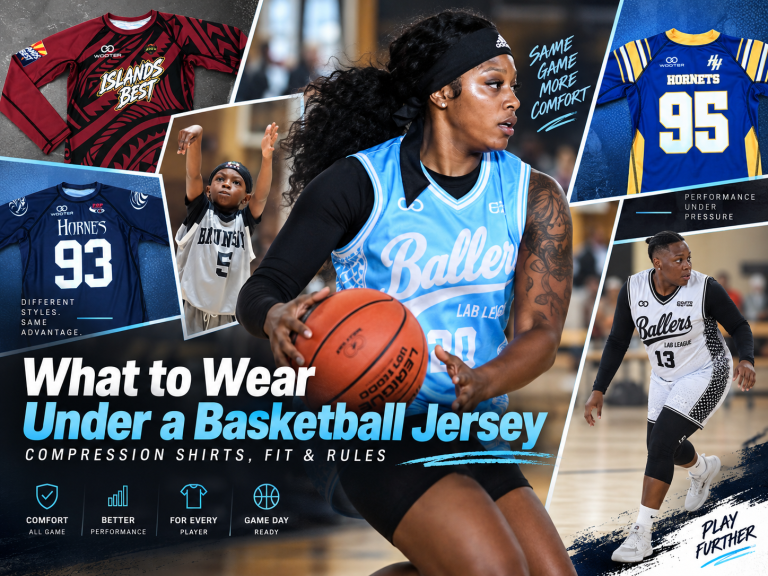
You put on your basketball jersey, start warming up, and something immediately feels off.
The shirt underneath bunches near the armholes. The sleeves keep shifting. Your jersey suddenly feels tighter across the shoulders. Or you reach game day and realize the visible undershirt does not meet your league’s uniform requirements.
That is why what you wear under a basketball jersey matters.
A good basketball compression shirt should almost disappear once play starts. It should stay close to the body, move naturally beneath the jersey, and give you the coverage you want without adding unnecessary bulk.
But sleeveless, short-sleeve, and long-sleeve options do not all work the same way. And the layer that feels perfect during practice may not be the right choice for a regulated game.
So what should you actually wear?
This guide breaks down the options, fit, rules, and real use cases so players and teams can choose the right layer before stepping onto the court.
Can You Wear a Compression Shirt Under a Basketball Jersey?
Yes, in many basketball settings you can wear a compression shirt under a basketball jersey.
The important distinction is between practice preference and game-day compliance.
For training, players generally have more freedom to choose the coverage and style they prefer. During organized competition, visible undershirts can be subject to rules involving color, sleeve length, and team consistency.
From a fit standpoint, the base layer should stay close to the body instead of folding or shifting underneath the jersey.
Wooter’s Custom Short Sleeve Compression Shirts are designed to work as either standalone training tops or base layers beneath jerseys. The current product uses a 90% polyester and 10% spandex blend with flatlock seams and a close athletic fit.
That is the basic idea you want from any basketball undershirt:
Close enough to stay put. Comfortable enough to forget about.
What Should You Wear Under a Basketball Jersey?
You do not automatically need another layer under a basketball jersey.
Some players prefer wearing the jersey directly against the body. Others want additional coverage or simply prefer how a fitted base layer feels.
If you do add one, these are the main options.
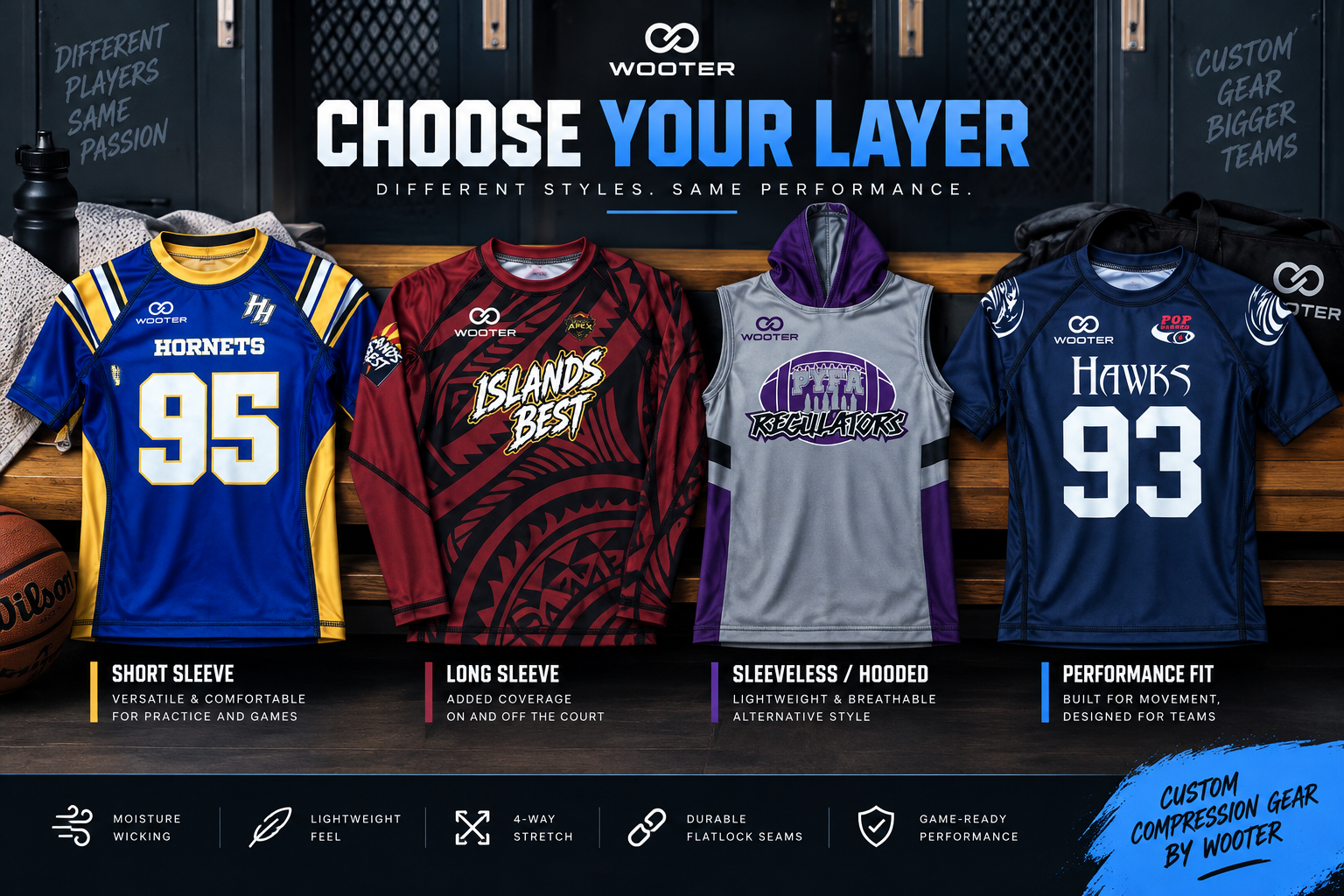
Sleeveless Compression Shirt: Best for Maximum Arm Freedom
A sleeveless compression top gives you torso coverage without placing extra fabric around the upper arms.
That makes it useful for players who want the feel of a base layer while keeping the shoulders as open as possible.
It also tends to stay less visible beneath a traditional sleeveless jersey.
The trade-off is coverage. If you specifically want your upper arms covered, sleeveless is not going to solve that problem.
Short-Sleeve Compression Shirt: Best All-Around Option
For many players, short sleeve is the middle ground.
You get more coverage than a sleeveless base layer without covering the entire arm.
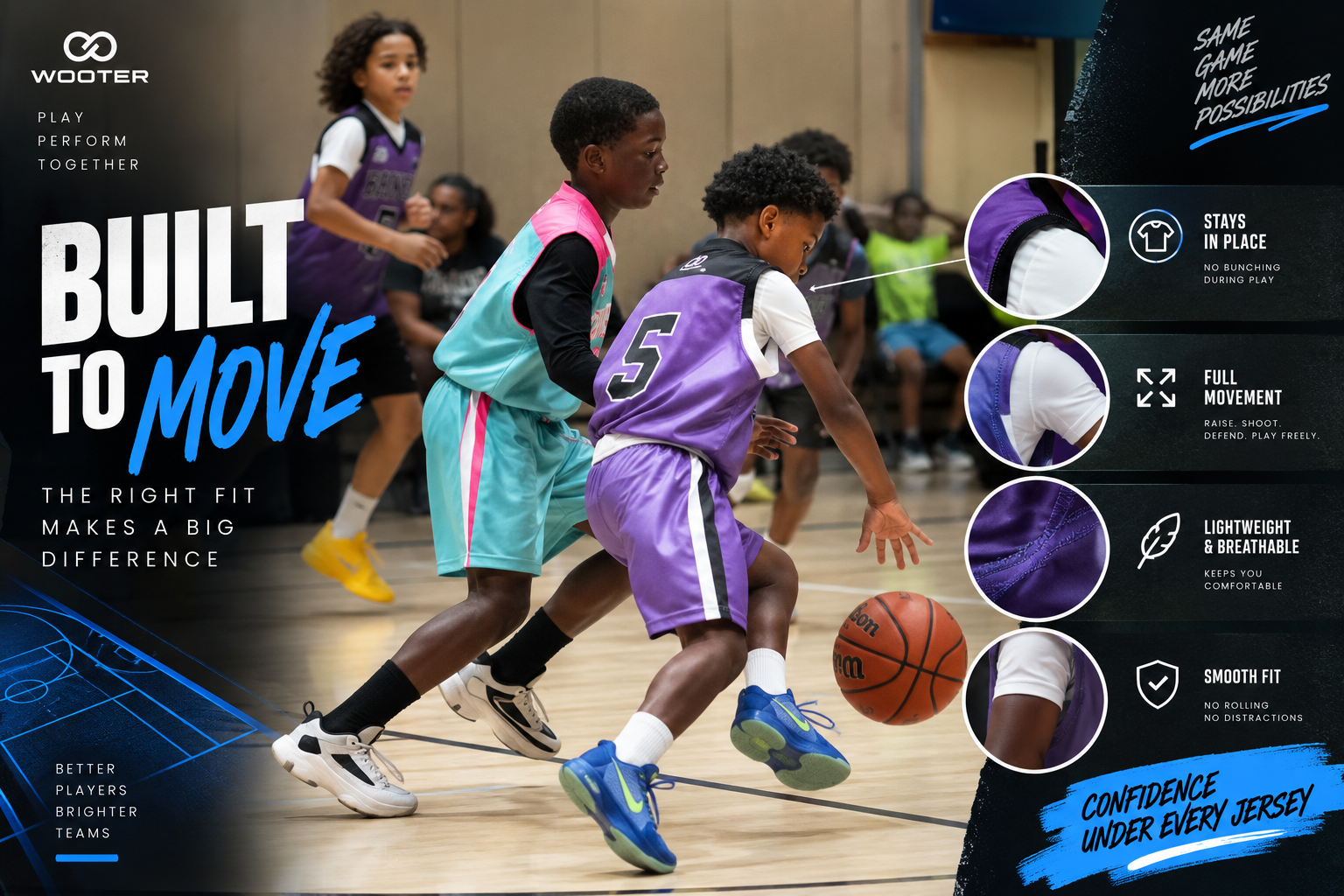
The sleeves should sit smoothly against the upper arm. If they roll upward, bunch near the armpit, or pull every time you raise your arms, the shirt is not working properly under the jersey.
This is also one of the easiest styles to use for coordinated team compression gear because it provides visible branding space without dominating the uniform.
Long-Sleeve Compression Shirt: Best for Maximum Coverage
Long sleeves provide the most coverage.
They can work well for warmups, training, practices, and game situations where the applicable uniform rules permit them.
The trade-off is simple: more visible material means there is more to check before game day.
You need to consider fit, color, sleeve requirements, and how the layer works with the jersey during a full shooting motion.
Regular T-Shirt: Fine Casually, Less Ideal for Layering
Can you wear a regular shirt under a basketball jersey?
In casual basketball, sure.
But loose fabric can collect beneath the jersey, shift around the underarms, and change how the outer layer feels during movement.
If your goal is a clean athletic base layer, a fitted undershirt is usually the more practical setup.
Sleeveless vs Short Sleeve vs Long Sleeve: Which Should You Choose?
This decision becomes much easier when you stop asking which style is “best” and ask what you actually need from the layer.
| Style | Choose It When | Watch For |
|---|---|---|
| Sleeveless | You want maximum shoulder freedom and minimal visible layering. | Neckline and armhole placement |
| Short Sleeve | You want balanced coverage and mobility. | Sleeves rolling or bunching |
| Long Sleeve | You want full arm coverage. | Game rules, sleeve fit, and restriction |
Choose sleeveless if the base layer is mainly about torso coverage.
Choose short sleeve if you want a balanced everyday option.
Choose long sleeve if arm coverage matters enough to justify the additional visible layer.
Wooter currently offers sleeveless, short-sleeve, long-sleeve, racerback, hooded, and reversible compression tops, so teams do not have to force every player into the same cut when different coverage needs exist.
Find the Base Layer That Fits Your Game
Compare compression styles for training, layering, and complete team customization.
How Should a Compression Shirt Fit Under a Basketball Jersey?
A compression shirt should fit close, not painfully tight.
The easiest way to judge it is to stop looking at the mirror and start moving.
Raise both arms overhead. Rotate your shoulders. Move through a jump-shot motion. Reach across your body and drop into a defensive stance.
The shirt should stay smooth rather than sliding, rolling, or collecting underneath the jersey.
Then check the outer layer.
A compression top that fits well can still create a bad combination if the jersey is already very tight through the chest, shoulders, or armholes.
That is why both layers should be tested together.
For example, Wooter’s Custom Pro Basketball Jerseys use a structured pro-cut silhouette with curved seams and side splits designed around basketball movement. A player adding a compression layer underneath should confirm that the jersey still moves naturally rather than relying on the size label alone.
The simple rule:
Fit the uniform as a system, not as two separate pieces.
Can a Compression Shirt Make Your Basketball Jersey Feel Too Tight?
Yes.
A compression layer is thin, but it still occupies space underneath the jersey.
This becomes noticeable when the outer jersey already sits close around the upper body.
You may feel extra tension across the chest. The armholes may feel tighter. The jersey may pull upward more when you shoot.
Neckline can affect the layering experience too.
A Custom V-Neck Basketball Jersey creates a more open neckline and Wooter specifically notes that the style can pair with compression gear underneath. A Custom Round Neck Basketball Jersey uses a more traditional crew-neck opening, creating a different layering profile around the upper chest.
Neither neckline is automatically better.
What matters is whether your chosen base layer stays clean beneath your chosen jersey.
Practice vs Game Day: This Is Where the Rules Matter
The compression setup you love at practice is not automatically the setup you should wear during competition.
During practice, comfort and preference usually drive the decision.
During games, uniform rules can matter.
Practice
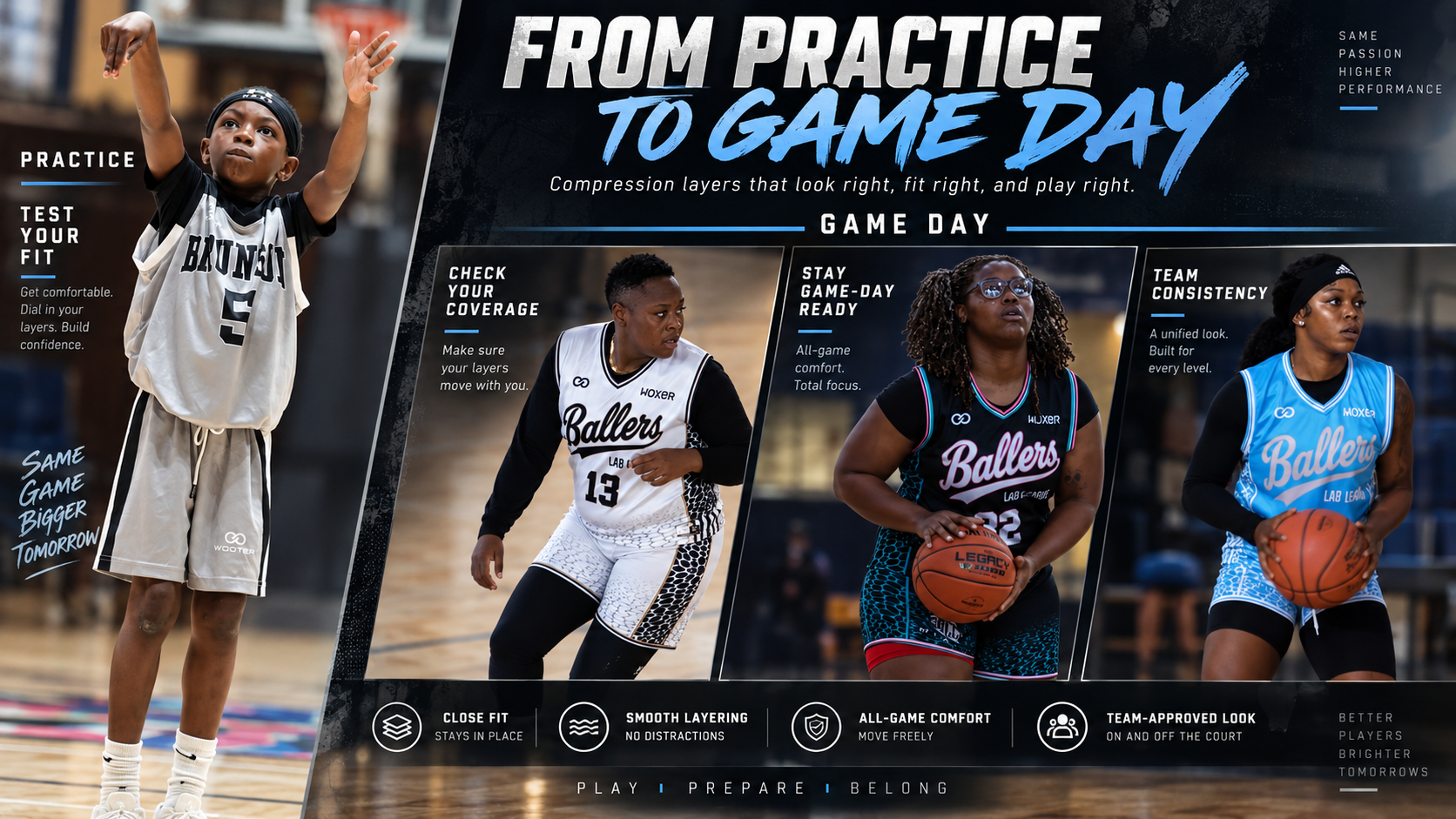
This is the best environment to test your layering setup.
Wear the compression shirt through shooting drills, scrimmages, sprints, and defensive work.
If sleeves roll, fabric bunches, or the jersey suddenly feels restrictive, you want to discover that during practice, not during the first quarter.
Teams using separate training tops can also test layers beneath products such as Wooter’s Custom Reversible Basketball Practice Jerseys, which are specifically built for repeated drills, scrimmages, conditioning, and team practice.
Game Day
Now the question becomes bigger than comfort.
You may need to check undershirt color, visible sleeves, team consistency, and the rules used by your competition.
NFHS changed basketball Rule 3-5-6 to allow visible undershirts in a single solid color and also permit solid black for visiting teams wearing dark jerseys. The rule change was intended in part to make coordinated undershirts easier for schools to source.
Because rules can be revised and local associations may apply additional requirements, high-school programs should confirm the current rule set they actually play under.
College basketball has its own framework. The NCAA currently maintains official men’s basketball rules, a 2026–27 case book, and separate uniform guidelines; it also maintains a separate rules and uniform-guidelines resource for women’s basketball.
The practical takeaway is simple:
Choose the look after you know the rules.
What Color Compression Shirt Should You Wear?
For practice, this may simply be a branding decision.
For games, it can become a compliance decision.
If your team wants visible compression gear, determine the permitted color before customizing an entire roster.
Also think beyond one jersey.
A team wearing reversible uniforms may need the same undershirt to work with more than one uniform color.
Wooter’s Custom Reversible V-Neck Basketball Jerseys give teams two playable sides in one jersey, which makes base-layer color selection especially worth thinking through before the season starts.
The best compression color is not simply the one that looks coolest.
It is the one that works with the uniform and can actually be worn when it matters.
Which Compression Setup Makes Sense for You?
This is where the decision gets easier.
If your priority is maximum shoulder freedom, start with sleeveless.
If you want more coverage without covering the whole arm, short sleeve is the strongest all-around option.
If you want full arm coverage, consider long sleeve, but verify the game-day rules first.
And if you are perfectly comfortable without a base layer?
You do not need to force one.
That matters because good team gear should solve a problem, not create another purchase simply for the sake of having more apparel.
A basketball compression shirt makes sense when it improves the player’s layering setup, gives them the coverage they prefer, or provides a consistent team base layer.
It should not be treated as a magic performance product.
The job is much simpler:
Stay close. Stay comfortable. Stay out of the way.
Ordering Compression Shirts for a Team? Decide These Things First
Buying one base layer is easy.
Ordering for an entire roster needs more discipline.
Start with the competition rules. Then choose the preferred coverage and approved color.
Next, collect actual compression-shirt sizes rather than automatically copying jersey sizes.
Finally, test the chosen layer underneath the actual team jersey before production.
Wooter’s compression category includes different cuts and sizing ranges, while its compression sizing resource provides product-specific sizing charts rather than relying on generic jersey sizing.
That extra check is worth it.
One bad fit is annoying. A full roster of bad fits becomes an expensive problem.
FAQs About Wearing Compression Shirts Under Basketball Jerseys
Can you wear a compression shirt under a basketball jersey?
Yes, compression shirts can be worn underneath basketball jerseys in many settings. For organized competition, players should check the current uniform rules governing visible undershirts, colors, and sleeves.
What do basketball players wear under their jerseys?
Players may wear no additional layer or choose sleeveless, short-sleeve, or long-sleeve athletic undershirts. The best option depends on desired coverage, comfort, jersey fit, and competition rules.
Should a basketball compression shirt be tight?
It should fit close to the body without restricting breathing, shoulder rotation, or a normal shooting motion. If the shirt causes discomfort or changes how you move, the fit is too aggressive.
Can you wear a long-sleeve shirt under a basketball jersey?
Long-sleeve base layers can work in many training and basketball settings. During organized games, check the competition’s current undershirt and uniform rules before wearing visible long sleeves.
What color undershirt can you wear in basketball?
That depends on the competition. High-school, college, tournament, and recreational rules may differ, so teams should confirm the applicable regulations before ordering visible game-day base layers.
Is sleeveless or short sleeve better under a basketball jersey?
Neither is universally better. Sleeveless maximizes arm freedom and minimizes visible layering, while short sleeve provides more upper-body coverage. The better choice depends on the player’s preference, jersey style, and game rules.
The Best Layer Is the One That Works With Your Uniform
There is no single undershirt every basketball player needs.
Some players prefer sleeveless. Others want short sleeves or full-arm coverage. Some feel best wearing no additional layer at all.
The right choice should match the player’s coverage needs, stay comfortable beneath the jersey, and work within the rules of the competition.
For teams, add one more requirement:
consistency.
Build the compression gear around the same colors, identity, and uniform system as the rest of the roster rather than treating it as an afterthought.
Ready to Build Compression Gear for Your Team?
Create custom compression apparel around your team colors, logos, player needs, and basketball uniform setup.