
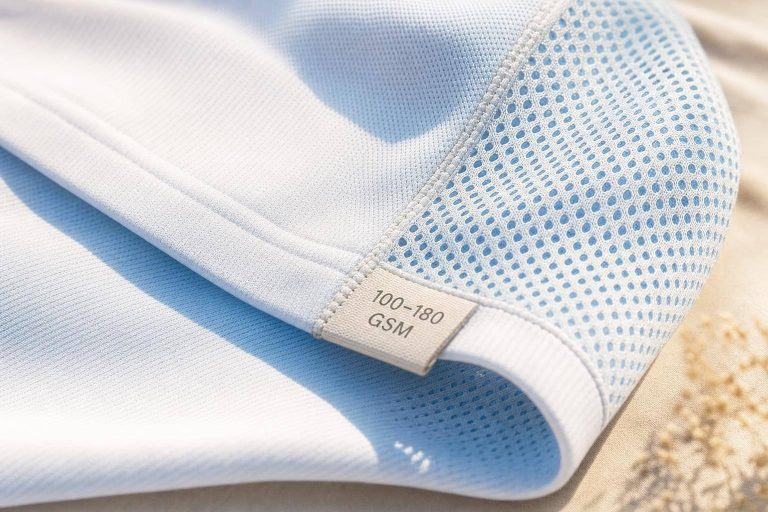
If I had to boil it down to one rule, it’s this: pick a light fabric that breathes well, moves sweat off the skin, and still survives the season.
In hot weather, I’d look at three things first:
- Breathability: open knits and mesh help heat escape
- Moisture control: polyester-based fabrics dry faster than cotton and don’t stay soaked
- Fabric weight: for summer tops, under 200 GSM is a solid target, with many jerseys landing around 100 to 180 GSM
I’d also check construction, fit, color, and coverage. Mesh panels in the back, sides, and underarms can help with airflow. A closer fit can help wicking work better. And lighter colors can stay cooler in the sun than darker ones.
Here’s the short version of the fabric choices:
- Polyester interlock: good all-around pick for many team jerseys
- Polyester mesh: best when airflow matters most
- Poly-spandex blends: better for stretch and body-hugging fits
- Game-weight polyester: built for heavier contact and wear
- Nylon-reinforced blends: useful in high-friction spots
Quick Comparison
| Fabric Type | Airflow | Sweat Drying | Wear Resistance | Best Use |
|---|---|---|---|---|
| Polyester (Interlock) | High | High | High | Baseball, soccer, standard team jerseys |
| Polyester Mesh | Very high | High | Medium | Basketball, hot-weather training, vent panels |
| Poly-Spandex Blend | Medium | High | Medium | Compression pieces, fitted uniforms, cheer/dance |
| Game-Weight Polyester | Medium | Medium | Very high | Football, hockey, rough-use uniforms |
| Nylon-Reinforced Blends | Medium | Medium | Very high | Volleyball, sliding areas, reinforced zones |
One more thing I’d keep in mind: fiber alone doesn’t decide comfort. The knit, panel placement, print method, and wash routine all affect how cool a uniform feels on a July game day.
If I were choosing for a team, I’d start with polyester or polyester mesh, stay in the 100 to 180 GSM range when possible, and use mesh only where players need extra airflow most.
sbb-itb-4d95ad3
Step 1: Evaluate Breathability, Moisture Management, and Fabric Weight
Start with Breathability and Airflow
Breathability means the fabric lets heat and moisture escape instead of trapping them against the skin.
Look for open-knit structures, mesh panels, and lightweight constructions. Here’s a simple test: hold a fabric swatch up to the light. If you can see visible gaps, it will likely ventilate better than a tightly packed weave.
Research supports that idea. A football jersey study found that a polyester fabric with an open-knit structure had an air permeability of 2,149.2 mm/s and the lowest thermal resistance of any tested fabric.
Breathability comes first. But airflow by itself won’t do the whole job.
Check Moisture-Wicking and Drying Speed
Breathability and moisture management are connected, but they’re not the same. A fabric can let air pass through and still hang onto sweat. In high-sweat team sports, that gets uncomfortable fast.
The big difference is wicking vs. absorbing. An absorbent fabric, like cotton, soaks up sweat and keeps it there. A wicking fabric pulls moisture away from the skin, spreads it across the surface, and helps it evaporate faster. Performance polyester can dry up to 50% faster than cotton. In one test, a 100% polyester mesh fabric absorbed less than 0.2% of its weight in water and dried in about 20 minutes.
After airflow and drying speed, move to fabric weight.
Use Fabric Weight as the Final Filter
Once you’ve checked breathability and wicking, look at fabric weight, usually measured in GSM. For summer sports uniforms, staying below 200 GSM is a solid rule of thumb. Most athletic jerseys and tops sit in the 100–180 GSM range, while running tops are often 100–120 GSM (3–3.5 oz/yd²).
Lighter fabric doesn’t always mean weaker fabric. Many performance knits in that range can handle contact, sliding, and repeated washing without losing shape.
A practical check works well here:
- Does the fabric feel light during movement?
- Does it recover after stretching?
- Does it hold up after multiple wash cycles?
If the fabric clears those three checks, the next step is to compare fiber type and construction. Once you’ve selected your materials, you can get an instant quote for your custom team gear.
Step 2: Compare the Best Summer Uniform Fabric Types
Now that you know what to look for, it’s time to compare the fabric types that work best for summer play.
Polyester: Lightweight, Durable, and Fast-Drying
Polyester is a strong starting point for team sports uniforms. It doesn’t absorb much moisture, dries fast, and holds color well for sublimation. That makes it a solid pick for teams that want uniforms to look sharp game after game. In hotter weather, polyester mesh can add even more airflow.
Polyester Mesh: Maximum Ventilation for High Heat
Mesh is polyester made with an open mesh construction. That open build lets more air move through the fabric, which makes it a smart pick when cooling matters most. It works especially well for main jersey bodies, back panels, side panels, and custom crew neck T-shirts for practice.
There is a tradeoff, though. Mesh can be less durable than solid polyester. So if a team wants the most airflow possible, mesh is a strong choice. But if the goal is a better balance of airflow, durability, and print quality, solid polyester or a hybrid design with mesh panels is often the better fit.
And what if players need more stretch and snap-back? That’s where blends come in.
Polyester Blends with Performance Finishes
Polyester-spandex blends add stretch and recovery. They can also come with finishes for wicking, odor control, and UV protection. In summer heat, that mix can help uniforms move sweat fast and give players a bit more freedom to move.
That said, there’s a catch. Wicking, anti-odor, and UPF finishes can help, but they usually wear off after repeated washing. For uniforms that need to last multiple seasons, breathable construction and built-in moisture control should do the heavy lifting. Finishes work best as an added layer, not the main plan.
Step 3: Look at Construction, Fit, Color, and Coverage
Fiber matters, but construction, fit, color, and coverage decide how that fabric holds up in the heat.
Choose Open Weaves, Mesh Panels, and Lightweight Knit Structures
Once you’ve picked the right fabric, construction decides how much of that upside actually reaches the athlete.
Use mesh with purpose, not across the entire uniform. Open-knit and mesh zones help air move through the garment and let heat escape where players need it most. Traditional mesh panels move much more air than micro-perforated vents. A simple light test can help you spot where those open zones sit, especially on the back, sides, and underarms.
The best setups usually mix materials: solid knit where the uniform needs structure or opacity, and mesh or open-knit panels in high-heat areas like the upper back, side panels, and underarms. That gives athletes cooling where it matters without wearing down the uniform too fast.
After airflow, fit plays a big role in whether moisture can move off the skin during play.
Match Fit to Movement and Moisture-Wicking Performance
An athletic fit keeps the fabric close enough to wick well and cut drag. Compression fits can help move sweat faster, while looser cuts may work better for sports that need more range of motion.
The rule is simple: the fit should stay in contact with the body during movement without pulling or binding at major joints.
From there, color and coverage affect how much heat the uniform picks up outdoors.
Use Lighter Colors and Smart Coverage for Hot Weather
Lighter colors absorb less sunlight than darker shades, which helps keep surface temperatures lower. If a team has to use dark colors for branding, that’s still workable. The key is pairing them with open construction and smart coverage.
UPF-rated lightweight fabric can add sun protection without trapping extra heat. For example, a garment rated UPF 44 blocks about 97.7% of UV rays, which lets teams add coverage without adding weight, as long as the construction stays open.
For summer sports, the sweet spot is pretty clear: lighter colors, open construction, and targeted UPF coverage.
Fabric Comparison Table and Final Selection Checklist
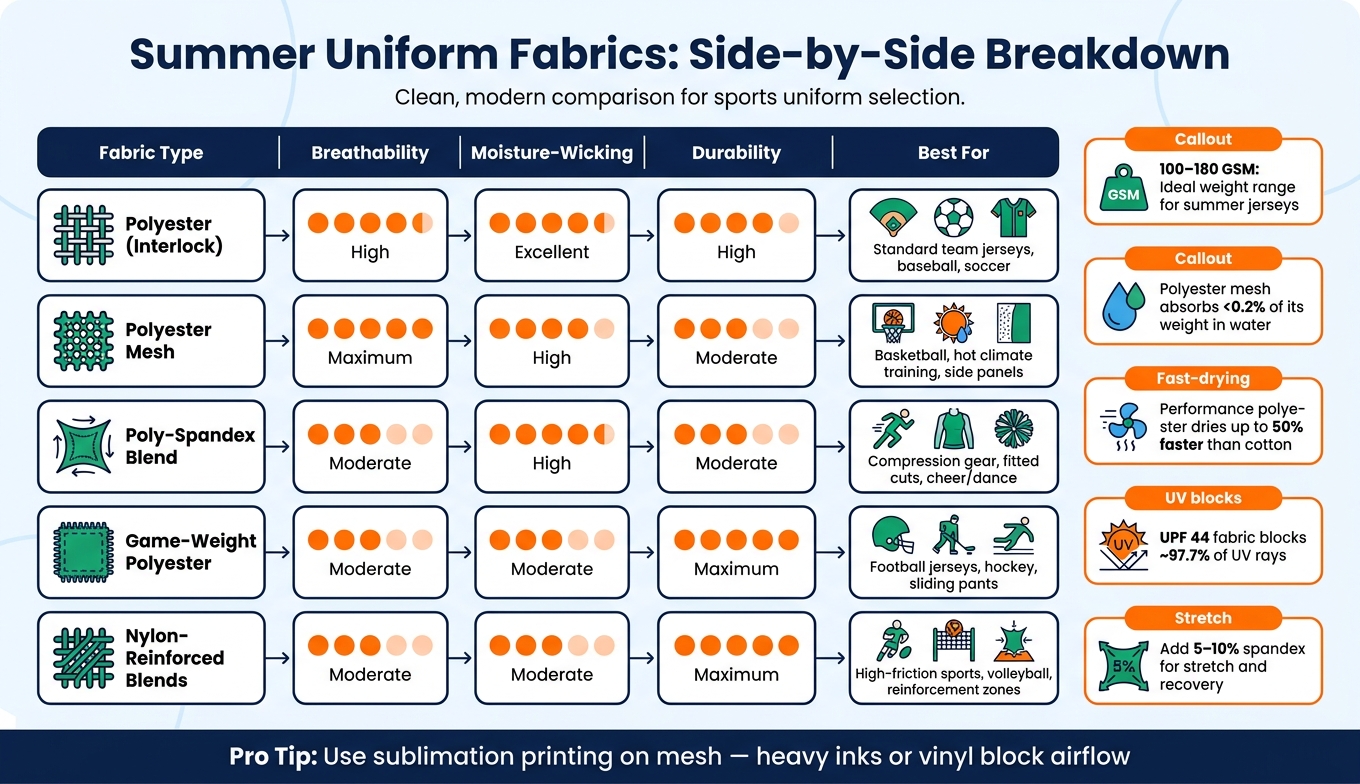
Summer Uniform Fabrics Compared: Breathability, Wicking & Durability
Summer Fabric Options Side by Side
You’ve already looked at breathability, moisture control, and fabric weight. Now it’s time to compare the main options next to each other and narrow things down.
Use this table to compare common summer fabrics based on breathability, moisture-wicking, durability, and the type of sport they suit best:
| Fabric Type | Breathability | Moisture-Wicking | Durability | Best For |
|---|---|---|---|---|
| Polyester (Interlock) | High | Excellent | High | Standard team jerseys, baseball, soccer |
| Polyester Mesh | Maximum | High | Moderate | Basketball, hot climate training, side panels |
| Poly-Spandex Blend | Moderate | High | Moderate | Compression gear, fitted cuts, cheer/dance |
| Game-Weight Polyester | Moderate | Moderate | Maximum | Football jerseys, hockey, sliding pants |
| Nylon-Reinforced Blends | Moderate | Moderate | Maximum | High-friction sports, volleyball, reinforcement |
One thing to keep in mind: wicking doesn’t come from fiber alone. It also depends on the yarn and knit structure. Interlock feels smoother and holds its shape better. Mesh, on the other hand, is built more for airflow, but it can snag more easily. And if you need stretch, adding 5% to 10% spandex helps with movement and recovery.
How to Make the Final Choice for Your Team
Once you’ve compared the fabric types, the last step is matching them to how your team actually plays.
- Sport and position: Does the athlete need extra abrasion resistance for sliding, or more freedom for cutting, sprinting, and jumping?
- Climate: Are games played in heavy humidity? If so, mesh panels in heat-heavy zones like the upper back, underarms, and side panels matter more.
- Practice frequency: Will uniforms go through the wash every day? Choose high-grade polyester that can handle repeated wash cycles. Also, skip fabric softeners – they coat fibers and reduce wicking performance .
- Fit preference: Do players want compression, or a more relaxed, light feel?
- Budget: Weigh the added performance of premium blends like poly-spandex against how long the garment needs to last through the season.
Printing method matters too. Use sublimation on mesh, since heavy inks or vinyl can block airflow and create hot spots.
Conclusion: Keep It Cool, Dry, and Durable
The best summer uniform fabric does three jobs at once: it lets heat out, moves sweat off the skin, and holds up through contact and repeated washing. In plain terms, go with the lightest fabric that can still deal with your sport, your weather, and your season-long wear.
"A uniform is athletic equipment. The right fabric wicks sweat away from the skin, lets heat escape, stretches with the athlete and survives a full season of play and washing." – XROAD Sports Team
FAQs
What GSM is best for summer uniforms?
For summer uniforms, a lightweight fabric weight of 30 to 150 GSM is usually the sweet spot if you want better breathability and easier movement in hot weather.
The best range can shift a bit depending on the sport:
- Soccer: 120 to 150 GSM is a common pick.
- Basketball or track: 140 to 180 GSM can work well when you need a balance between low weight and durability.
Is mesh too fragile for game jerseys?
No. Modern mesh is built for athletic performance. It’s strong enough for intense play and helps air move more freely.
That’s why it shows up so often in sports like football and basketball. It gives players a solid mix of breathability and durability. Many mesh uniforms also use tough synthetic yarns, which help the fabric hold its shape and stand up to wear and tear over time.
How do I keep wicking fabric working longer?
Turn uniforms inside out and wash them in cold water, around 60°F to 80°F, with a mild detergent made for sportswear. Skip fabric softener. It can leave a coating on the fibers and block the tiny openings that help move sweat away from the body.
Air drying is the safest option. If you need to use a dryer, set it to the lowest heat and take items out while they’re still slightly damp. That helps protect the elastic and the shape of the fabric.