
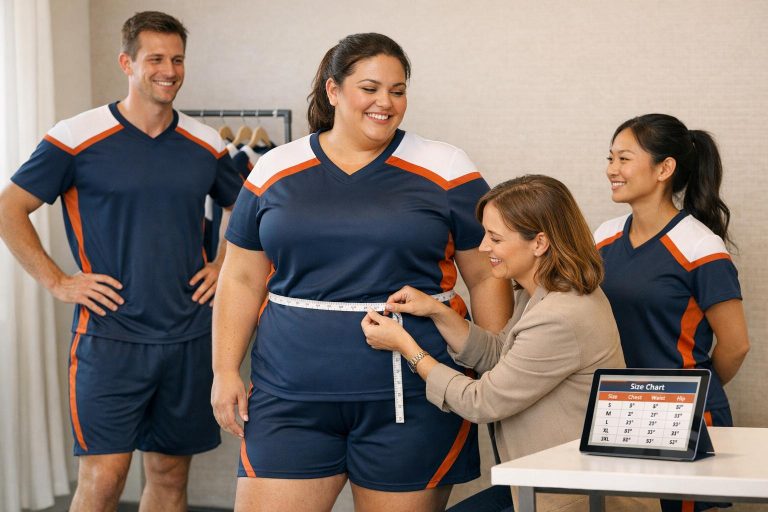
Accurate uniform sizing is key for comfort, performance, and team confidence. Athletes come in many shapes and sizes, making standard size charts unreliable. Custom sizing ensures every player gets a uniform that fits properly, avoiding issues like restricted movement or excess fabric.
Key takeaways:
- Why fit matters: A good fit boosts mobility, comfort, and confidence.
- Challenges: Standard sizing doesn’t account for unique body proportions.
- Solutions: Custom cuts, flexible fabrics, and sizing kits help teams get it right.
- Measurement tips: Use precise tools, focus on key areas (chest, waist, hips), and avoid common errors.
- Youth considerations: Size up for growing athletes.
Wooter Apparel simplifies the process with sport-specific sizing kits, accurate charts, and flexible designs. Proper preparation and attention to detail ensure every athlete looks and feels their best.
How to Find Your Perfect Uniform Fit | Stimulus Athletic Sizing Guide!
sbb-itb-4d95ad3
Accurate Body Measurements: The Basis of a Good Fit
Getting the measurements right is the key to ensuring a uniform fits well. Even a small error, like being off by an inch in the chest or waist, can make a uniform uncomfortable or restrict movement. Since custom uniforms are made to order, there’s no easy way to fix errors later. These precise measurements are the starting point for creating uniforms tailored to each athlete’s unique body.
How to Prepare for Measurements
Before starting, athletes should wear close-fitting underwear or thin athletic clothing. Extra layers can throw off the accuracy of measurements. Players should stand evenly with a neutral, relaxed posture. A soft, flexible tape measure is a must – metal tapes won’t conform to body curves. Write down each measurement immediately to avoid forgetting or mixing them up.
Once the preparation is complete, it’s time to focus on the essential measurements.
Key Measurements for Tops and Bottoms
For tops, three main measurements are critical: chest, shoulder width, and sleeve length.
- Chest: Wrap the tape measure around the fullest part of the chest, just under the armpits. Keep the tape snug and level.
- Shoulder Width: Measure across the widest part of the shoulders, from edge to edge, ensuring the tape stays straight.
- Sleeve Length: Start at the center back of the neck, go across the shoulder, and measure down to the wrist. Make sure the arm is slightly bent for accuracy. Avoid starting at the shoulder point – beginning at the center back ensures the sleeve length is correct.
For bottoms, focus on the waist and hips:
- Waist: Measure at the natural waist, about 1 inch above the belly button. To locate the natural waist, have the athlete bend slightly to the side – where the body creases is the natural waist.
- Hips: Wrap the tape measure around the widest part of the buttocks, a few inches below the hip bones.
| Measurement | Where to Measure | Watch Out For |
|---|---|---|
| Chest | Fullest part, under armpits, tape level | Tape sagging at the back or pulled too tight |
| Waist | Narrowest part, ~1 inch above belly button | Measuring at the trouser line instead of natural waist |
| Hips | Widest part of the buttocks | Measuring too high at the hip bones |
| Shoulders | Widest point, edge to edge | Measuring too narrow across the top of the back |
| Sleeve | Center back of neck, over shoulder to wrist | Starting from the shoulder point instead of center back |
Common Measurement Mistakes to Avoid
Even with careful preparation, mistakes can happen. A common error is confusing body measurements with garment measurements. As Wooter Apparel explains:
"Most of our sizing charts give the exact measurements of our custom uniforms and apparel – not the measurements of the player."
This means you can’t just measure an athlete’s chest at 42 inches and assume they need a size labeled "42." Instead, take a similar uniform the athlete already wears comfortably, lay it flat, and measure it. Then, compare those dimensions to the garment chart. Also, keep in mind that finished uniforms can vary by up to 5% due to manufacturing tolerances. If a player’s measurements fall between sizes, it’s usually better to size up – especially for youth players who might grow during the season.
Fitting Uniforms to Different Body Types
Once you’ve got accurate measurements, the next step is figuring out how different body types impact the fit of a uniform – and what tweaks make the most difference.
Fit Styles and Body-Specific Adjustments
First, decide on a fit style: fitted, regular, or loose. This decision sets the tone for everything else. A fitted style hugs the body closely, ideal for athletes who want minimal fabric movement during play. Regular fits strike a balance, offering room to move without being too baggy. Loose fits focus on comfort and airflow, which some athletes prefer for a relaxed feel.
Modern uniforms often use stretchy, flexible fabrics, which means fit styles and sizing can overlap in unexpected ways. These materials allow for slight adjustments, offering options for both snug athletic fits and more relaxed looks. For example, athletes seeking a tighter fit might size down, while those favoring comfort should stick to their usual size or even size up. The trick? Decide on the fit style before using the size chart – not after.
From here, it’s important to consider how men’s, women’s, and youth uniforms differ in design.
Men’s, Women’s, and Youth Sizing Differences
Men’s, women’s, and youth uniforms aren’t just scaled versions of the same pattern – they’re designed around distinct body proportions. Men’s uniforms typically feature broader shoulders and a V-shaped torso. Women’s designs, on the other hand, include bust shaping, more defined waists, and different hip-to-waist ratios, creating a completely different silhouette. Youth uniforms are specifically tailored for shorter torsos and limbs, rather than simply being smaller versions of adult sizes.
Because of these differences, Wooter Apparel provides sport-specific size charts. For instance, a basketball jersey and a football jersey won’t fit the same way, even on the same athlete. Always refer to the size chart for the specific uniform style you’re ordering.
For athletes who fall outside standard sizing, additional adjustments are key.
Sizing for Plus Size, Tall, and Petite Athletes
Athletes on the edges of standard size ranges need extra considerations. Plus size athletes should measure a well-fitting garment they already own and compare those dimensions to the size chart, rather than relying solely on body measurements. Wooter Apparel uniforms are designed to run slightly larger than average, which helps, but comparing garment dimensions ensures accuracy.
For tall athletes, the focus should be on torso and sleeve length. Standard sizes might fit the chest but fall short in length. Petite athletes, on the other hand, often deal with excess fabric in the torso or sleeves, which can restrict movement. To address these challenges, Wooter Apparel offers sizing kits with a fully refundable deposit. These kits let players try on different cuts before placing their final order. If someone is between two sizes, going up is usually the safer choice – especially for youth athletes who might grow during the season.
These adjustments make sure every athlete, no matter their body type, gets a uniform that fits well and supports top performance.
Team Sizing Workflow: Step by Step
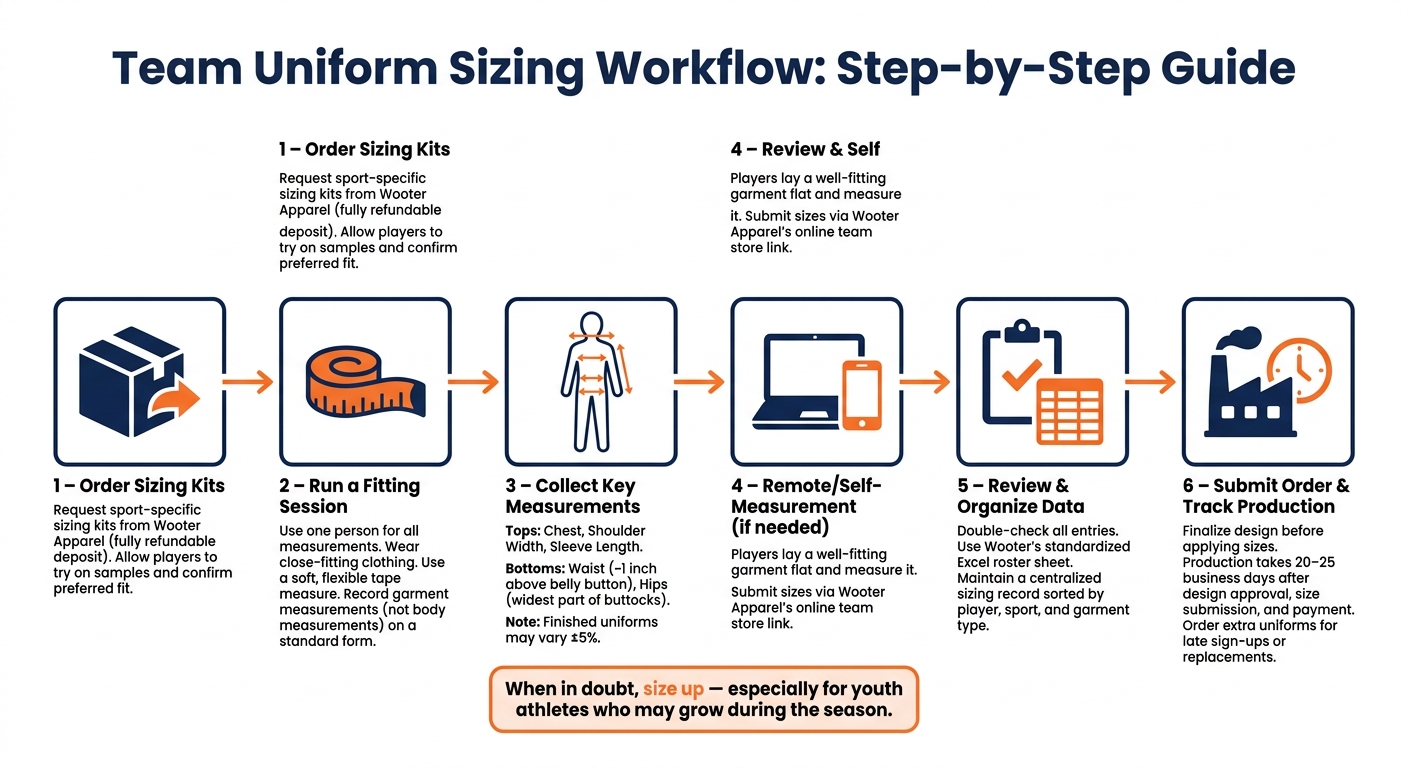
Team Uniform Sizing Workflow: Step-by-Step Guide
Getting the right roster size isn’t just about crunching numbers – it’s about ensuring every athlete ends up with a uniform that fits perfectly. A well-organized, repeatable process minimizes mistakes and guarantees a better experience for everyone involved.
How to Run a Team Fitting Session
The gold standard for accurate sizing is an in-person fitting session. Start by ordering sport-specific sizing kits ahead of time so players can try on samples and confirm their preferred fit. Use the same person to take measurements for consistency and stick to a standard measurement form for all players. Always record garment measurements on the form, keeping in mind that finished dimensions can vary slightly (by up to +/- 5%).
Once all measurements are collected, double-check the entries before submitting the order. This is especially important since custom sublimated uniforms are non-returnable and non-exchangeable. A careful review can save a lot of headaches later.
Remote and Self-Measurement Options
If an in-person session isn’t possible, self-measurement is the next best option. Players should start with a similar garment that fits well, lay it flat, and measure it according to the provided sizing chart diagrams. This ensures accuracy even when fittings can’t happen face-to-face.
Wooter Apparel simplifies this process with online team stores. These platforms allow players or parents to input their names, sizes, and payment details directly through a shared link. This not only cuts down on errors but also makes the overall process easier to manage.
Tracking and Updating Player Sizing Data
Once measurements are collected, keeping them organized is key to avoiding future issues. Maintaining a centralized sizing record – sorted by player, sport, and garment type – streamlines reorders and reduces errors. Wooter Apparel’s platform supports this by letting teams manage rosters and orders in one place, eliminating the need for spreadsheets.
It’s also important to update records regularly. Changes in position, growth spurts, or feedback about fit can all influence sizing needs. For youth programs especially, sizes can shift significantly between seasons. To stay prepared, order a few extra uniforms during the initial production run. This makes it easier to accommodate late sign-ups or mid-season replacements without starting a new production cycle, which typically takes 20–25 business days after design approval, size submission, and payment are finalized.
Custom Tailoring and Design Adjustments
Once your team’s sizing data is finalized, the next step is ensuring every uniform fits like a glove while maintaining a seamless team look.
Fit and Style Adjustments Through Custom Design
With precise sizing data in place, Wooter Apparel’s sublimation process ensures every uniform fits perfectly while preserving the team’s unified appearance. Since the design is embedded directly into the fabric, colors, logos, and patterns remain consistent across all cuts – whether it’s men’s, women’s, or youth uniforms. This means players in different styles can stand together, showcasing a cohesive visual identity.
Fit preferences are addressed during the design phase. For example, some players may prefer a snug fit for compression gear, while others might want a looser cut for warmup jackets. Wooter Apparel’s design team can handle these customizations, ensuring every player gets what they need without compromising the team’s overall look. This approach balances individual comfort with a polished team appearance.
Keeping Team Aesthetics Consistent While Fitting Individuals
Even with personalized fit preferences, maintaining a unified team aesthetic is crucial. The process starts by finalizing the design before applying individual sizes. Digital mockups confirm that all design elements are accurate before production begins. From there, personalized touches like names and numbers are added, ensuring that every uniform fits well while still contributing to the team’s cohesive image.
Fixing Common Fit Problems
Despite careful measurements, occasional fit issues can crop up. Below is a quick guide to some common challenges and how to address them:
| Fit Issue | Likely Cause | Practical Fix |
|---|---|---|
| Tightness or restricted movement | Between sizes; heavy patches on stretch zones | Choose a larger size; minimize heavy embroidery in stretch areas |
| General looseness | Sizing runs large; body measurements used instead of garment dimensions | Measure a well-fitting garment flat instead of using body measurements |
| Waist inconsistency | Unique body proportions | Opt for adjustable features like elastic waistbands |
| Shrinkage over time | Improper washing | Wash in cold water; hang dry or use low heat settings |
When in doubt, it’s better to size up – especially for youth players who might grow during the season.
"If someone is between sizes, choose the option that supports movement and comfort, especially for youth players who may grow during the season." – Wooter Apparel
This approach ensures that every player feels comfortable and confident in their uniform while keeping the team’s overall look sharp and consistent.
Conclusion: Getting the Right Fit for Every Player
Achieving a perfect uniform fit starts with accurate measurements, the right tools, and understanding each player’s unique shape and needs.
A well-fitted uniform doesn’t just look good – it enhances performance and boosts confidence. As highlighted earlier, precise measurements and tools are essential. Take it from Alex A., a Verified Reviewer, who shared, "Most comfortable uniforms my players had," or Feazel L., a Verified Buyer, who noted, "The players loved the uniforms. Everywhere we play people talk about our uniforms."
Wooter Apparel makes the process easier with physical sizing kits, offered with a fully refundable deposit, and sport-specific size charts tailored to different garments, like basketball jerseys, pro football jerseys, or baseball pants. To avoid production mishaps, their standardized Excel roster sheets help keep everything – from player names to sizes – well-organized.
Wooter uniforms are designed to run true to size, with stretchy, flexible fabric for added comfort. If you’re unsure about sizing, especially for growing youth athletes, it’s a good idea to go slightly larger.
FAQs
Should we use body measurements or garment measurements?
Wooter Apparel suggests using body measurements to determine the right uniform size. Their sizing charts are based on the actual dimensions of the uniforms, so taking the player’s measurements helps ensure a good fit. Since the uniforms are designed with a slightly looser fit and made from stretchy, flexible fabric, there’s some leeway for adjustments when sizing.
What should we do if a player is between sizes?
If a player falls between standard sizes, exploring custom sizing options can make all the difference. Custom uniforms are crafted to prioritize both comfort and performance. Take a look at Wooter’s sizing charts and consider going for a custom fit instead of settling for the nearest standard size to ensure the best possible outcome.
How can we size accurately without an in-person fitting?
To get the right size, take precise measurements of areas like the chest, waist, and hips, then compare them to Wooter Apparel’s sizing charts. Their uniforms are made with a bit of flexibility, so aligning your measurements closely will help you achieve a great fit. For added accuracy, you can request sizing kits to double-check before placing an order. If you’re unsure, Wooter’s support team is ready to help you find the perfect fit, even without an in-person fitting.