
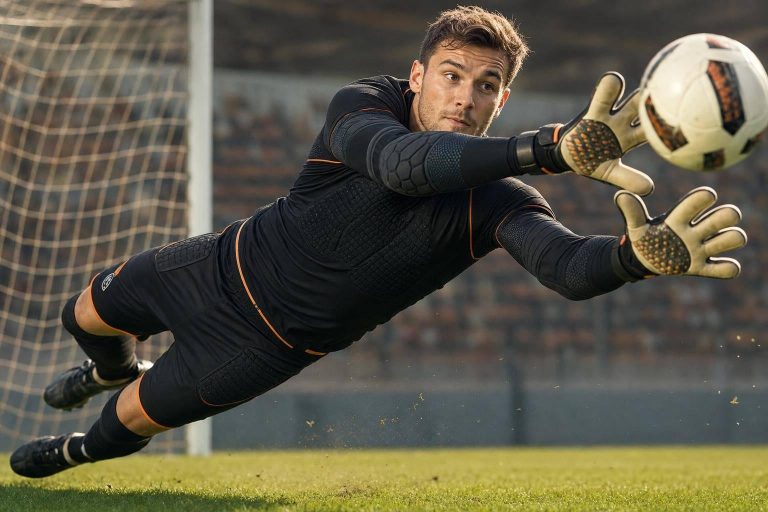
More padding does not always mean better play. From what I see in the article, the best setup is padding in key impact spots – mainly the elbows, chest, forearms, hips, and hands – while keeping the rest of the kit light.
If you want the short answer, here it is:
- Padding helps reduce contact stress in the areas goalkeepers hit most.
- Too much bulk can limit movement, especially on dives, reaches, and torso turns.
- Heat and sweat matter because foam and tight gear can feel heavier over 90 minutes.
- Fit and fabric matter almost as much as the padding itself.
- The best option for most keepers is targeted padding, not full bulk coverage.
I’d sum it up like this: use protection where you hit the ground most, and keep everything else lean. That gives you a better balance between impact protection, motion, and comfort.
A few points stand out:
- Elbow and chest padding help with repeated contact on dives
- Padded shorts add hip protection on side landings
- Gloves focus on grip, finger support, and hand impact control
- Breathable, moisture-wicking fabrics help with heat and sweat
- Low-profile designs tend to interfere less with reaction play
Why Goalkeepers Need Hip Protection During Training
sbb-itb-4d95ad3
Quick Comparison
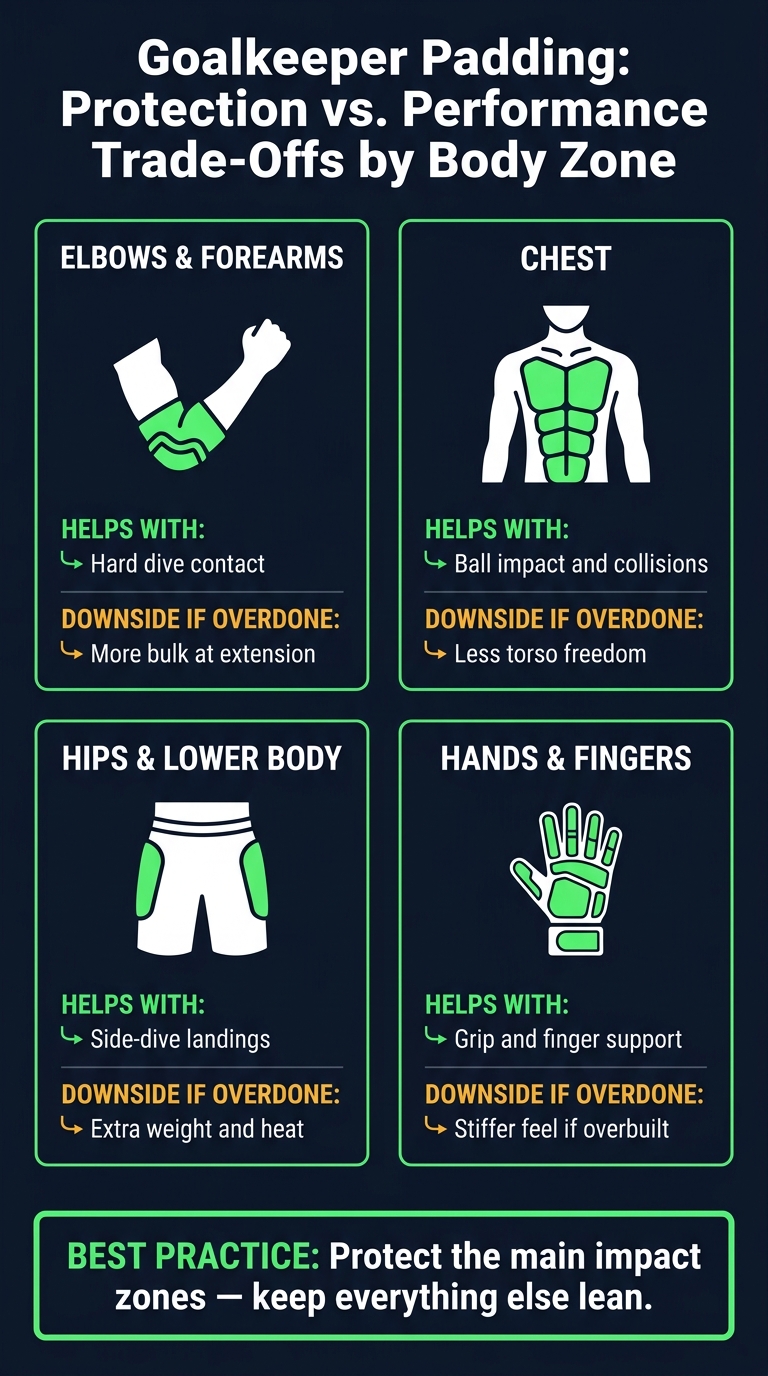
Goalkeeper Padding: Protection vs. Performance Trade-Offs by Body Zone
| Area | What padding helps with | Main downside if overdone |
|---|---|---|
| Elbows/Forearms | Hard dive contact | More bulk at extension |
| Chest | Ball impact and collisions | Less torso freedom |
| Hips/Lower body | Side-dive landings | Extra weight and heat |
| Hands/Fingers | Grip and finger support | Stiffer feel if overbuilt |
For me, the article’s message is simple: goalkeeper padding works best when it protects the main impact zones without slowing movement or trapping too much heat.
Safety: What Studies Say About Injury Reduction
Research looks at a simple idea: which padded areas take the hardest hits. For goalkeepers, that usually means protection around the elbows, chest, forearms, hands, fingers, hips, and lower body.
Padded Shorts and Hip Protection
Padded shorts help protect the hips and lower body during side dives.
Gloves, Headgear, and Other Protective Accessories
Goalkeeper gloves are one of the main protective accessories. Many pairs focus on three things: grip, finger support, and impact protection. Headgear adds another layer for the head, especially during aerial challenges and collisions.
Comparison Table: Padding Type, Body Area, and Protection Focus
| Padding Type | Target Body Area | Key Protection Focus |
|---|---|---|
| Jersey Padding | Elbows, Chest, Forearms | Impact protection while preserving movement |
| Gloves | Hands, Fingers, Palms | Grip, finger support, and impact protection |
| Shorts | Hips, Lower Body | Side-dive protection |
| Headgear | Head | Impact protection during aerial challenges and collisions |
That trade-off matters. Padding only helps if it protects the keeper without slowing dives or recovery, which the next section looks at.
Performance: Mobility, Reaction Speed, and Movement Mechanics
The big issue is simple: does added protection change how a goalkeeper moves?
Padding is there to protect the body. But if it adds too much bulk or stiffness, it can get in the way. That’s why modern goalkeeper gear leans on targeted padding in high-impact areas, paired with lightweight, moisture-wicking fabrics that help cut garment weight and support agile movement during a match.
What matters most is the balance: how much padding you use, where it sits, and what that costs in terms of movement.
What Biomechanics Studies Show
Biomechanics studies lean toward low-profile padding that protects impact zones without limiting motion in the shoulders, elbows, or torso.
That makes sense in practice. A goalkeeper needs to dive, reach, twist, and recover in one fluid chain of movement. If padding gets in the way of even one part of that chain, reaction play can feel a half-step slower.
Protection Versus Agility Trade-Offs
There’s a clear trade-off here. Thicker padding can help with impact protection, but it can also limit arm extension on dives and reduce torso rotation.
In plain terms, more protection can sometimes mean less freedom. And for goalkeepers, that freedom matters. A shirt that feels fine standing still can feel very different when you’re stretching full length to push a shot around the post.
Comparison Table: Design Features and Performance Trade-Offs
| Design Feature | Performance Effect | Trade-Off | Evidence Type |
|---|---|---|---|
| Reinforced Elbow Padding | Impact protection during dives | Adds bulk if not ergonomically shaped | Design insight |
| Chest Padding | Protection against high-velocity impacts | Can restrict torso flexibility if too thick | Design insight |
| Lightweight Fabrics | Improved agility and reduced fatigue | Potential trade-off in long-term durability | Biomechanics/design finding |
| Slim/Ergonomic Cut | Reduces wind resistance; keeps padding in place | May feel restrictive if sizing is off | Design insight |
| Modular Padding Systems | Customizable protection for training vs. match play | More complex for team equipment managers | Biomechanics/design finding |
Those same fit choices also affect heat management and how comfortable the gear feels over a full match.
Comfort and Wearability: Heat, Fit, and Material Choice
After protection and mobility, comfort is what decides if padded gear still feels usable by the end of a full match. If the fit is off or the fabric runs hot, focus can slip fast. And once that happens, even solid padding starts to feel like a problem instead of help.
Breathability and Heat Management
The biggest comfort issue with padded goalkeeper gear is heat retention. Padding, especially foam, tends to hold warmth close to the body. As sweat builds up, the gear can also feel heavier over time.
That’s why modern long sleeve soccer jerseys often use mesh panels and compression fits. The goal is simple: keep the padding in place while still letting air move through the garment. Lightweight, moisture-wicking fabrics also help gear feel easier to wear during high-intensity play.
Fit matters just as much as padding thickness. For futsal or turf, slim padding usually works better because it cuts down on bulk without getting in the way.
Material Testing: Foam, Shell Fabrics, and Fit
Material choice shapes both heat buildup and how impact feels on contact. Reinforced foam can provide strong impact protection, but it may hold heat if it isn’t perforated. Lightweight fabrics like recycled polyester help with moisture management and are showing up more often in performance kits.
Most comfort differences come down to three things:
- padding density
- shell fabric
- fit
Comparison Table: Materials, Comfort Traits, and Durability
| Material/Feature | Comfort & Breathability | Protection Level | Best-Use Setting |
|---|---|---|---|
| Reinforced Foam Padding | Moderate; can retain heat if not perforated | High | Hard ground, turf, or high-impact training |
| Recycled Polyester | High; standard moisture management | Low; supports moisture control | Training kits and eco-conscious teams |
| Lightweight Moisture-Wicking Fabrics | High; breathable during high-intensity play | Low; supports moisture control | High-intensity outdoor and indoor matches |
| Compression Fit Construction | High; reduces chafing and keeps padding stable | Moderate | All-weather play |
Conclusion: What Teams Should Take From the Research
When you weigh safety, mobility, and comfort together, the research lands on one clear rule: targeted padding works better than all-over padding. The main trade-off is protection versus agility. Put padding in the right spots, and you improve that balance. Add bulk where it isn’t needed, and movement suffers without much upside.
Key Findings for Coaches, Players, and Equipment Managers
The biggest takeaway is simple: there isn’t one padding setup that works for every case. Surface type and climate change the equation. A keeper playing in hot weather on a hard field needs gear that’s different from what works in a cooler, controlled setting.
Across most situations, three priorities keep showing up:
- Protect the areas that take repeated contact, not every possible impact zone: Reinforced padding at the elbows and chest helps cover the main points of contact while still letting the arms and torso move well.
- Match fabrics to heat and sweat levels: Lightweight, moisture-wicking fabrics help limit heat buildup during hot, high-intensity play. That matters even more when temperature and surface conditions shift.
- Avoid unnecessary bulk: Extra bulk hurts performance.
Custom team uniform design gives teams more control over padding placement, fabric weight, and fit.
For teams, this is a practical choice, not a theory exercise: put padding where impact happens most, and keep the rest of the kit lean.
FAQs
How much padding is too much for a goalkeeper?
Padding becomes too much when it feels bulky, limits movement, or slides around during play. The best modern goalkeeper uniforms use targeted padding in key spots like the elbows and chest, giving you impact protection without making the kit feel heavy or hot.
Fit matters just as much as the padding itself. A snug fit helps keep everything in place. If the padding is loose or the uniform fits poorly, it can shift on contact and leave joints or other exposed areas less protected.
Which padded areas matter most during dives?
During goalkeeper dives, the areas that need the most protection are the elbows, chest, and forearms.
Modern goalkeeper uniforms add reinforced padding in these key spots to help absorb impact without adding extra bulk that can limit movement.
How does padding affect heat and movement?
Modern goalkeeper padding is built to give players impact protection where it matters most without getting in the way of movement. Light, high-density padding and body-aware designs help shield areas like the chest and elbows while still letting keepers dive, stretch, and react freely.
These garments are also made to help with comfort during play. Moisture-wicking, breathable fabrics improve airflow and help sweat evaporate, which cuts down on heat buildup and helps players stay cool, comfortable, and mobile throughout the match.