
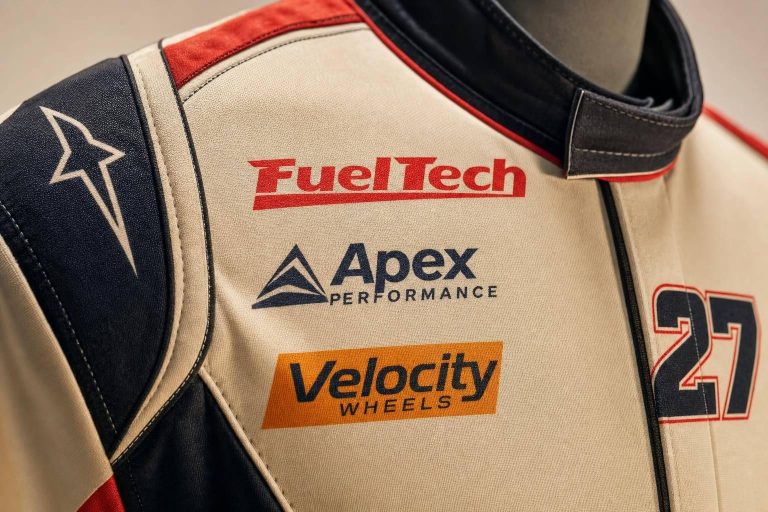
If you want motorsport uniforms that stay light, flexible, and sharp-looking, sublimation is often the best fit. I’d sum it up like this: sublimation bonds color into polyester at about 400°F, helps graphics last through 50+ washes, and avoids the stiff, heavy feel that comes with surface prints.
Here’s the short version:
- Sublimation puts dye inside polyester fibers, not on top of the fabric.
- That means no cracking, peeling, or heavy print layer.
- It helps uniforms stay light, breathable, and easy to move in.
- It works well for karting suits and non-fire-rated teamwear.
- It can also be used on some FIA/SFI-certified driver suits, but only when the exact suit model is approved to that rule set.
- It is less suitable when the fabric or garment does not meet required race safety standards.
If I compare the main motorsport uniform types, the difference is simple: driver suits are ruled by fire-safety approval, karting gear is more about abrasion and wear, and teamwear is mostly about comfort, look, and sponsor display.
Quick Comparison
| Uniform type | Main need | Where sublimation fits |
|---|---|---|
| FIA/SFI driver suits | Fire protection and race approval | Works only on approved certified suit builds |
| Karting suits | Wear resistance and full graphics | Strong fit for bold, full-garment designs |
| Teamwear | Comfort, branding, and repeated washing | Strong fit for polos, pit shirts, and fan gear |
I see the main point as simple: sublimation improves comfort, wear life, and sponsor clarity, but safety approval still comes first for race suits.
Sublimation Technology and Motorsport Material Limits
That same dye bond sets the material limits of motorsport sublimation. With sublimation, heat bonds dye into polyester, so the color becomes part of the fabric instead of sitting on top of it. In motorsport, that makes fabric choice a big deal.
Sublimation works only on polyester-rich fabrics, usually at least 65% polyester, and most motorsport gear uses 91% to 100% polyester. Cotton and other natural fibers won’t bond the right way. That matters most with driver suits, where weight and freedom of movement can affect performance.
How Dye Bonding Affects Fabric Feel and Flex
Because there’s no ink layer on the surface, the fabric keeps its natural softness and stretch. You don’t get stiff patches, rubbery spots, or extra bulk. Sublimation adds zero weight or thickness to the garment.
That difference shows up on the scale, too. A sublimated size-L suit weighs about 1.35 kg, compared with about 1.6 kg for an embroidered version.
FIA and SFI Rules for Driver Suits
Certified driver suits must meet FIA 8856-2018 or SFI 3.4/5 rules. These standards govern fire resistance, which means sublimation can only be used on approved suit constructions.
Beltenick‘s RSN-700 (FIA 8856-2018) and RS-08 (SFI 3.4/5) are examples of certified suits that use sublimated graphics without affecting their protective ratings. When you order a driver suit, check that the exact model is certified to the right standard. If sublimation is used on non-certified fire-resistant material, the suit will not qualify for competition use.
For pit crew shirts and mechanics’ polos, standard polyester blends work well and don’t face certification limits.
sbb-itb-4d95ad3
Durability and Wear Resistance of Sublimated Graphics
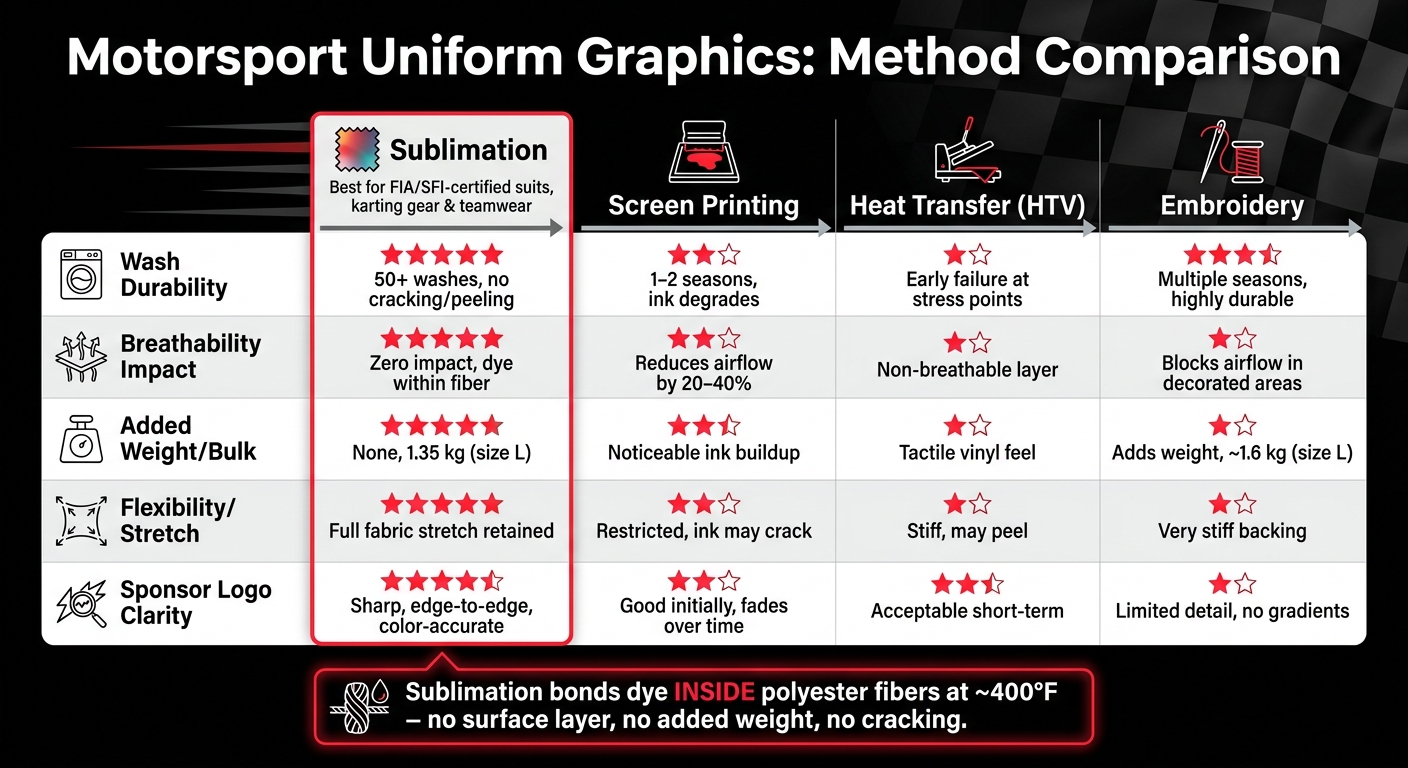
Sublimation vs. Screen Printing vs. Embroidery: Motorsport Uniform Graphics Compared
Sublimated graphics last because the dye bonds inside the polyester fiber. There’s no top layer sitting on the fabric, so there’s nothing to crack or peel off later.
That’s a big deal in motorsport. Harness straps rub. Drivers slide in and out of seats. Suits get washed often. All of that puts graphics under steady stress. With sublimation, uniforms can keep a clean, sharp look on the grid and in the paddock even with heavy use. Care is simple too, although direct sun can still fade colors over time.
How Sublimation Holds Up Through Washing, Friction, and Sun
High-quality sublimated graphics can keep sharp color through 50+ wash cycles without cracking, peeling, or fading. To help them last longer, wash in cold water, skip bleach and fabric softener, and air-dry in the shade.
Sublimated vs. Screen-Printed vs. Embroidered Graphics
The table below compares durability by graphic method.
| Graphic Method | Common Failure Modes | Response to Repeated Washing | UV & Chemical Sensitivity | Likely Service Life |
|---|---|---|---|---|
| Sublimation | Fabric wear-through; artwork usually outlasts the garment | Permanent; no cracking, peeling, or fading | High resistance; colors are locked inside the fibers | Multiple seasons; 50+ washes |
| Screen Printing | Cracking, flaking, and fading over time | Ink layer can degrade, especially on stretch fabrics | Moderate; surface ink can fade in sun | 1–2 seasons |
| Heat Transfer (HTV) | Peeling at edges; delamination along fold lines | Adhesive bond weakens with repeated cycles | Sensitive to high heat and harsh cleaners | Short-term; prone to early failure at stress points |
| Embroidery | Thread fraying; fabric puckering | Excellent; stitching is highly durable | High; thread colors generally stable | Multiple seasons; adds weight and stiffness |
Once durability is covered, the next issue is whether a print method also keeps breathability and driver comfort intact.
Thermal Performance, Breathability, and Driver Comfort
Durability matters. But in racing, comfort often comes down to a simpler issue: does the graphic method make the suit hotter or stiffer?
Motorsport cockpits can climb past 100°F during a race. At that point, every layer matters. Airflow is limited, sweat builds up fast, and the way a logo or graphic is added to the fabric can change how the suit feels against the driver.
What Textile Research Says About Heat and Moisture
Screen printing and heat transfer vinyl sit on top of the fabric like a layer of film. That surface layer can hold heat and slow sweat evaporation. On technical knit fabrics, heavy screen-printed ink deposits can cut breathability by 20% to 40%.
Sublimation works differently. The dye bonds inside the fiber instead of sitting on top of it. So the fabric keeps its original structure and airflow. There’s no film, no sealed surface, and no blocked pores. That matters because moisture-wicking depends on that open structure to do its job.
Print Methods Compared for Breathability and Comfort
The comparison below shows why sublimation stays closest to bare fabric in race conditions.
| Feature | Sublimation | Screen Printing | Heat Transfer (Vinyl) | Embroidery |
|---|---|---|---|---|
| Breathability Impact | Zero; dye is within the fiber | Reduces airflow | Creates a non-breathable layer | Blocks airflow in decorated areas |
| Added Bulk/Weight | None; design is infused into the fiber | Noticeable ink buildup | Tactile "vinyl" feel | Adds noticeable weight |
| Flexibility | Full fabric stretch retained | Restricted; ink may crack under tension | Stiff; may peel | Very stiff backing materials |
| Thermal Effect | No heat trapping | Can create localized "heat patches" | Traps heat under the film | Adds insulation and bulk |
| Driver Comfort | High; feels like unprinted fabric | Moderate; can feel rubbery or stiff | Low; can feel sticky or stiff | Low; can cause chafing |
Flexibility matters more than people think. It affects steering feel, pedal input, and how easily a driver can get out of a tight cockpit in a hurry. Stiff ink patches or embroidery backing can limit movement in ways that show up at the worst time.
That’s why placement matters too. In underarms and joint panels, avoiding surface-applied graphics helps cut heat buildup and keeps movement free where drivers need it most.
There’s also a branding upside. A smooth printed surface helps sponsor graphics look sharp on teamwear, without the bulk or stiffness that comes with other methods.
Visual Clarity, Sponsor Placement, and Teamwear Use
That same low-profile build helps teams keep sponsor graphics clean and easy to read. It’s not just about comfort or wear life. Sublimation also helps with sponsor visibility and a consistent look across the whole team. Because the surface stays smooth and light, artwork, gradients, and small design details come through clearly.
Design Benefits for Sponsors and On-Track Visibility
Sponsor logos need to stay sharp in broadcast shots and social posts all season.
First, color accuracy. Sublimation keeps sponsor colors consistent across different garment types, which helps teams maintain one clear visual identity.
Second, placement flexibility. Sublimation can cover the entire garment, seam to seam. That gives teams more room to place primary sponsors on the chest and back, while putting secondary partners on sleeves, collars, or lower panels.
Third, long-term clarity. Sublimated graphics are embedded into the fibers, so they don’t crack, peel, or fade like surface-applied graphics can. High-quality sublimated designs can stay bright through 50 or more washes, helping teams keep a polished look over the full season.
The table below shows how common teamwear goals line up with what sublimation delivers:
| Design goal | How sublimation helps | Motorsport use case |
|---|---|---|
| Number legibility | High-contrast, integrated graphics with no raised layer | Driver crew tops, mechanic shirts, role-labeled teamwear |
| Small-detail logo reproduction | Vector-based artwork preserves fine lines and small text | Sponsor marks, badge logos, technical labels |
| Visual identity across teamwear | Pantone matching and edge-to-edge coverage keep garments coordinated | Full paddock and event staff kits |
Teams often use sublimation to match apparel graphics with car livery and sponsor identity. 2 Seas Motorsport, for example, uses fully sublimated teamwear to match paddock apparel to car livery, with primary sponsor placements designed to be readable in photography from 5 meters away.
Where Wooter Apparel Fits
For paddock polos, warmup gear, and crew apparel, fully sublimated designs help keep the entire team looking aligned. Wooter Apparel offers fully sublimated custom team uniforms and apparel that support the clean, professional look motorsport teams need throughout the season.
Conclusion: Why Sublimation Works Well for Motorsport Uniforms
The research points to one clear takeaway: sublimation locks graphics into polyester instead of sitting on top of the fabric.
That matters more than it might seem. It helps keep uniforms light, flexible, and easier to wear in hot conditions.
For certified driver suits, sublimation also works well with fire-rated construction because it doesn’t add a stiff outer layer. And high-quality sublimated designs can last through 50+ washes without visible cracking, peeling, or fading.
For motorsport teams, that means graphics that last, sponsor logos that stay sharp, and gear that fits the demands of movement. In plain terms, it gives teams one uniform system for drivers, crew, and sponsor presentation.
FAQs
Can all motorsport uniforms be sublimated?
No. Sublimation works best on polyester because heat opens the fibers, which lets the dye sink in deep.
For the best results, Wooter Apparel recommends 100% polyester. Blends with at least 65% polyester can also work, though the print may not come out as strong. Cotton and other natural fibers are not a good fit for this process.
How do I know if a sublimated driver suit is race legal?
Check that the suit meets the homologation standards your racing series or governing body requires. Look for labels such as FIA 8856-2018 or SFI 3.4/5.
It also helps to confirm that the manufacturer clearly says the suit meets those rules. Then double-check your series’ official rulebook to make sure the suit matches the standards for your competition class.
Does sublimation affect cooling or comfort in hot races?
Yes. Sublimated designs can help with cooling and comfort in hot races because the dye is infused into polyester fibers instead of sitting on top as a heavy layer.
That means the fabric can keep its natural breathability and moisture-wicking performance. In plain English, air moves through the material more easily, sweat can evaporate better, and drivers and pit crews stay cooler, drier, and more focused.