
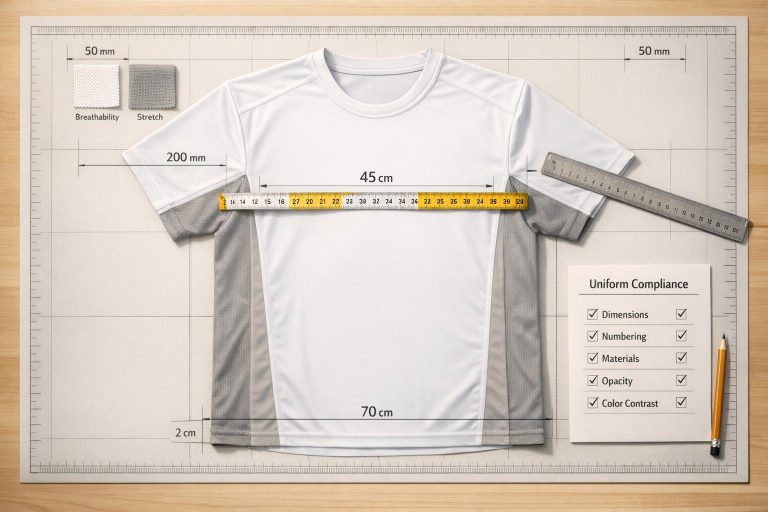
Non-compliance with uniform standards can disqualify athletes from global competitions. Here’s what you need to know:
- Federation rules vary by sport: FIFA, World Athletics, and IFSC have specific requirements for uniforms, including logo sizes, material standards, and design elements.
- Logos and trademarks: Placement and size must meet strict specifications to avoid penalties.
- Material matters: Approved fabrics enhance performance and durability.
- Design approval: Early collaboration with officials ensures uniforms meet all guidelines.
Key takeaway: Start designing early, follow the rules closely, and test uniforms in real conditions to avoid last-minute issues.
For teams needing support, companies like Wooter Apparel specialize in creating compliant uniforms with fast turnaround times.
Major Sports Federation Uniform Rules
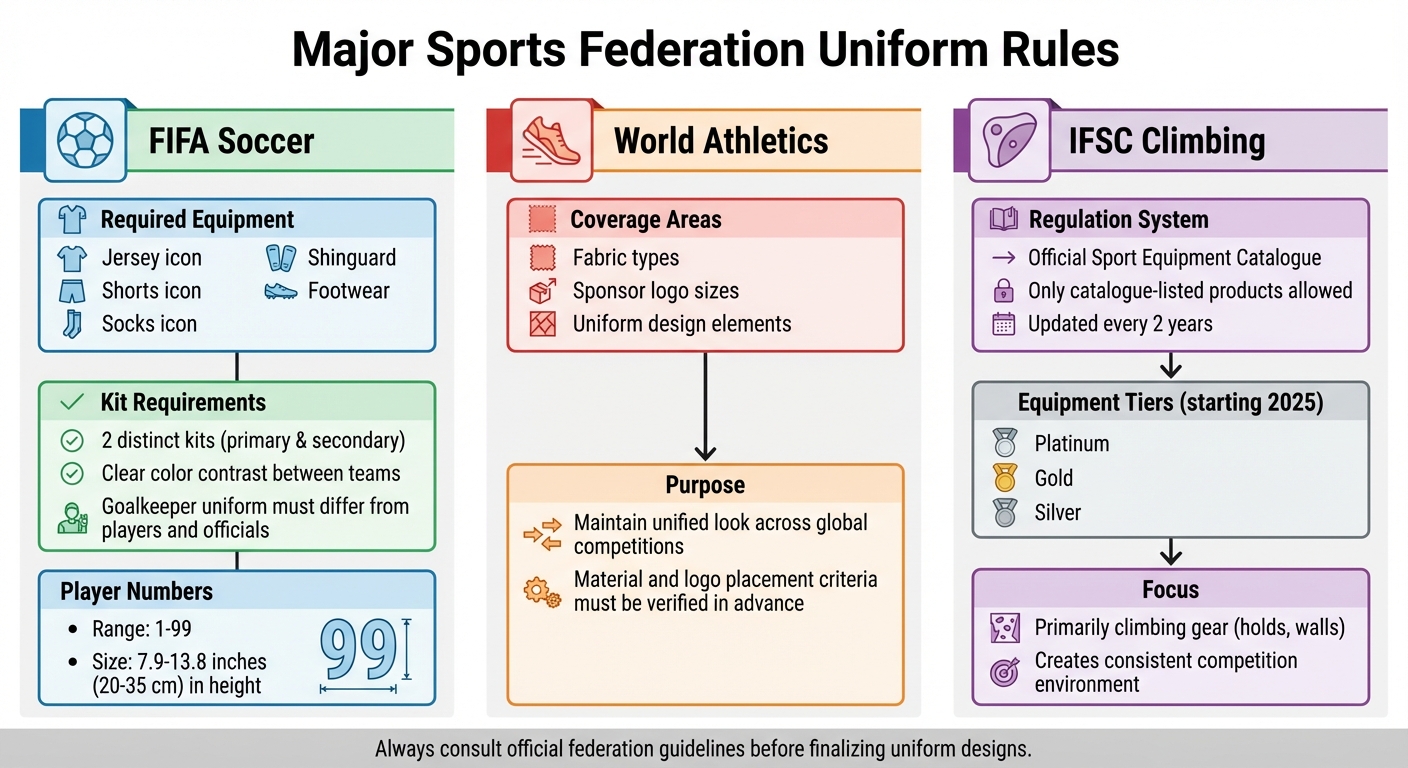
International Sports Federation Uniform Requirements Comparison Chart
Each international sports federation has its own set of uniform guidelines. Knowing these rules in advance is crucial to ensure your team complies with all technical requirements and avoids any risk of disqualification. Below are the uniform requirements for three prominent federations.
FIFA Soccer Uniform Requirements
FIFA mandates specific equipment for all players. The essential items include a jersey or shirt with sleeves, shorts, socks (stockings), shinguards, and footwear. Teams are required to have two distinct kits – primary and secondary – to ensure clear color contrast, especially when facing opponents with similar colors. Goalkeepers must wear uniforms that set them apart from both field players and match officials.
Player numbers must also adhere to strict rules. Jerseys must display numbers between 1 and 99, with the size ranging from 7.9 to 13.8 inches (20–35 cm) in height to allow for quick identification.
World Athletics Apparel Rules

Track and field athletes must follow World Athletics guidelines, which cover everything from fabric types to sponsor logo sizes and uniform design elements. These standards are in place to maintain a unified look across global competitions. Athletes should verify their uniforms meet the required material and logo placement criteria well in advance to avoid any last-minute complications.
IFSC Climbing Uniform Requirements
The International Federation of Sport Climbing (IFSC) enforces its uniform and equipment rules through an Official Sport Equipment Catalogue. Only products listed in this catalogue are allowed during competitions.
The catalogue, updated every two years, categorizes equipment into Platinum, Gold, and Silver tiers, ensuring top-tier standards starting in 2025. While these regulations primarily focus on climbing gear like holds and walls, they play a key role in creating a consistent competition environment for international events.
sbb-itb-4d95ad3
Tips for Meeting International Uniform Standards
Creating uniforms that align with international federation requirements involves paying close attention to technical specifications during the design and production process. Below, you’ll find key guidelines to help ensure compliance.
Logo and Trademark Size Limits
International sports federations often have strict rules regarding logo placement and size. For adult uniforms, left-chest logos are typically 3 to 4.5 inches wide, positioned 3–4 inches below the shoulder seam and 4–6 inches from the centerline. Center-chest logos, on the other hand, generally range from 6 to 10 inches wide and should sit 3–4 inches below the collar for balanced visuals. Sleeve logos are usually between 1–4 inches wide and placed 1–3 inches above the hem.
For larger sizes like XL to 4XL, it’s important to scale up logo dimensions to 4.5–5 inches to maintain proportionality. If you’re working with 100% cotton uniforms, consider increasing logo dimensions by 5% to account for shrinkage after washing. Always prepare logos at 300 DPI in CMYK and use vector formats (like SVG) to ensure sharp, scalable printing.
Selecting Approved Materials
Uniform fabrics must meet specific performance standards based on the sport. Approved materials should offer the right balance of elasticity, moisture absorption, and durability to handle the demands of competition. Before full production, conduct wash and stretch tests on sample garments to check for issues like ink adhesion or embroidery puckering.
Different sports require different fabric properties. For instance, track and field athletes benefit from lightweight, breathable materials that allow for a full range of motion, while soccer uniforms must withstand frequent washing and physical contact. Make sure the fabrics you select meet all required standards well in advance of competition deadlines.
Design Approval Process
Creating a compliant uniform involves careful planning and teamwork. Begin by thoroughly researching your federation’s guidelines for colors, logos, and materials. Draft initial sketches that incorporate your team’s identity through thoughtful color combinations and patterns. Share these concepts with key stakeholders, such as coaches and players, to ensure the design aligns with their expectations.
Leverage advanced design software to create 3D visualizations of the uniform, allowing you to make precise adjustments before moving to physical samples. Once samples are produced, test them in real game conditions and gather feedback from athletes to ensure they meet both performance and comfort requirements. Only after these steps should you submit the design for final federation approval and proceed with mass production of custom uniforms.
How Wooter Apparel Supports Uniform Compliance
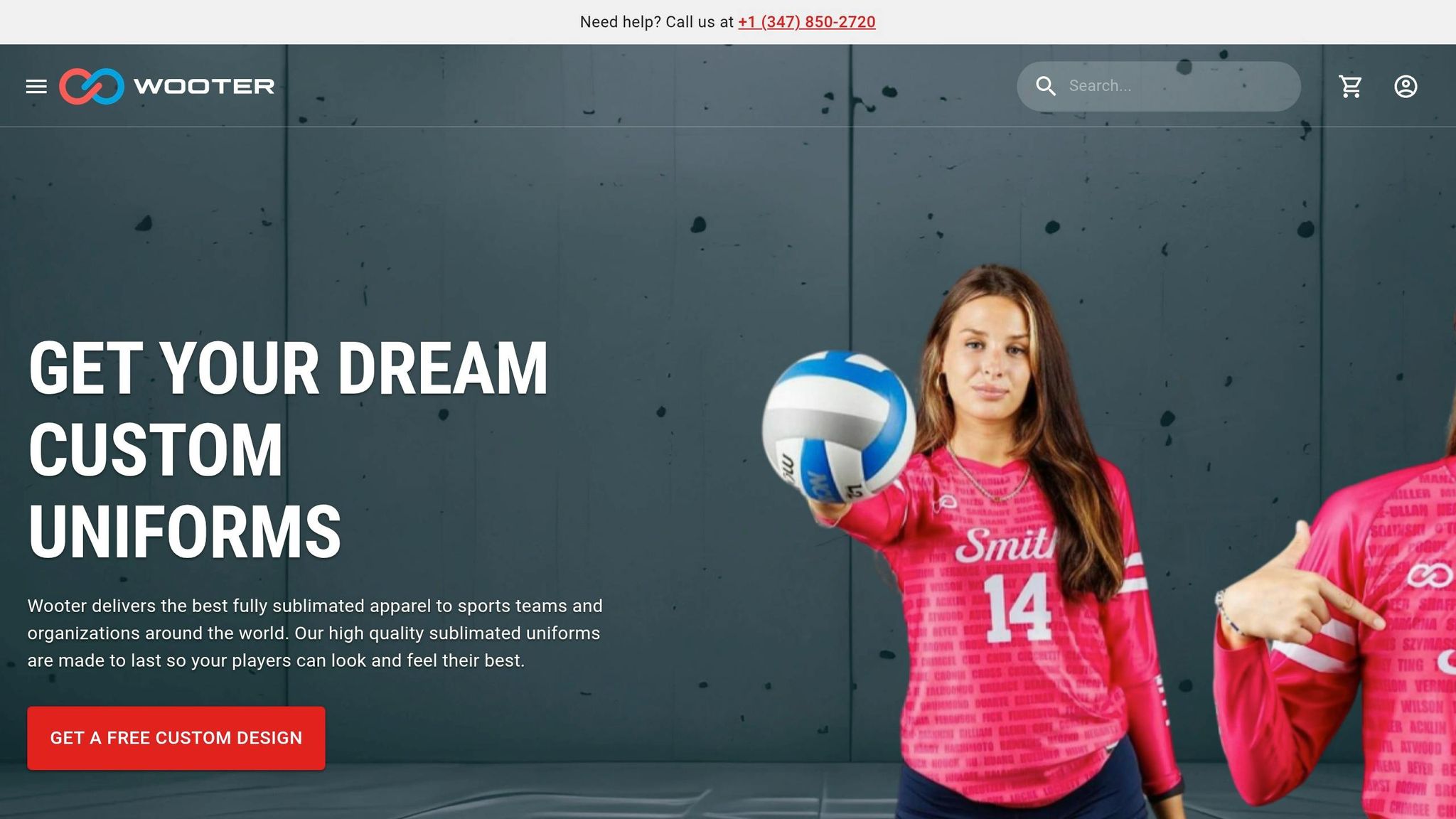
Wooter Apparel provides tailored solutions to ensure your team uniforms align with international standards, building on essential compliance practices.
Custom Designs That Follow Federation Rules
Wooter Apparel offers free custom design services to create uniforms that meet international federation rules. Their design team works directly with the logos and requirements you provide, refining artwork and adjusting layouts to ensure compliance and production readiness. Jared Musolino, Head Designer at Wooter Apparel, describes the process:
"Colors are selected, design elements are accurately placed, logos are measured, numbers and names typed, checked, and checked again, before the garment goes to print."
To guarantee color accuracy, Wooter uses the Pantone Color System, a globally recognized standard for printers. All you need to do is send your logos to their design team, and they’ll handle the rest.
Fully Sublimated Uniforms for All Sports
Wooter utilizes a full sublimation process to produce high-quality uniforms that are both durable and comfortable. Sublimation inks bond directly with the fabric, creating vibrant, fade-resistant designs that withstand over 50 washes. The lightweight polyester material remains soft because the ink does not add any extra layers to the garment.
"Sublimation, a digital printing process, enables unlimited design elements and personalizations – such as names and numbers – in a single print." – Jared Musolino, Head Designer, Wooter Apparel
This technique allows for intricate designs, including gradients and wrap-around details, while maintaining a professional look. Customers consistently praise the uniforms for their "vibrant colors", "amazing material", and "professional look", as reflected in a 4.9-star rating from 1,366 reviews. The sublimation process ensures compliance without compromising style or functionality.
Fast Production and Delivery
Wooter Apparel offers a standard production turnaround of 2–3 weeks (16–25 business days) after final design approval and payment, ensuring teams receive their uniforms well ahead of competition deadlines. For urgent needs, rush production is available in as little as 10 business days for an additional 25% fee.
Shipping is handled worldwide through FedEx and DHL from Wooter’s New York headquarters. To ensure a perfect fit and avoid compliance issues, teams can request Wooter’s 100% refundable sizing kits to measure players before submitting final rosters. Note that international duties and taxes are invoiced separately and are the responsibility of the customer.
Conclusion
Following international uniform standards is critical for ensuring your team’s eligibility in competitive events. Non-compliance can result in disqualification from major competitions like the Olympic Team Trials, making it essential to adhere to the guidelines set by your sport’s international federation. These standards not only promote fairness but also support optimal athletic performance across events. To avoid issues, always consult the official Uniforms Catalogues and Branding Guidelines to confirm logo dimensions, placement rules, and material specifications before finalizing your uniform design.
Wooter Apparel simplifies this process by offering custom football uniforms and free design services that align with federation rules. They handle everything from accurate logo sizing to color matching and layout adjustments, allowing you to focus on training instead of uniform compliance.
Teams can expect production times of 16–25 business days, with a 10-day rush option available for urgent needs. Additionally, working closely with technical officials and reviewing event-specific rules early in the process can help avoid last-minute changes and ensure athletes are easily identifiable by officials and media during competitions.
FAQs
Where can I find my sport’s official uniform rules?
You can find the official uniform rules for your sport in the regulations issued by its international governing body. For instance, FIFA provides Equipment Regulations that detail uniform requirements for soccer. To ensure you have the most accurate and current information, visit the official website of your sport’s federation.
How do I get a uniform design approved before an event?
To ensure your uniform design gets approved, start by checking that it aligns with your league’s specific rules regarding measurements, colors, and styles. Each organization – whether it’s the NBA, NCAA, or FIFA – has its own set of guidelines, so review their regulations carefully. Once your design is finalized, follow the league’s approval process. This might involve submitting the design to officials or uploading it through an official portal. Always wait for confirmation of approval before moving forward with production to avoid any complications during the event.
What tests should we run to confirm fabric and print compliance?
To ensure fabric and print meet required standards, it’s essential to perform tests that assess material quality and print durability. These typically include checks for fabric strength, colorfastness, and print adhesion. Such evaluations confirm that the materials align with safety and performance expectations. For detailed testing methods, refer to ASTM sports standards, which provide specific guidelines for assessing athletic apparel and materials. These tests are critical for verifying that uniforms meet both quality and safety requirements.