
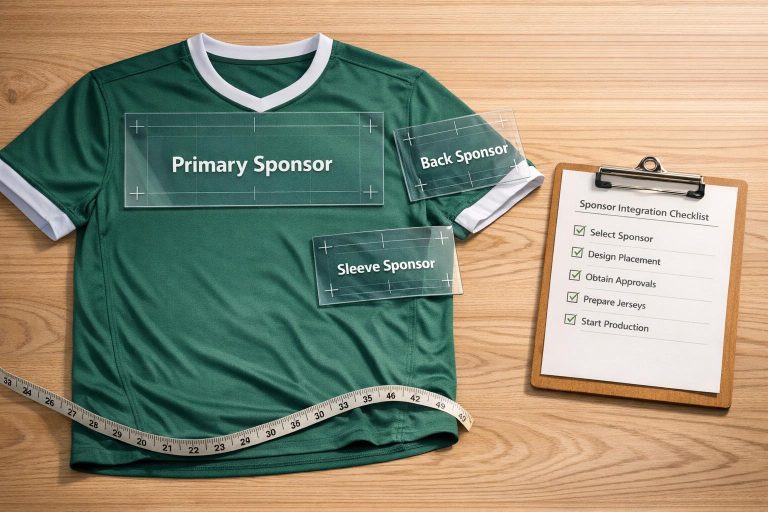
Adding sponsors to soccer jerseys involves careful planning, compliance with rules, and professional execution. Here’s a quick summary of the process:
- Understand League Rules: Check your league’s regulations on logo size, placement, and restrictions on certain industries (e.g., betting or alcohol).
- Define Sponsorship Tiers: Offer clear levels of sponsorship with benefits like logo placement, event involvement, or social media exposure.
- Obtain Jersey Quotes: Get detailed quotes for jerseys, including design, setup fees, and extras for replacements or new players.
- Create a Proposal: Share your team’s story, audience demographics, and mock-ups of logo placements to attract sponsors.
- Tailor Pitches: Customize your approach for each sponsor, aligning with their goals and target audience.
- Negotiate Terms: Finalize logo placement, exclusivity agreements, and performance-based fees.
- Design Approval: Use high-quality sponsor assets and preview the jersey design with all stakeholders.
- Order Jerseys: Use sublimated printing for durable, vibrant designs and plan for extra inventory.
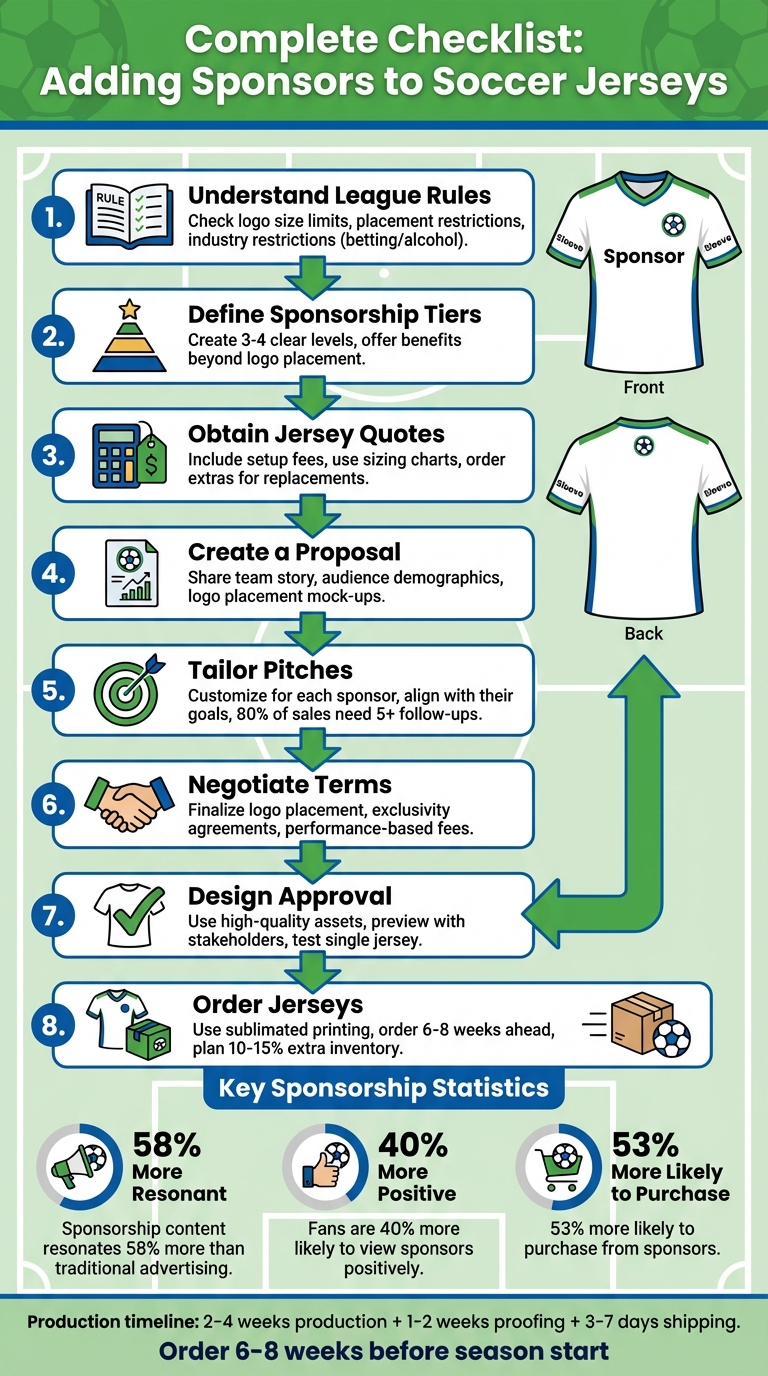
8-Step Process for Adding Sponsors to Soccer Jerseys
Preparation Steps Before Approaching Sponsors
Before reaching out to potential sponsors, it’s crucial to lay a solid foundation. Proper preparation ensures your proposal is professional, compliant, and appealing to both your team and potential partners.
Review League and Association Rules
Begin by reviewing your league’s rules regarding sponsor logos. Most competition organizers have strict guidelines about where logos can appear on jerseys, including their size and placement on the front, sleeves, and training kits. In some cases, leagues reserve specific areas for their own partnerships. For instance, as part of a 10-year partnership introduced in February 2025, Major League Soccer (MLS) and Apple TV required all 30 clubs to feature an Apple TV sleeve patch on the left sleeve. This means that space is unavailable for team-specific sponsors.
Additionally, check ethical and regulatory guidelines, such as restrictions on sponsorships from certain industries like betting. Be mindful of exclusivity agreements that could conflict with potential sponsors in similar categories. Violating these agreements can result in expensive disputes. Also, confirm whether there are mandatory league patches or other obligations that might reduce the available space for sponsor logos.
Once you’ve clarified these regulations, you can move on to organizing sponsorship tiers.
Define Sponsorship Levels and Benefits
Create clear sponsorship tiers that specify the benefits each sponsor will receive. Instead of generic labels like "Gold/Silver/Bronze", consider using titles that reflect the sponsor’s role, such as "Presenting Partner", "Official Partner", or "Community Partner". Each tier should offer unique benefits, going beyond logo visibility to include deeper involvement in your team’s activities.
Keep the tiers simple, with no more than three or four levels. Research shows that sponsorship content resonates with sports fans 58% more effectively than traditional advertising. Additionally, fans familiar with a sponsor are 40% more likely to view the company positively and 53% more likely to consider purchasing from them.
"Sponsorship levels are not strategy. They are the structure that makes strategy possible." – SponsorCX
After defining these tiers, the next step is obtaining detailed jersey quotes to solidify your proposals.
Get Custom Jersey Quotes
Obtain detailed quotes for custom jerseys that incorporate all necessary design elements, such as player names, numbers, sponsor logos, and club crests. Make sure the quotes include all setup fees and any additional charges for design elements.
Use the supplier’s sizing chart to calculate the exact number of jerseys needed, including extras for new players or replacements. Place orders well ahead of time to avoid delays. Accurate quotes not only help with budgeting but also make your sponsorship proposals more credible.
For teams seeking custom jerseys that integrate sponsorships seamlessly, providers like Wooter Apparel offer free custom designs and extensive customization options, making them a strong option for this process.
sbb-itb-4d95ad3
Securing Sponsorships
After your preparation is complete, it’s time to engage potential sponsors and turn those opportunities into formal agreements. This phase requires professionalism, personalized communication, and clear negotiations to create partnerships that benefit both your team and the sponsor.
Create a Sponsorship Proposal
Think of your proposal as more than just a funding request – it’s an invitation to collaborate. Start by sharing your club’s story, including its history, mission, and values. This helps build an emotional connection with potential sponsors. Include detailed audience demographics, such as age, gender, income level, and location, along with key digital metrics like website traffic and social media engagement.
"An impactful sponsorship proposal goes beyond simply asking for support – it’s a thoughtful invitation to collaborate." – Sara Gundy, Managing Director, The Goods BMC
Be specific about logo placements, such as the front of jerseys, sleeves, training kits, website banners, and social media posts. Front placements typically attract the most interest, followed by raglan sleeve soccer jerseys and training kits. Use data visualizations to present clear ROI projections, and include case studies from previous sponsorships that highlight measurable results. Make sure your proposal looks polished, featuring high-quality images of your team, facilities, and mock-ups of logo placements.
Once your proposal is ready, refine your pitch to align with each sponsor’s unique goals.
Customize Pitches for Each Sponsor
A one-size-fits-all approach won’t cut it. Instead, tailor your pitch to each sponsor’s specific objectives. Avoid generic tiered packages and focus on creating a customized offer that resonates with their goals. Research each potential sponsor to understand their priorities – whether it’s shifting public perception, reaching new markets, or encouraging specific behaviors.
"Tier level sponsorship packages give brands the impression that you don’t really understand what they are trying to accomplish, and if you did, your package would be customized to fit those needs." – Erynn LaFlamme, Winmo
Show how your audience aligns with their target market by highlighting fan demographics that match their customer base. Personalize your outreach by referencing recent milestones, such as new funding or major hires. Persistence is crucial – 80% of sales conversations don’t happen until the fifth follow-up. Use testimonials and performance data from past sponsors to strengthen your case.
The sponsorship landscape is evolving. For example, Premier League sponsorship spending hit a record £1.35 billion for the 2023/24 season. While traditional brand investments have declined, spending by technology and digital brands has grown, indicating these sectors may be more open to your pitch.
Negotiate Terms and Logo Placement
Once a sponsor expresses interest, it’s time to discuss the details. Define logo size and placement, keeping in mind that front positions are the most valuable. Address exclusivity – will the sponsor be the only partner in their industry? Negotiating exclusivity terms, including duration, territory, and category, is essential for protecting both parties’ interests.
Consider performance-based fee structures that tie sponsorship fees to team achievements, like reaching league finals or other milestones. Discuss contingencies for unexpected events, such as reduced stadium capacities or underperformance. Additionally, clarify how player imagery will be used, ensuring compliance with individual player contracts and obligations. These discussions lay the groundwork for a balanced and effective partnership.
Design and Customization of Jerseys
After securing sponsorships and finalizing agreements, the next step is to bring your vision to life through detailed jersey design and customization. This stage ensures your sponsorships are seamlessly integrated into a polished and professional jersey layout.
Select Logo Placement Areas
Start by deciding where each logo will go. The primary logo typically sits about 3–3.5 inches below the collar, with a width of 3–4 inches for maximum visibility. Secondary logos are best placed on the sleeves, limited to a size of 3 inches. For youth jerseys, adjust proportions accordingly – for example, scale back numbers to 6–8 inches versus 8–10 inches for adult jerseys.
If your team operates under UEFA or similar guidelines, keep in mind the restrictions: front-of-shirt sponsor logos can cover up to 200 cm², while sleeve logos are capped at 100 cm² with a maximum height of 12 cm.
Once you’ve mapped out logo placements, ensure you have all sponsor assets that meet your design specifications.
Collect High-Quality Sponsor Assets
To achieve crisp, professional prints, request high-resolution or vector files of sponsor logos. These formats are crucial for ensuring clarity, especially when using printing methods like DTF (Direct to Film), screen printing, or silicone transfers. Durable application is key, as jerseys endure frequent washing and intense use.
"Getting jersey decoration right comes down to heat transfer application, sizing, and formula choice." – 613 Originals
The choice of transfer method should match your jersey fabric. For example, silicone transfers are ideal for sublimated performance fabrics as they prevent dye migration, while DTF transfers are perfect for personalized jerseys or smaller production runs. Always confirm that sponsor assets comply with any content restrictions, such as prohibitions on tobacco or high-alcohol-content branding.
Finalize Design with All Parties
Before production, share a digital preview of the jersey with sponsors, team leaders, and your jersey provider. This step ensures everyone approves details like spelling, logo orientation, color accuracy, and placement. To avoid surprises during production, test a single jersey for adhesion and color consistency.
A practical example: In February 2025, Atlanta United FC unveiled their jersey featuring American Family Insurance as the primary sponsor on the front and Emory Health on the sleeve. This design not only looked professional but also delivered impressive results – generating $2.52 million in social value and 91.5 million impressions across their platforms during the 2025 regular season.
For a smooth process, consider working with providers like Wooter Apparel (https://wooter.com), which offers free custom design services and digital previews. Tools such as T-squares or laser guides can help ensure precise alignment. Getting final approval from all stakeholders sets the stage for a seamless production phase.
Production and Implementation
Once the designs are approved and everyone is on the same page, it’s time to move into production. Here’s how to make sure your jerseys meet both quality expectations and sponsor requirements.
Order Customized Jerseys
Work with a manufacturer that uses fully sublimated printing. This printing method permanently bonds dyes to the fabric, ensuring vibrant colors and durability. It also prevents sponsor logos from cracking, peeling, or fading – even after multiple washes and rigorous gameplay. Before giving the green light, request samples or proofs to verify logo quality, color accuracy, and correct placement.
Keep in mind that custom sublimated jerseys typically take 2-4 weeks for production, plus an additional 1-2 weeks for proofing and 3-7 business days for shipping. To avoid last-minute stress, place your order at least 6-8 weeks before the season starts .
For example, companies like Wooter Apparel (https://wooter.com) offer fully sublimated soccer jerseys and include free custom design services. Their process ensures sponsor logos are integrated seamlessly and provides digital previews and quality checks before production begins.
Plan for Future Needs
Thinking ahead can save you time and money down the road. It’s a good idea to order about 10-15% extra jerseys to account for new players or unexpected needs.
If your sponsorship deals cover multiple years, talk to your manufacturer about ordering additional inventory upfront. This could help you save on reordering costs later. To stay organized, create a jersey inventory system that tracks quantities by size and player. Use a distribution checklist to ensure every player gets the right fit. Finally, store your jerseys in a climate-controlled space to protect the fabric and keep logos looking sharp .
Conclusion
Securing sponsors for your soccer jerseys takes careful planning, skilled negotiation, and a focus on the finer details. Skipping these steps can lead to errors that might compromise the quality of your jerseys or strain sponsor relationships. Clear, well-defined contract terms are essential to avoid potential disputes and ensure everything runs smoothly.
"A well-prepared checklist helps avoid mistakes and ensures your team receives uniforms that are comfortable, durable, and filled with pride." – thesoccerfactory.com
The design and placement of sponsor logos play a big role in shaping how your team is perceived by fans, players, and future sponsors. By following a structured approach, you can create high-quality jerseys that not only look great but also boost your team’s image and maximize sponsor value.
To simplify the process, consider working with experienced providers like Wooter Apparel (https://wooter.com). They specialize in fully sublimated soccer jerseys and offer free custom design services, ensuring sponsor logos are seamlessly integrated and built to last.
FAQs
What should be in a jersey sponsorship contract?
A jersey sponsorship contract needs to spell out the essential terms to avoid confusion and protect both parties. These include the scope of rights, exclusivity clauses, fees, contract duration, and termination conditions. It should also address intellectual property usage, branding guidelines, and any pre-emption rights for future renegotiations. Covering these points ensures clarity and safeguards the interests of everyone involved.
How much should we charge for a jersey sponsor?
The price of a jersey sponsorship varies based on factors like the league, the team’s standing, and how prominently the sponsor’s logo is displayed. For youth or community-level teams, sponsorship fees usually fall between $200 and $2,000. On the other hand, professional teams, such as those in Major League Soccer (MLS), command much higher rates, with top-tier agreements reaching hundreds of thousands or even millions of dollars. To set a fair price, take into account your team’s visibility, the extent of the sponsorship, and the going rates in your local market.
How do we measure sponsor ROI?
To gauge the return on investment (ROI) for sponsorships, focus on key metrics like brand exposure, game visibility, and social media engagement. These indicators give insight into how well the sponsorship is performing.
Here are some specific factors to track:
- Media Impressions: Measure how often the brand is seen across various platforms.
- Audience Interactions: Look at engagement levels, such as likes, shares, and comments on social media.
- Brand Perception: Monitor changes in how the audience views the brand, including any shifts in reputation or alignment with positive values.
Also, consider how the sponsorship contributes to building brand recognition and enhancing the company’s overall reputation. By tracking these elements over time, you can better understand the impact on both market share and audience engagement.