
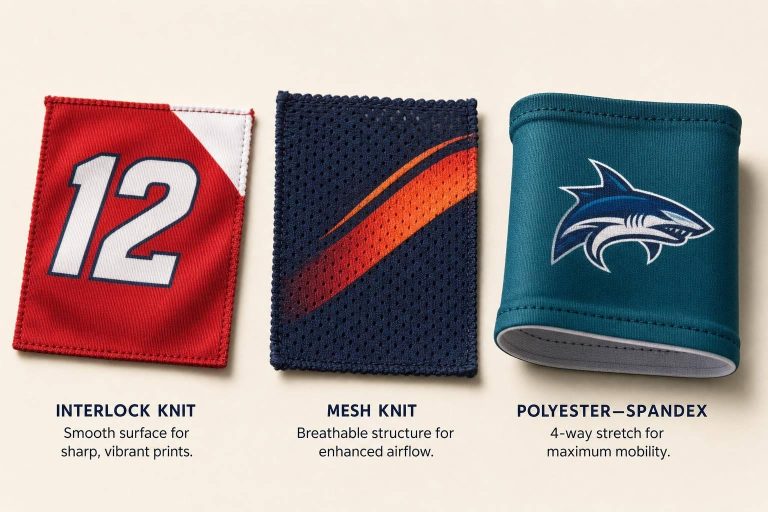
If you want the short answer: polyester interlock is the safest all-around pick, mesh is best for airflow, and polyester–spandex is best for stretch.
I’d choose fabric based on four things first: print sharpness, airflow, stretch, and wear life. In this lineup, interlock gives the cleanest print surface, warp knit adds more movement with a smooth face, mesh and micro-mesh cool better, polyester-spandex gives the closest fit, and nylon-spandex works better for compression pieces than for the main jersey.
A few numbers matter right away:
- 95%+ recovery helps a jersey bounce back instead of staying stretched
- 88% to 90%+ polyester helps sublimation hold color better
- 3x to 5x more airflow is a common upside with mesh-style fabrics
- 200–240 GSM is a strong range for heavier, contact-sport builds
If I were picking fast, I’d use this rule:
- Pick interlock for sharp graphics and rough play
- Pick warp knit for light game jerseys with clean prints
- Pick mesh for hot gyms and max ventilation
- Pick micro-mesh for airflow with a more athletic look
- Pick polyester-spandex for close fit and four-way stretch
- Pick nylon-spandex for base layers, rash guards, or support panels
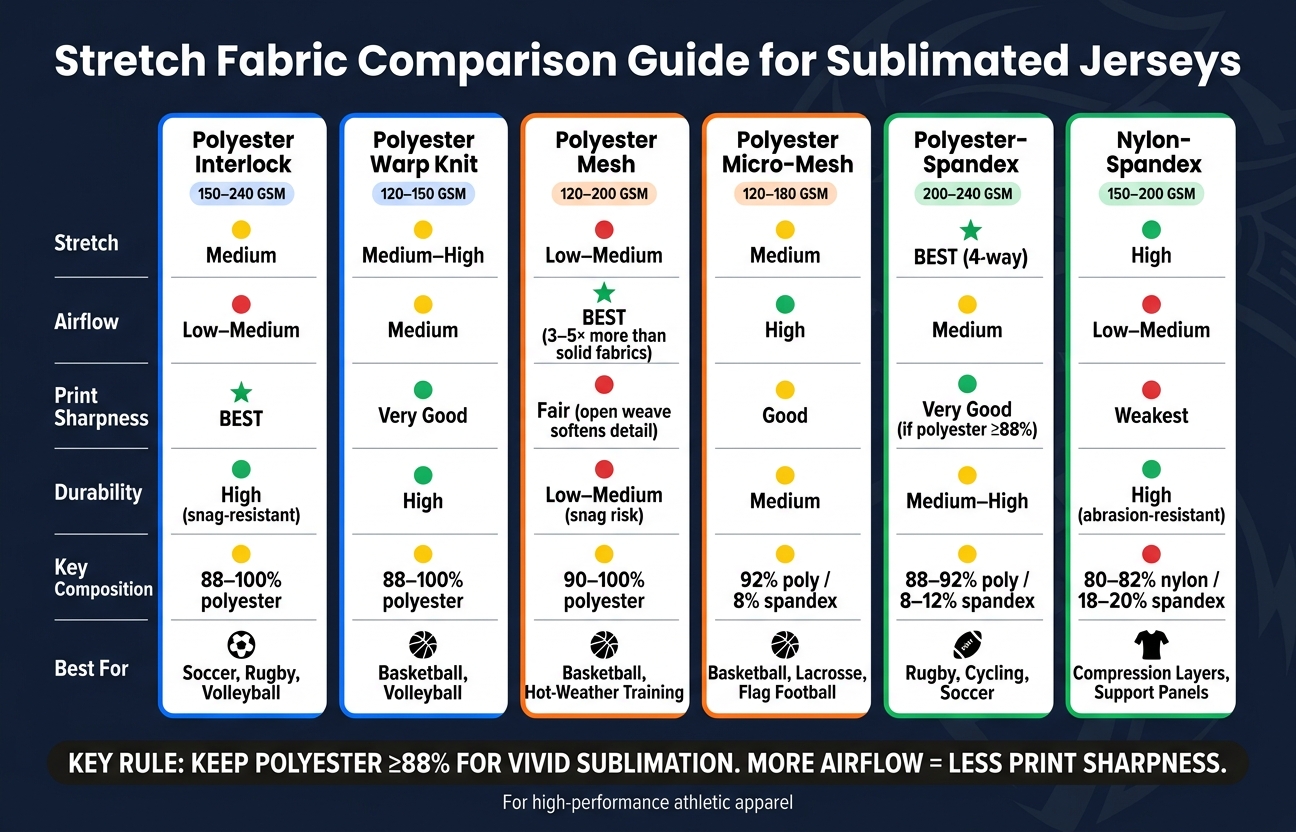
Stretch Fabric Comparison Guide for Sublimated Jerseys
Polyester/Spandex Knit Fabric For Dye Sublimation
sbb-itb-4d95ad3
Quick Comparison
| Fabric | Stretch | Airflow | Print Detail | Wear Life | Best Fit |
|---|---|---|---|---|---|
| Polyester Interlock | Medium | Low to medium | Best | High | Standard / semi-fitted |
| Polyester Warp Knit | Medium to high | Medium | Very good | High | Standard / athletic |
| Polyester Mesh | Low to medium | Best | Fair | Low to medium | Loose |
| Polyester Micro-Mesh | Medium | High | Good | Medium | Athletic |
| Polyester-Spandex | Best | Medium | Very good if polyester stays high | Medium to high | Athletic / close fit |
| Nylon-Spandex | High | Low to medium | Weakest for sublimation | Medium to high | Compression |
So if you’re trying to make the right jersey, the trade-off is simple: more airflow usually means less print sharpness, and more spandex can mean less color strength if polyester drops too low.
1. Polyester Interlock
Polyester interlock is a double-knit fabric with the same smooth finish on both sides. It’s the standard starting point for many jerseys because it gives you a good mix of stretch, shape, and clean print results. The knit is tight, so it’s less likely to snag. That makes it a smart pick for rough-contact sports like soccer and rugby.
Performance
Interlock has enough stretch and flex for easy movement on the field or court. It also pulls moisture away from the body and dries fast. The downside is airflow. Since the knit is tighter than mesh, it usually feels less ventilated. Side or underarm mesh panels can help bring in more air without hurting print quality on the main body.
Durability
That mix of stretch and structure also helps interlock stand up to repeated use. Because the dye bonds with the polyester fibers, the design is less likely to crack, peel, or fade.
One production note matters here: use silicone-free, OBA-free fabric before printing. Leftover residue can block dye and lead to patchy fading or white spots.
Visual Appeal
Interlock gives sublimation a flat, even surface, which helps logos, small text, and detailed graphics come out sharp. If your jersey has sponsor marks, tight patterns, or artwork with lots of fine detail, interlock is often the safer option. Unlike mesh, it doesn’t warp the print around open holes.
Best Use Case
Interlock fits best for soccer, rugby, volleyball, and esports jerseys where print detail, snag resistance, and wear life all matter. If airflow is the top concern, the next fabric to look at is polyester warp knit.
2. Polyester Warp Knit
Polyester warp knit gives you strong stretch, a smooth face for printing, and clean sublimation results. Next to interlock, it trades a bit of structure for more freedom of movement and a lighter feel.
Performance
That extra movement is a big reason warp knit shows up so often in fast, high-output sports. When it’s blended with spandex, it delivers four-way stretch and a recovery rate above 95%, which means the fabric snaps back into shape after repeated motion instead of getting loose and saggy over time.
It also wicks sweat and dries fast. Lighter warp-knit builds in the 120–150 GSM range are common for basketball and other aerobic sports.
Durability
Warp knit handles repeated wear well. Because the print is embedded in the fabric, it resists peeling, cracking, and wash fade. In testing, the fabric can keep 95% color fastness after 20 industrial wash cycles, compared with 78% for standard woven polyester.
Before transfer, pre-press the fabric for 5–10 seconds to stop edge curling and graphic distortion. Warp knits can shrink 3–5% under heat, so skipping this step can throw off the final print.
Visual Appeal
The smooth surface helps produce crisp gradients, sharp text, and detailed graphics. If your jersey design includes sponsor logos, fine patterns, or artwork with lots of small details, warp knit gives you a steady surface for clean output.
Best Use Case
Use warp knit for lightweight performance jerseys when stretch and print clarity matter more than maximum airflow. If ventilation is the bigger priority, move to polyester mesh or reversible button-down baseball jerseys made from breathable Swiss Pique.
3. Polyester Mesh
Polyester mesh is the fabric people reach for when airflow matters most. The open weave lets heat escape and keeps air moving. In practice, mesh knit structures can deliver 3–5 times more airflow than similar solid fabrics, and a ventilated mesh jersey can cut an athlete’s core temperature increase by 15–20% during a 60-minute effort compared with non-mesh fabrics. The catch is simple: mesh usually gives you less stretch.
Performance
Standard 100% polyester mesh has some natural give. It moves well enough for play, but it doesn’t offer the four-way stretch you get from spandex blends.
If you want more flex without giving up too much ventilation, a 90% polyester/10% spandex stretch mesh at 120–200 GSM is a smart middle ground. It adds moderate four-way stretch while keeping most of the airflow mesh is known for. For rougher sports, heavyweight 150-denier mesh brings more toughness, which makes it a fit for football and hockey.
Durability
Even with an open weave, sublimation holds up well on mesh. The graphics stay vivid without adding texture or extra weight, so the jersey keeps that light, airy feel.
There is one care point that matters: mesh is heat-sensitive. Wash it in cool water, then air-dry or tumble dry on the lowest heat setting to help protect the fibers.
Visual Appeal
Mesh has that classic basketball and streetwear look. Depending on the fabric, it can have a slight sheen or a more retro, open texture.
The downside shows up in print detail. Fine text, thin lines, and gradients tend to look softer on mesh than they do on interlock or warp knit. Bold, high-contrast artwork usually works best.
Best Use Case
Mesh works well for:
- Basketball jerseys
- Practice tops
- Retro-style uniforms
- Ventilation panels in hockey or football jerseys
If you want close to the same airflow but need more stretch, polyester micro-mesh is the next step.
4. Polyester Micro-Mesh
Polyester micro-mesh sits in the middle of standard mesh and stretch blends. You get strong airflow with a fit that feels a bit closer to the body. The holes are much smaller than the retro mesh jerseys many people remember from the 1990s, so the fabric feels lighter and less bulky while still letting heat escape.
Performance
Its biggest strength is breathability. That open structure helps cut down heat buildup, which matters a lot during fast play. Higher-end micro-mesh also pulls moisture away from the skin and lets it move through the fabric, helping athletes stay drier.
A common fabric mix is 92% polyester / 8% spandex. That blend adds four-way stretch without shutting down the pinhole ventilation that makes micro-mesh useful in the first place.
Durability
Micro-mesh is tougher than standard mesh, but it doesn’t resist snags as well as interlock. That tradeoff is worth noting if jerseys will see a lot of contact, rough washing, or repeated use.
Warp-knit micro-mesh also tends to hold up better than circular-knit versions. It resists runs and fraying more effectively, which makes it the better pick for jerseys worn often.
Visual Appeal
Micro-mesh handles bold sublimation well, though the open texture can soften very fine design detail. So if a team logo or graphic has tiny lines, the finish may not look quite as sharp as it would on a smoother fabric.
The pinhole surface also gives the jersey a more technical look. Because the fabric is less opaque, some designs may work better with lining in certain panels.
Best Use Case
Micro-mesh is a strong fit for basketball, flag football, lacrosse, and roller hockey. It works especially well for summer leagues and indoor games, where airflow can make a big difference.
For teams trying to balance print sharpness with ventilation, a hybrid build often makes the most sense:
- Interlock on the main torso for cleaner sublimation prints
- Micro-mesh panels in high-heat zones like the underarms and side seams
And if the goal is an even tighter, more flexible fit, the next move is usually a polyester-spandex blend.
5. Polyester-Spandex Blends
When teams need more stretch and a closer fit than micro-mesh can offer, polyester-spandex is the next move. Most team jerseys are made with 88–92% polyester and 8–12% spandex. That small share of spandex makes a big difference in how the jersey fits, moves, and feels on the body.
Performance
Polyester-spandex is the top pick when fit and movement come first. Its four-way stretch helps the jersey move with the athlete, cuts down on bunching, and springs back after repeated motion. At the same time, polyester helps the fabric stay quick-drying and moisture-wicking.
Durability
Spandex is sensitive to heat, so these fabrics need a lower sublimation setting. A common setup is around 385°F for 40 seconds instead of 400°F for 100% polyester. Too much heat can weaken recovery and leave shine marks.
Care matters here more than people think. Cold washing and air drying help protect the fabric’s stretch, while high-heat tumble drying is the main reason elasticity breaks down over time. With cold washing and air drying, the jersey can keep its close fit for 3 to 5 seasons of competitive use.
For similar stretch with a different feel and wear profile, move next to nylon-spandex blends.
Visual Appeal
To get vivid sublimation that lasts through washing, keep polyester at 88–90% or higher. When the polyester share drops, color quality tends to fade faster. After curing, always run a stretch test to make sure the ink doesn’t crack when the fabric is pulled.
Best Use Case
Polyester-spandex blends are a strong fit for sports that need a close-cut jersey and lots of movement, like soccer, basketball, and netball. For high-contact sports such as rugby, a heavier 200–240 GSM polyester-spandex interlock is a solid build choice.
6. Nylon-Spandex Blends
Nylon-spandex is the outlier in sublimated jerseys. It’s softer, stretchier, and less friendly to sublimation than polyester-based fabrics. Most performance versions use an 80/20 or 82/18 nylon-to-spandex blend. So If comfort comes first, this fabric makes sense for custom uniforms. If print sharpness is the goal, it usually doesn’t.
Performance
Compared with polyester-spandex, nylon-spandex gives up print strength in exchange for better recovery and a softer handfeel. Its biggest upside is shape retention. Nylon-spandex snaps back better than polyester-spandex, so it keeps its shape better under repeated stretch.
The downside shows up once sweat enters the picture. Nylon absorbs more moisture than polyester, so it dries more slowly and can feel heavier during hard play. And when nylon gets wet, its friction against skin rises a lot, which can increase chafing risk in high-movement sports.
Durability
Nylon is strong and stands up well to abrasion and pilling. But it has a weak spot: UV exposure breaks it down faster than polyester. For jerseys worn outdoors for long stretches, that makes nylon-spandex a less appealing pick.
Visual Appeal
This is the weakest print surface in the group. For sublimated jerseys, nylon-spandex prints with less punch and holds color less well than polyester.
Best Use Case
This blend works best for pieces where stretch and next-to-skin comfort matter more than print quality.
- Compression layers
- Rash guards
- Structural panels
For main sublimated team jerseys, especially for outdoor use, polyester-spandex is still the more practical pick. Nylon-spandex sits at the far end of the stretch-versus-print trade-off.
Performance, Durability, and Visual Trade-Offs by Fabric
After the fabric-by-fabric breakdown, this section boils the main trade-offs down into one fast comparison. Each fabric gives you a different mix of stretch, airflow, print sharpness, and wear life. If you want the short version, the table below is the fastest way to compare them.
Print quality mostly comes down to polyester content. Interlock, warp knit, and polyester-spandex blends tend to produce the sharpest results. Mesh and micro-mesh soften fine detail, while nylon-spandex is less suited to sublimation and gives lower vibrancy.
When stretch is the top goal, polyester-spandex stands out. It offers the best four-way stretch and recovery, though more spandex usually means some drop in print quality. Nylon-spandex also has strong recovery, but it gives up more print quality in the process.
For wear life, heavier interlock at 200–240 GSM holds up best in contact sports. Mesh sits at the other end of the spectrum and is the most likely to snag.
Use this chart to line up your fabric pick with what matters most: print sharpness, airflow, stretch, or durability.
| Polyester Interlock | Polyester Warp Knit | Polyester Mesh | Polyester Micro-Mesh | Polyester-Spandex | Nylon-Spandex | |
|---|---|---|---|---|---|---|
| Performance | High durability; tight surface | Smooth movement; good drape | Maximum airflow; lightweight | Airflow with smoother print surface | 4-way stretch; high mobility | Strong recovery; weaker print |
| Durability | High (snag-resistant; heavy GSM) | High | Low to moderate (snag risk) | Moderate | Moderate to high (shape retention) | High (abrasion-resistant) |
| Visual Appeal | Sharpest print resolution | Very good; smooth face | Moderate (open weave softens detail) | Good (smaller holes improve detail) | Vibrant with high polyester content | Lower vibrancy |
| Care | Standard wash | Standard wash | Low heat; avoid snags | Low heat | Cold wash | Cold wash |
| Fit | Semi-fitted / standard | Standard / semi-fitted | Loose / relaxed | Athletic / standard | Athletic / compression | Tight / compression |
| Best For | Soccer, rugby, volleyball | Basketball, volleyball | Basketball, lacrosse | Basketball, soccer | Soccer, basketball, netball | Base layers, compression panels |
The next section breaks those same fabrics into clear pros and cons.
Pros and Cons of Each Fabric
If the performance chart helped trim the options, this table makes the tradeoffs easy to scan. It gives you a quick side-by-side look at how the six fabrics stack up on stretch, wear, airflow, and print results.
| Fabric | Top Pros | Main Cons | Best Jersey Uses |
|---|---|---|---|
| Polyester Interlock | Sharp print detail; snag-resistant; stable structure | Less breathable than open-knit options; can trap heat if the GSM is too high | Soccer, rugby, volleyball |
| Polyester Warp Knit | High durability; holds shape well; optional dazzle sheen finish | Less breathable than interlock or mesh | Baseball, football jerseys and basketball trim, vintage-style jerseys |
| Polyester Mesh | Maximum airflow; fast-drying | Prone to snagging; open-hole structure softens fine print detail | Basketball, practice pinnies, hot-weather training |
| Polyester Micro-Mesh | Breathable with smaller, more aesthetic holes; lighter weight | Textured surface can soften fine detail | Basketball, lacrosse, flag football |
| Polyester-Spandex Blends | Four-way stretch; excellent shape recovery; vivid prints when polyester content stays high | Sensitive to high heat during washing and drying; artwork can distort under stretch | Rugby, cycling, performance soccer |
| Nylon-Spandex Blends | Silky feel; close compression fit; strong support | Holds sublimation less vividly | Compression base layers, contact sport reinforcement panels |
One rule matters more than most: keep polyester high and spandex moderate. Push spandex too far, and dye bonding gets weaker, which can make prints look less vibrant.
Conclusion
Choose based on the sport, the weather, the fit you want, and how you want to balance durability, airflow, and print sharpness. After that, it’s mostly about what matters most to you: easier movement, better cooling, cleaner graphics, or longer wear.
For contact sports like football and rugby, a heavy polyester-spandex interlock in the 200–240 GSM range with 8–12% spandex is a strong pick. It handles abrasion better, keeps its shape under tension, and still supports sharp sublimated graphics.
For high-activity sports in hot weather, like basketball, soccer, or track, lightweight micro-mesh or polyester mesh helps athletes stay cooler and dry out faster.
If print quality matters most for a logo-heavy jersey, go with smooth-surface interlock or warp knit. Smooth, tightly woven fabrics give you the sharpest sublimation. For compression-fit uses, pick a higher-spandex polyester-spandex blend with 12–15% spandex for a close fit that bounces back well. Keep polyester at 88–90% or higher, since print vibrancy and wash durability drop as polyester content falls below that range.
Wash cold and air-dry. High heat wears down spandex over time.
| Fabric | Best For | GSM Range | Key Composition |
|---|---|---|---|
| Polyester Interlock | Soccer, rugby, volleyball; logo-heavy jerseys | 150–240 | 88–100% polyester |
| Polyester Warp Knit | Basketball, volleyball; print-priority builds | 120–150 | 88–100% polyester |
| Polyester Mesh | Basketball, practice tops, hot-weather training | 120–200 | 90–100% polyester |
| Polyester Micro-Mesh | Basketball, lacrosse, flag football | 120–180 | 92% polyester / 8% spandex |
| Polyester-Spandex Blends | Rugby, cycling, soccer, cheer | 200–240 | 88–92% polyester / 8–12% spandex |
| Nylon-Spandex Blends | Compression base layers, contact sport panels | 150–200 | 80–82% nylon / 18–20% spandex |
FAQs
Which fabric is best for hot weather?
For hot weather, go with lightweight fabrics in the 100–140 GSM range. They allow more airflow and help you stay cooler when temperatures climb.
Materials that wick moisture, like polyester or poly-spandex blends, also help by pulling sweat away from the skin. That can make a big difference for comfort and temperature control.
If breathability matters most, mesh and pinhole knits work especially well because they let air move through the fabric more easily.
How much spandex is too much for sublimation?
There’s no fixed upper limit. But if you want a high-quality sublimated jersey, keeping polyester at 88% to 90% matters for bright prints and good wash durability.
Spandex usually falls in the 8% to 15% range to add stretch and help the fabric bounce back. Once spandex goes past 20%, the fabric is often a better fit for specialized compression gear than a standard team jersey.
Should I use one fabric or a hybrid jersey build?
It comes down to your team’s sport and what the players need on the field.
A single fabric, like a polyester-spandex blend, is often the best pick for all-around flexibility, moisture control, and steady print quality. A hybrid build can make more sense for high-intensity or contact sports like football, with mesh in hot zones for airflow and heavier fabric in high-impact areas for durability.