
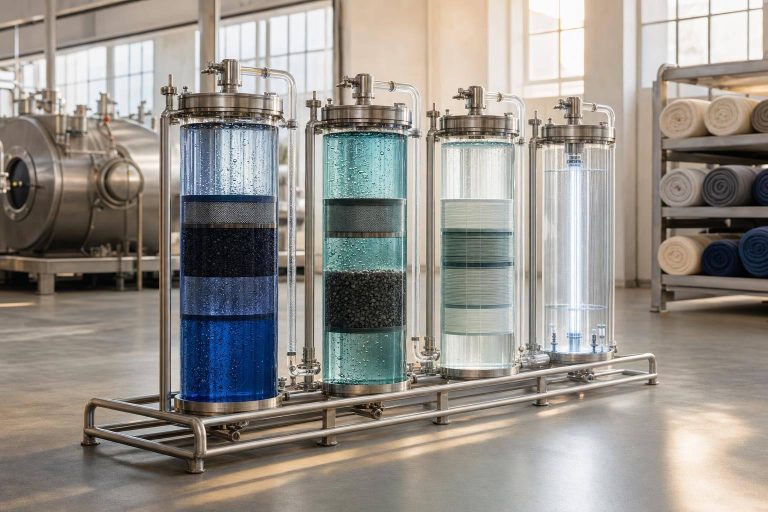
If water is off, fabric quality is off. In textile mills, water affects dye shade, print clarity, finish quality, reuse rates, and EPA discharge results. Wet processing uses about 72% of a mill’s water, and making 1 ton of fabric can take 100 to 200 m³ of water, with 80% to 90% leaving as wastewater.
Here’s the short version:
- I’d treat textile water as a quality-control issue, not just a wastewater issue.
- Mills need layered treatment because textile wastewater contains solids, dyes, salts, surfactants, metals, microfibers, and PFAS.
- The usual path is simple:
- Primary treatment for fibers, solids, and pH control
- Secondary treatment for organic load like BOD and COD
- Tertiary filtration for color, salts, and trace chemicals
- Common systems include MF, UF, NF, RO, MBR, activated carbon, and AOPs.
- For reuse in dyeing and finishing, RO and sometimes NF are often the last polishing steps.
- Reuse can work without hurting dye quality: one study found polyester dyeing with recycled water stayed below ΔE* 1.5, which is a common pass level for color matching.
- U.S. mills also need to meet EPA Textile Mills Effluent Guidelines (40 CFR Part 410) for items like pH, BOD₅, COD, TSS, oil and grease, sulfide, phenols, and chromium.
Quick Comparison
| Stage / System | Main Job | What It Removes | Where It Helps Most |
|---|---|---|---|
| Primary treatment | First cleanup | Fibers, large solids, pH swings | Protects downstream equipment |
| Secondary treatment | Organic load reduction | BOD, COD, oils, phenols | Lowers bulk pollution |
| MF / UF | Fine particle removal | Suspended solids, colloids, microfibers | Pretreatment and membrane protection |
| NF | Color and partial salt removal | Dyes, divalent ions | Rinse-water reuse |
| RO | Final polishing | Dissolved salts, metals, trace organics | Dyeing and finishing reuse |
| MBR | Bio-treatment plus membrane separation | Organics, TSS, nitrogen | High-grade feed before RO |
| Activated carbon | Adsorption polishing | PFAS, dyes, surfactants | Tertiary cleanup |
| AOPs | Chemical breakdown | Hard-to-remove organics and color | Pretreatment or polishing |
If I were judging a mill’s water setup for sportswear or team uniforms, I’d look at one thing first: Can it keep reuse water steady enough for repeat color and clean finishing while still meeting discharge limits? That’s the point of the full treatment train.
sbb-itb-4d95ad3
Where Water Is Used and What Must Be Removed
Water-Intensive Stages in Fabric Manufacturing
Wet processing generates most textile wastewater, and each step leaves behind its own mix of pollutants. Once water exits the dye and finishing lines, filtration has to deal with both visible solids and dissolved chemicals.
Scouring comes first. It uses alkaline water to remove natural oils, waxes, and other impurities from raw fibers. Bleaching follows as part of the wet-processing sequence. Then comes dyeing, which is the most water-heavy stage. It uses about 3.6 to 18 gallons per pound of fabric, depending on the dye and substrate.
After dyeing, fabrics move through washing and rinsing, then finishing. And this is where things can get messy fast. Sportswear finishes, including moisture-wicking and antimicrobial treatments, add more chemicals and increase the organic load.
Common Pollutants in Textile Wastewater
Textile wastewater often contains high pH, COD, BOD, TDS, suspended solids, TOC, chlorides, and sulfates. What comes out of a textile mill isn’t one simple waste stream. It’s a chemical mix, and each part of that mix calls for a different treatment approach.
Some of the main pollutants include:
- Synthetic dyes, which are easy to spot and hard to break down because they are made to bind tightly to fibers
- Salts such as sodium chloride and sodium sulfate, which are used during dyeing and often remain in the effluent at high levels
- Surfactants from scouring and finishing, which increase the organic load
- Heavy metals such as chromium, lead, cadmium, arsenic, zinc, and nickel, which are toxic even at low concentrations
- Microfibers and PFAS, which are now getting more attention
The EPA has noted that PFAS can appear in mill discharge even after a facility has stopped using them in production.
A BOD/COD ratio of 0.2 to 0.4 points to mostly non-biodegradable compounds. That matters because biological treatment on its own won’t be enough. Mills need staged filtration since no single process can remove the full range of contaminants in textile wastewater.
U.S. Compliance and Water Footprint Basics
These pollutants shape both treatment system design and EPA discharge limits. In the U.S., textile mills fall under the EPA’s Textile Mills Effluent Guidelines (40 CFR Part 410). The rules cover several subcategories, including woven fabric finishing, knit fabric finishing, and wool finishing. They also set limits on pH, BOD₅, COD, TSS, oil and grease, sulfide, phenols, and total chromium.
A medium-sized mill processing about 17,637 lbs of fabric per day uses roughly 422,675 gallons of water. EPA monitoring focuses on pH, TSS, BOD₅/COD, oil and grease, chromium, sulfide, and phenols.
Next, the treatment stages show how mills remove each contaminant before reuse or discharge.
The Water Treatment Process in Textile Mills
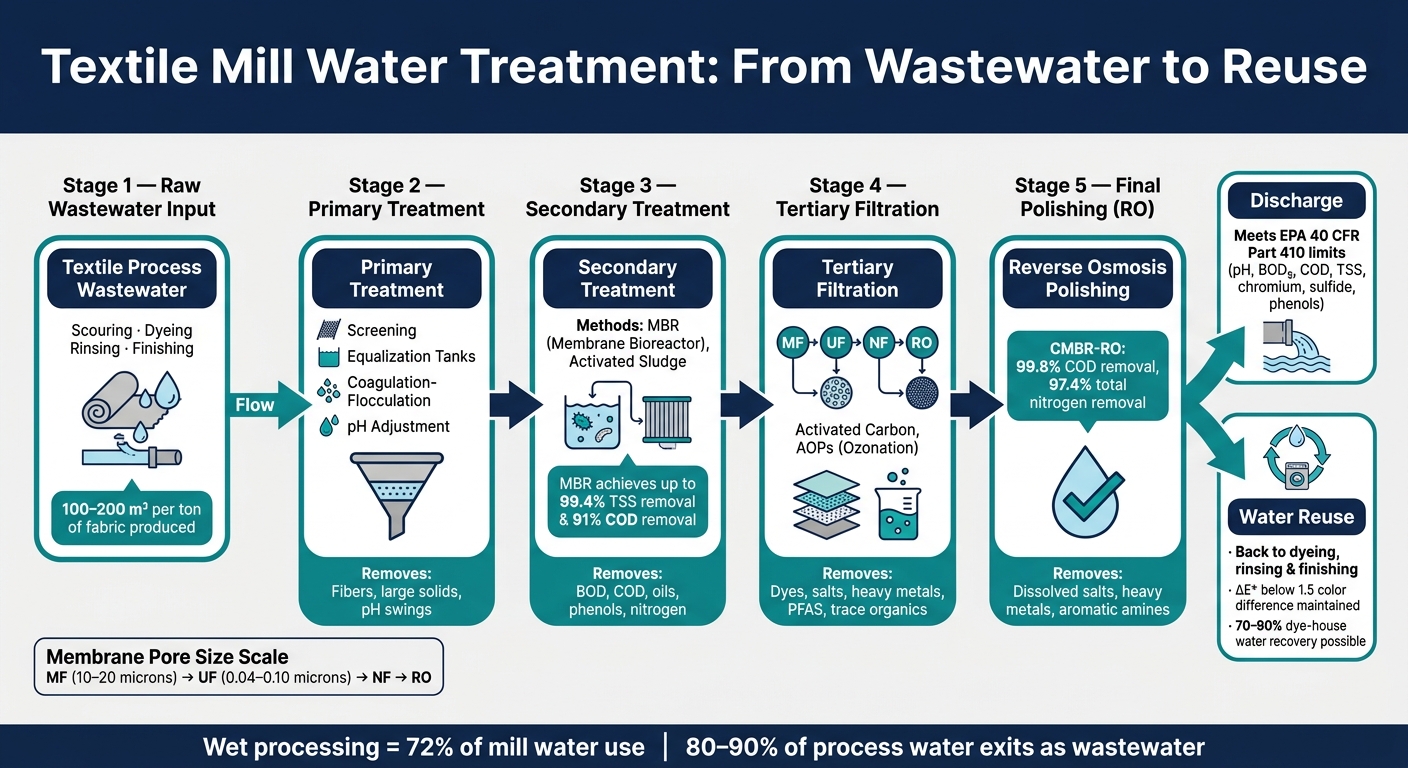
Textile Mill Water Treatment Process: From Wastewater to Reuse
Textile wastewater moves through a staged treatment path. Each step targets a different group of pollutants. First come solids, then organics, then color and dissolved salts before the water is discharged or reused.
Primary and Secondary Treatment
Once wastewater leaves the process line, mills treat it step by step based on what each method can remove. Primary treatment deals with large solids through physical and chemical methods, and it also adjusts pH.
It usually begins with screening. Filters catch cotton fibers, yarn fragments, and other large debris before those materials clog equipment farther downstream. After that, equalization tanks help even out flow and keep pH more stable.
One example comes from a cotton dyeing facility in Arequipa, Peru. The mill replaced acid neutralization with CO2 diffusion and lowered alkaline effluent from pH 11 to 7.3.
Next, coagulation-flocculation adds chemicals that pull fine particles together into larger clumps. Those clumps can then be removed in clarifiers through gravity settling.
Secondary treatment focuses on dissolved organic matter, including BOD, COD, phenols, and residual oils. It uses microorganisms to break those pollutants down. Membrane Bioreactors (MBR) combine biological treatment with membrane filtration in one unit, reaching up to 99.4% TSS removal and 91% COD removal.
That said, biological treatment on its own usually does not meet reuse standards. Mills still need tertiary treatment to remove the last set of contaminants.
Tertiary Filtration and Final Polishing
After biological treatment removes most organic pollution, polishing steps deal with color, salts, and trace contaminants. In custom team uniform production, this stage helps reused water stay steady enough for repeat color matching and finishing.
Multimedia and sand filtration remove leftover turbidity and suspended matter. Then activated carbon adsorption pulls out dyes, heavy metals, and PFAS – pollutants that biological treatment may leave behind.
A two-stage reuse system in Foshan, China, used flocculation, sand filtration, ozonation, UF, and RO. It met reuse targets for CODcr, color, and turbidity at about $0.44 per m³.
At the end of the line, RO membranes remove almost all remaining dissolved salts and organics. That makes the water fit for reuse in dyeing and finishing.
The next section breaks down the membrane and adsorption technologies that make these stages work in sportswear mills.
Key Filtration Technologies for Sportswear Fabric Production
After primary, secondary, and tertiary treatment, mills still need to pick the right filtration step for whatever contaminants remain.
Membrane Systems: MF, UF, NF, RO, and MBR
Membrane filtration works like a series of finer and finer screens. Each stage removes smaller pollutants than the one before it, helping mills recover water for reuse in dyeing, rinsing, and finishing while keeping output uniform.
Microfiltration (MF) goes after suspended solids and large particles, using pore sizes of 10–20 microns before those materials reach more sensitive downstream equipment. Ultrafiltration (UF) comes next, with pore sizes of 0.04–0.10 microns. It removes colloidal particles and larger organic molecules, which makes it a useful guard step before NF or RO.
Nanofiltration (NF) is used for color removal and partial desalination, and it does this with lower energy use than RO. That makes it a practical option for rinsing-water reuse. Reverse Osmosis (RO) removes dissolved salts, heavy metals, and nearly all remaining organics. The result is high-purity water that can go back into dyeing and finishing, helping mills get repeatable color and finish from batch to batch, essential for custom sublimated polos and other teamwear.
"RO successfully provided sufficient permeate quality… textiles dyed with the use of RO filtrates did not differ in quality of dyeing from those dyed in pure deionized water." – Joanna Marszałek and Renata Żyłła
When wastewater still has a high organic load, biological cleanup usually comes first. Membrane Bioreactors (MBR) combine biological treatment with membrane separation in one unit. That setup replaces standard sedimentation and produces effluent suitable for RO. In a 2024 study, a hybrid ceramic membrane bioreactor (CMBR)-RO system treating real textile effluent in Changzhou City, China, achieved 99.8% COD removal and 97.4% total nitrogen removal, while eliminating nearly 100% of 20 carcinogenic aromatic amines.
Adsorption, Advanced Oxidation, and Microfiber Removal
Once membranes remove most solids and salts, mills often need another set of tools for color, trace chemicals, and synthetic fibers.
Activated carbon adsorption works well for PFAS, residual dyes, and surfactants. It holds contaminants on a porous surface and fits neatly into tertiary polishing. The downside is simple: media needs to be replaced over time, which adds to operating cost.
Advanced oxidation processes (AOPs), including ozonation and electrooxidation, create hydroxyl radicals that break down dyes and other persistent compounds. Ozonation can help cut membrane fouling, but it may also form by-products that affect downstream RO. Because of that, post-treatment monitoring matters.
For sportswear mills, microfiber removal deserves special attention. Wastewater from synthetic fabrics like those used in custom soccer hoodies can carry microplastics, so mills are using more dedicated removal systems to keep those particles out of the environment. MF and UF membranes also help here because they act as physical barriers against microfibers.
Filtration Technology Comparison for Fabric Mills
These systems do their best work when matched to the right treatment stage and feed quality. Here’s a side-by-side view of what each one does and where the trade-offs show up.
| Technology | Target Contaminants | Process Position | Reuse Value | Key Trade-offs |
|---|---|---|---|---|
| MF | Suspended solids, large particles | Pretreatment | Low (requires further steps) | Low energy; fouling risk from suspended solids |
| UF | Macromolecules, colloids | Primary or before RO | Moderate | Good turbidity removal; prone to organic fouling |
| NF | Dyes, color, divalent ions | Color removal / Desalination | High (for rinsing) | Lower energy than RO; partial salt passage |
| RO | Dissolved salts, heavy metals, aromatic amines | Final Polishing | Very High (for dyeing) | High energy demand; requires high-quality feed |
| MBR | COD, nitrogen, suspended solids | Secondary Treatment | High (as RO feed) | Compact footprint; more complex operation |
| Activated Carbon | PFAS, surfactants, color | Tertiary / Polishing | Moderate | Effective for specific toxins; media replacement required |
| AOPs | Persistent organics, biopolymers | Pre-treatment or In-situ | High (fouling reduction) | High cost; by-product formation risk |
No single technology removes everything. In practice, mills usually combine MF or UF, MBR, and RO, then add AOPs or activated carbon when they need extra color control or removal of trace contaminants. That kind of treatment train is what makes water reuse possible at scale in sportswear mills, and it underpins closed-loop water systems.
Closed-Loop Water Reuse and What It Means for Custom Team Uniforms
Closed-Loop and Zero Liquid Discharge Systems
Once a mill has treatment in place, the next call is simple: send treated water out, or put it back to work.
Closed-loop systems send treated effluent back into dyeing, rinsing, and finishing instead of discharging it. At the far end of water recovery, Zero Liquid Discharge (ZLD) systems go a step further. After membrane filtration, they use evaporation and crystallization to split water from dissolved solids until no liquid waste is left.
For mills aiming for ZDHC or Bluesign® certification, this setup can also ease compliance demands. If a reuse system recovers 70% to 90% of dye-house water, there’s much less effluent left to deal with.
How Water Filtration Supports Better Sportswear Production
Reuse only makes sense if the water stays clean and steady enough for repeat color matching and finishing.
Residual dyes, minerals, or salts can throw off shade and finish. High-purity permeate from NF or RO helps lower that risk. One study on polyester dyeing wastewater found that monochromatic dyeings made with 100% reused permeate had color differences (Delta E) below 1.5. In plain terms, properly filtered reuse water can still perform well in fabric production.
For fully sublimated uniforms, low conductivity and very low residual dye matter even more. Small changes in water quality can show up fast in print sharpness and color repeatability. That’s a big deal for Wooter Apparel‘s fully sublimated custom team uniforms, where sharp graphics and repeatable color aren’t optional.
Conclusion: Water Filtration in Fabric Production
For custom uniform buyers, filtration affects more than wastewater control. Water is involved in almost every stage of fabric manufacturing – scouring, dyeing, rinsing, and finishing – and each step brings its own pollutant mix. Suspended solids, reactive dyes, heavy metals, salts, surfactants, and microfibers don’t respond to the same treatment, so one system alone won’t do the whole job.
That’s why treatment happens in layers:
- Primary treatment removes bulk solids
- Secondary biological treatment cuts organic load
- Tertiary filtration through MF, UF, NF, or RO brings water to the purity needed for reuse
When mills combine those stages in a closed-loop or ZLD setup, they can recover most of their process water and cut freshwater use sharply.
Mills that put money into filtration and reuse often get a production bonus too: more steady fabric quality, more dependable color matching, and cleaner finishes. And yes, that shows up in the final product – more repeatable color, cleaner finishes, and more consistent uniforms.
FAQs
Why isn’t one filtration system enough?
One filtration system isn’t enough because textile wastewater carries a mix of pollutants, including suspended solids, dissolved salts, dyes, and organic matter. One method alone can’t remove all of them well.
That’s why mills use primary, secondary, and tertiary treatment steps. Each stage targets certain contaminants and handles different flow conditions. Pretreatment removes larger particles and helps stop membrane fouling, while advanced membranes handle the final polishing step for water reuse.
How do mills know reused water is safe for dyeing?
Mills make sure reused water is safe for dyeing by testing treated effluent against established quality standards. They track key measures like pH, total dissolved solids, color, conductivity, and chemical oxygen demand (COD).
To clean the water further, they also use membrane systems such as ultrafiltration and reverse osmosis to remove contaminants. After that, they confirm the water performs as needed through trial dyeings and color consistency checks.
What’s the difference between NF and RO?
RO strips out almost all dissolved salts, ions, and small organic molecules, with rejection rates usually above 99%. The tradeoff is pressure: it needs a lot more of it, usually 500–1,000 psi.
NF uses a looser membrane. That means it lets 50%–90% of monovalent ions pass through, while still blocking larger divalent ions, organic molecules, and color. It also runs at lower pressure, usually 300–600 psi.
Both systems need pretreatment, and both can foul if the feed water isn’t handled well.