
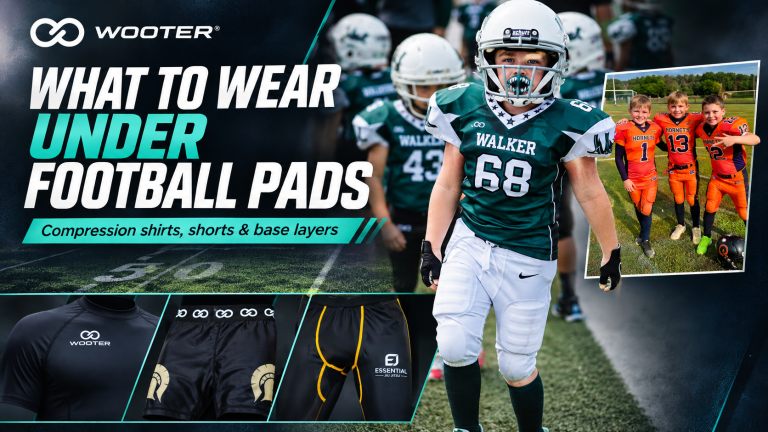
Football pads already add enough bulk. The layer underneath them should not add more.
Most players solve that with a fitted, moisture-managing base layer: a compression shirt under the shoulder pads and compression shorts or pants under the lower-body gear.
The best setup depends on the weather, how much coverage the player wants, and the equipment being worn. The goal is simple: stay close-fitting, keep unnecessary fabric out of the way, and choose layers that move with the player.
Here is what to wear under football pads and how to build the right base layer from top to bottom.
What Should You Wear Under Football Pads?
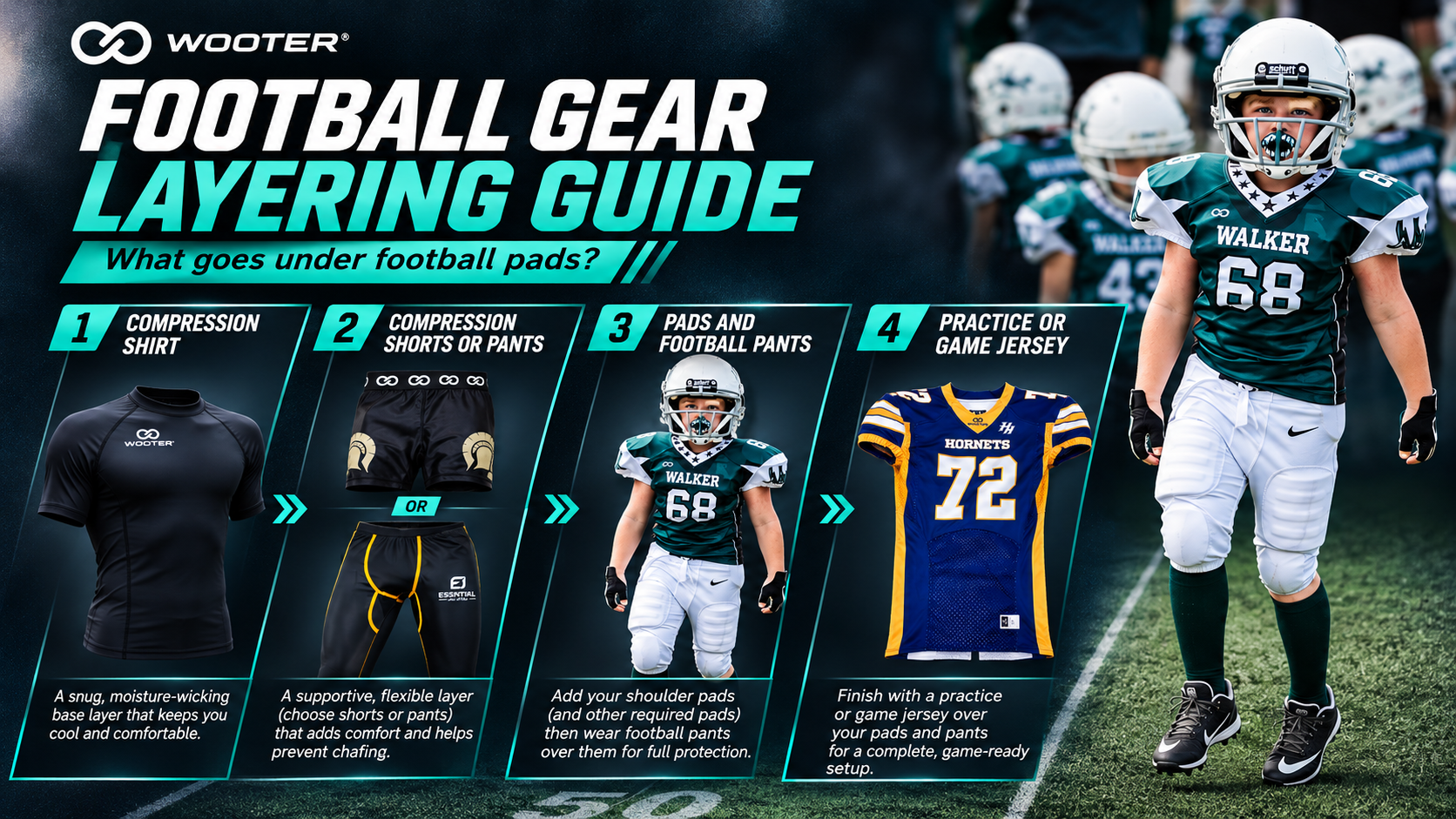
A practical football base layer usually looks like this:
Upper body: compression shirt
Lower body: compression shorts or compression pants
Over the base layer: protective equipment and football pants
Outer layer: practice or game jersey
Most players do not need multiple shirts under their pads.
One well-fitting base layer is usually the cleaner starting point.
The main choices are:
- Sleeveless compression shirt
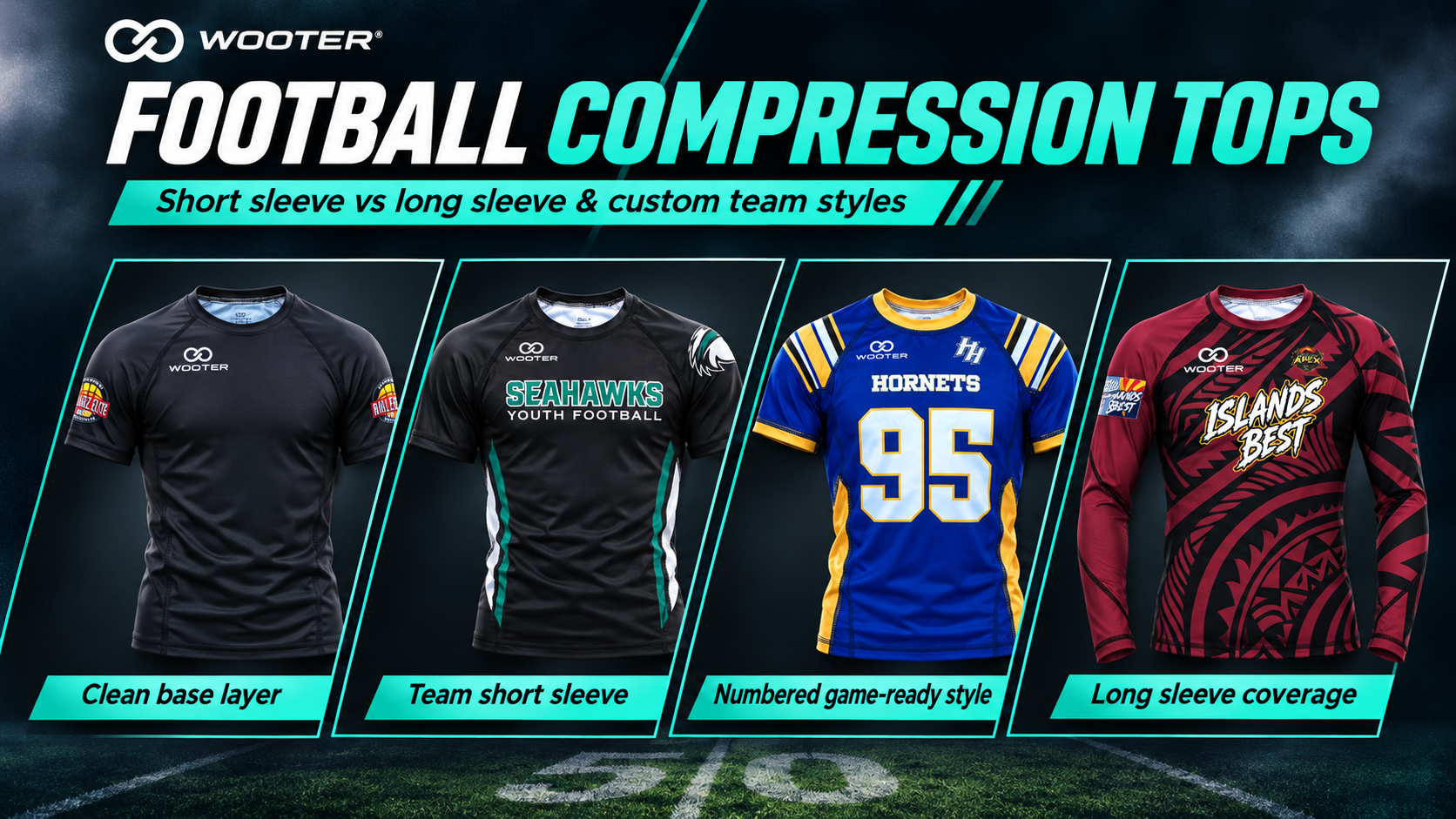
- Short sleeve compression shirt
- Long sleeve compression shirt
- Compression shorts
- Compression pants
Choose between them based on coverage, conditions, and comfort rather than stacking extra layers.
Why the Wrong Base Layer Can Make Football Gear More Annoying
The wrong shirt or shorts may seem like a small issue before the pads go on.
Once practice starts, those small issues become much more noticeable.
Loose Fabric Can Bunch Under Equipment
An oversized T-shirt can shift underneath shoulder pads or collect extra fabric around the torso.
That is not necessarily dangerous, but it can make the setup feel messier than it needs to.
Cotton Can Hold More Moisture
A basic cotton tee may absorb sweat and feel heavier as practice continues.
Football-specific compression apparel usually uses synthetic stretch fabrics designed for active wear.
Too Many Layers Add Unnecessary Bulk
More clothing does not automatically mean a better setup.
Anything worn underneath the pads should have a clear purpose.
Poor Fit Can Pull During Movement
If the base layer is too tight, players may feel the fabric pulling when they raise their arms, rotate, squat, or run.
If it is too loose, extra material can move underneath the equipment.
The ideal fit sits close to the body while still allowing normal football movement.
What Goes Under Football Shoulder Pads?
For the upper body, the main decision is usually sleeve length.
Sleeveless Compression Shirt
Sleeveless styles leave the arms and shoulders uncovered while keeping a fitted layer through the torso.
Wooter’s Custom Sleeveless Compression Shirt uses a lightweight dry-fit polyester and spandex blend with flatlock stitching.
Best for: players who want minimal upper-body coverage under the pads.
Short Sleeve Compression Shirt
Short sleeves are the most versatile middle ground.
They provide more coverage than a sleeveless top without extending fabric down the entire arm.
Wooter’s Custom Short Sleeve Compression Shirt uses 90% polyester and 10% spandex with lightweight dry-fit fabric, stretch construction, and flatlock seams.
Best for: players wanting one all-around base layer for practices and games.
Long Sleeve Compression Shirt
Long sleeves add full-arm coverage without requiring another loose shirt underneath the jersey.
Wooter’s Custom Long Sleeve Compression Shirt uses the same lightweight polyester-spandex construction.
Best for: cooler conditions or players who prefer more skin coverage.
Which Football Compression Shirt Should You Choose?
The simplest way to choose is by coverage.
| Style | Best For | Main Advantage |
|---|---|---|
| Sleeveless | Minimal coverage | Leaves the upper arms uncovered |
| Short sleeve | Most practices and games | Balanced all-around option |
| Long sleeve | Cooler conditions | Full-arm coverage |
| Reversible | Teams wanting two looks | More design flexibility |
Wooter offers multiple football compression shirt styles, so teams can choose based on how players actually wear their gear rather than forcing the entire roster into one option.
What Do Football Players Wear Under Football Pants?
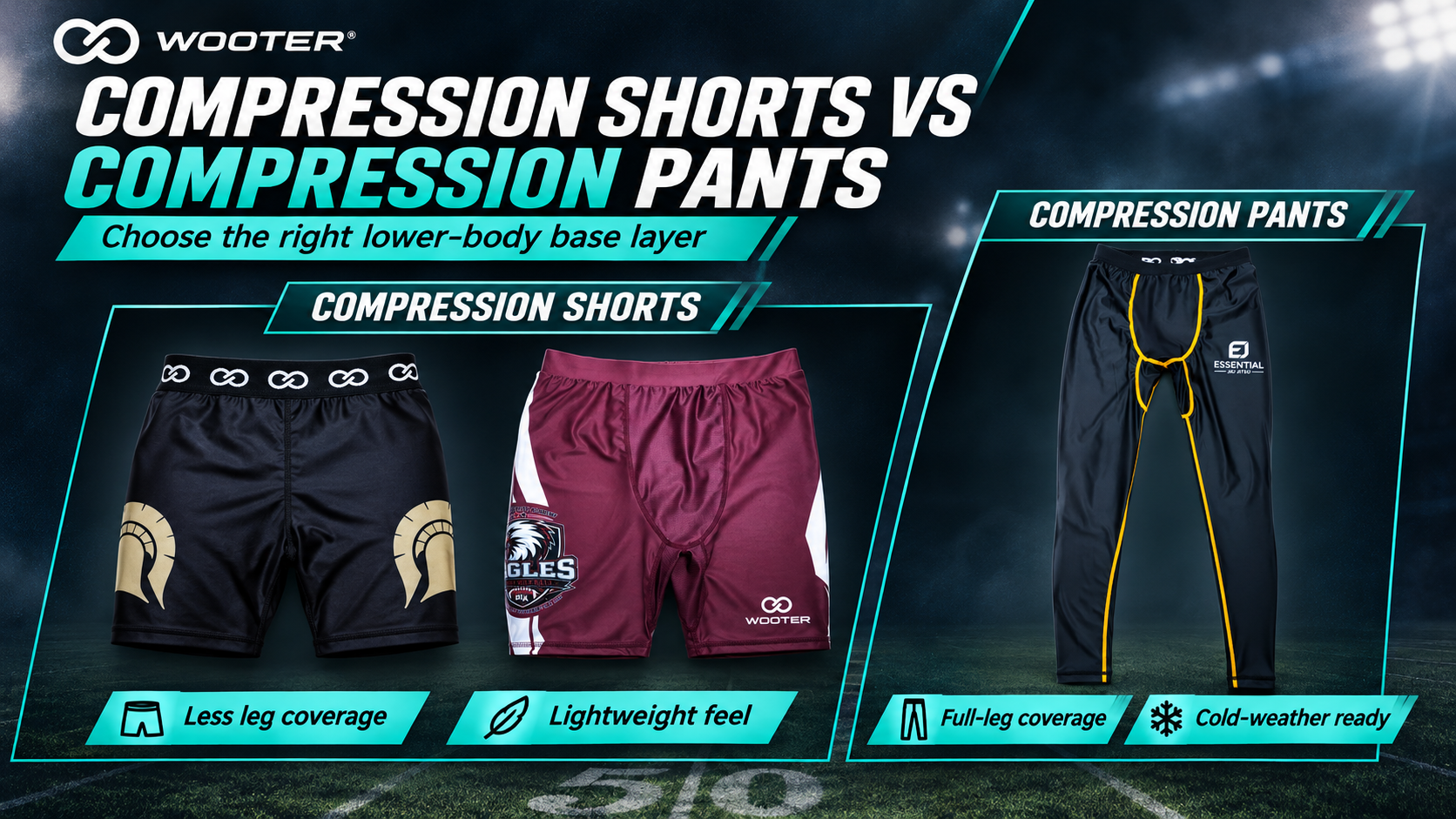
For the lower body, most players choose between compression shorts and compression pants.
Both provide a fitted layer underneath football pants.
The difference is how much of the leg they cover.
Compression Shorts
Compression shorts keep the lower-body layer compact.
Wooter’s Custom Compression Shorts use 90% polyester and 10% spandex with lightweight dry-fit fabric and flatlock stitching.
Best for: players who want a lightweight base layer with less leg coverage.
Compression Pants
Compression pants extend the fitted layer down the full leg.
Wooter’s Custom Compression Pants also use a polyester-spandex stretch construction with dry-fit fabric and flatlock seams.
Best for: players who want full-leg coverage underneath football pants.
Football Base Layer Setup by Weather
Weather can make the choice easier.
| Conditions | Upper Body | Lower Body |
|---|---|---|
| Hot | Sleeveless or short-sleeve compression shirt | Compression shorts |
| Mild | Short-sleeve compression shirt | Compression shorts or pants |
| Cold | Long-sleeve compression shirt | Compression pants |
This is a starting point, not a rule.
Some players naturally prefer more coverage. Others feel warm quickly once practice begins.
The best setup is the one that provides enough coverage without making the equipment feel unnecessarily bulky.
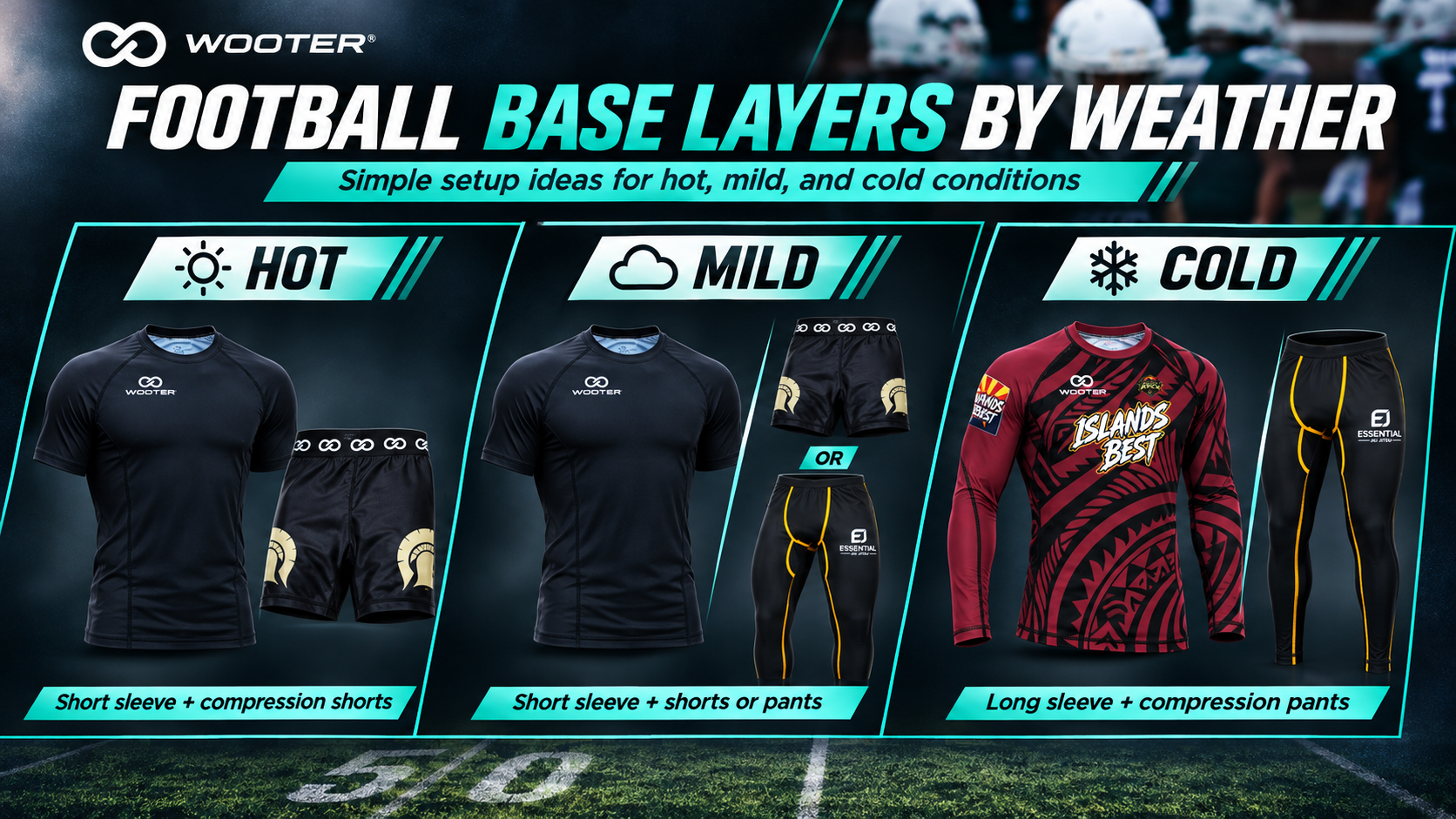
What to Wear Under Football Pads in Hot Weather
In hot conditions, avoid adding layers that serve no clear purpose.
A practical setup is usually:
- Sleeveless or short sleeve compression shirt
- Compression shorts
- Lightweight stretch fabric
- Football equipment over the base layer
The goal is not to wear as little as possible.
It is to keep the setup simple.
For players who want one compression top that can work across a wide range of practices and games, short sleeves are usually the most flexible starting point.
What to Wear Under Football Pads in Cold Weather
Cold weather changes the equation.
Players may prefer:
- Long sleeve compression shirt
- Compression pants
- Protective equipment
- Practice or game jersey
Additional layers may be allowed depending on the competition, but they should not interfere with the fit of the protective equipment.
Visible underlayers and uniform requirements can also vary by league. College programs can review the official NCAA Football Playing Rules, while high school and youth players should follow the rules that apply to their own competition.
Compression Gear vs a Regular T-Shirt Under Pads
A regular T-shirt can work under football pads.
Compression gear simply solves a different set of problems.
| Regular T-Shirt | Compression Shirt |
|---|---|
| Usually looser | Fits close to the body |
| Can shift under equipment | Stays closer to the torso |
| Cotton versions may hold more sweat | Often uses synthetic activewear fabric |
| Standard seams | Compression gear may use flatter seams |
| Designed as general apparel | Designed as a fitted athletic layer |
The point is not that every player must wear compression gear.
It is that a close-fitting athletic layer is often easier to manage underneath football equipment than a loose everyday shirt.
Should Football Compression Gear Be Tight?
Football compression gear should fit close to the body without restricting movement.
It should not hang like a loose T-shirt, but tighter is not automatically better.
A player should still be able to:
- Raise both arms
- Rotate the shoulders
- Squat
- Run
- Change direction
- Put on pads without the shirt pulling awkwardly
Do not size down simply to make compression gear feel more compressive.
Use the supplier’s sizing guidance and choose a fit that remains comfortable once the equipment goes on.
If you are building the rest of the training setup too, see our guide to football practice jerseys vs game jerseys to understand which outer jersey makes sense for each part of the week.
What Should You Look for in Football Compression Gear?
Before ordering, focus on the features that matter once the gear is underneath pads.
Stretch
The garment needs to move through throwing, blocking, tackling, running, and position-specific movements.
Lightweight Fabric
The base layer should not make the protective setup feel heavier than necessary.
Moisture-Managing Material
Football involves sweat. Synthetic dry-fit fabrics are commonly used because they are designed for active wear.
Flat Seams
Flatlock construction creates flatter seams, which can be useful in a garment worn directly against the body.
The Right Coverage
Pick the coverage around the player’s actual needs:
Sleeveless: minimal upper-body coverage
Short sleeve: versatile everyday option
Long sleeve: full-arm coverage
Compression shorts: lighter lower-body layer
Compression pants: full-leg coverage
Size Range
For team orders, make sure the supplier can cover the whole roster.
Wooter’s football compression range includes youth, women’s, and men’s sizing across core shirt styles, while compression pants are available across multiple age and gender ranges.
Customization
Compression gear can also become part of the team apparel system.
Wooter’s core compression products can be customized with:
- Team colors
- Logos
- Player names
- Numbers
- Full-color graphics
That gives programs the option to coordinate the base layer with the rest of their custom football uniforms.
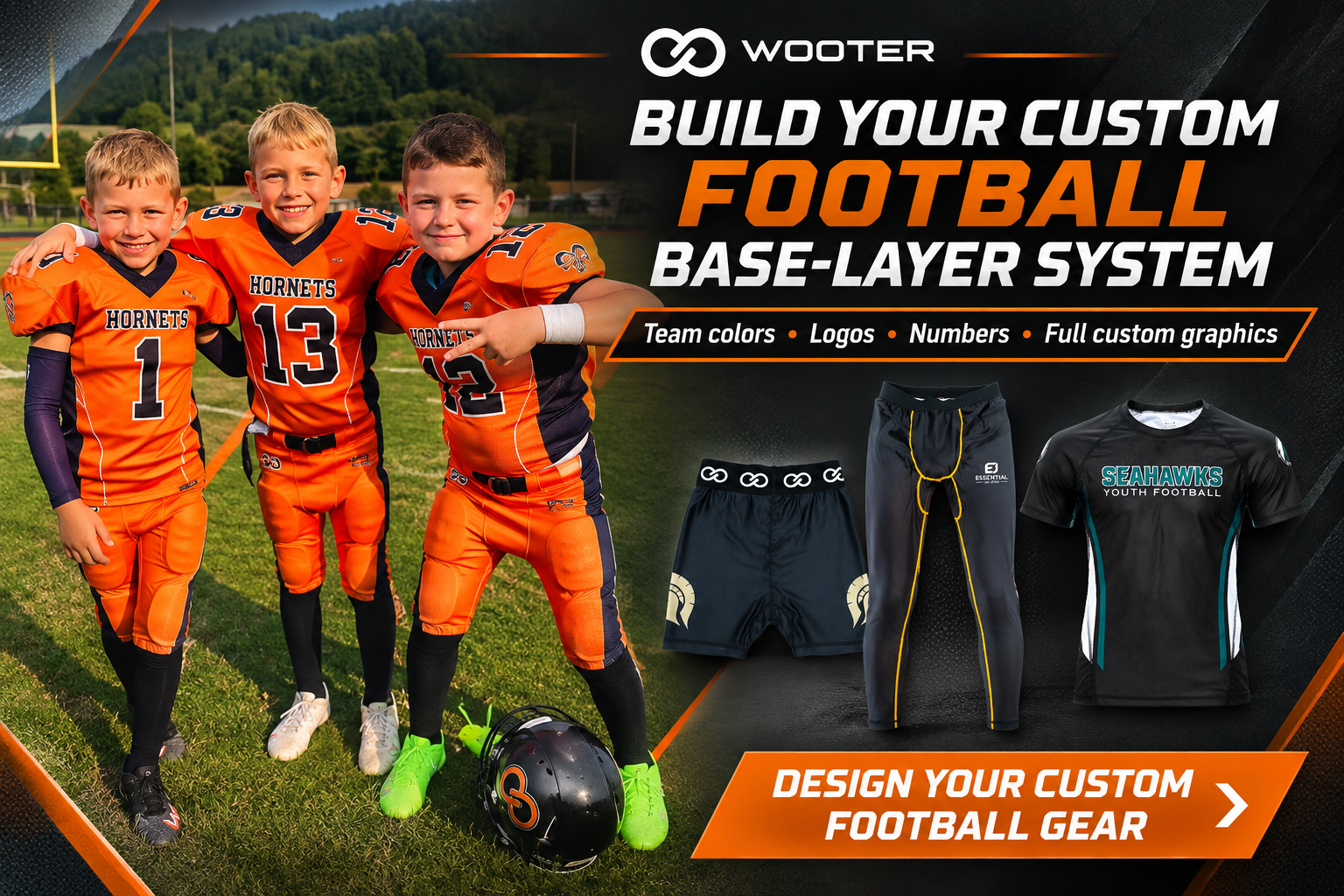
Build Your Football Base Layer
Choose the compression top and bottom that fit the way your players actually wear their pads, then customize the look around your program.
Which Wooter Football Compression Gear Is Best?
For teams comparing Wooter’s options, match the product to the use case.
Best All-Around: Wooter Short Sleeve Compression Shirt
The Short Sleeve Compression Shirt uses 90% polyester and 10% spandex with lightweight dry-fit construction and flatlock seams.
Best for: players wanting a versatile compression top for practices and games.
Best for Minimal Coverage: Wooter Sleeveless Compression Shirt
The Sleeveless Compression Shirt keeps the arms uncovered while maintaining a fitted torso layer.
Best for: players who prioritize minimal arm coverage underneath shoulder pads.
Best for More Coverage: Wooter Long Sleeve Compression Shirt
The Long Sleeve Compression Shirt extends the fitted layer down the arms.
Best for: cooler conditions or players who prefer full-arm coverage.
Best Lower-Body Option for Less Coverage: Wooter Compression Shorts
Wooter’s Compression Shorts combine stretch fabric with lightweight dry-fit construction.
Best for: players wanting a compact layer underneath football pants.
Best for Full-Leg Coverage: Wooter Compression Pants
Wooter’s Compression Pants extend the base layer through the full leg.
Best for: colder conditions or players who prefer full-length coverage.
These recommendations are based on coverage and garment construction, not on one product being universally better than another.
Do Football Teams Need Matching Compression Gear?
No.
A plain base layer can still do its job perfectly well.
Matching compression gear becomes useful when a program wants:
- Consistent team colors
- Player numbers
- Coordinated practice apparel
- A cleaner sideline look
- One visual system across multiple roster levels
For an individual player, function may come first.
For a team already ordering jerseys, pants, and other apparel, custom compression gear can extend the same design system underneath the uniform.
FAQs About Football Compression Gear
What do football players wear under their pads?
Most players wear a fitted athletic base layer under their protective equipment. A common setup is a compression shirt underneath the shoulder pads and compression shorts or pants underneath football pants.
Should you wear a compression shirt under shoulder pads?
A compression shirt is a practical option because it fits close to the body and reduces loose fabric underneath the pads. Sleeveless, short sleeve, and long sleeve styles can all work depending on coverage preferences and conditions.
What do football players wear under football pants?
Players commonly wear compression shorts or compression pants. Shorts provide less coverage, while compression pants extend the fitted layer down the full leg.
Are compression shorts good for football?
Compression shorts can work well as a lightweight base layer under football pants. Look for stretch, a close but comfortable fit, and fabric designed for active movement.
Should football compression gear be tight?
It should fit close to the body without restricting normal movement. Players should still be able to run, squat, rotate, and move comfortably once their equipment is on.
Is sleeveless or short sleeve compression better for football?
Sleeveless compression leaves the arms uncovered and minimizes upper-body coverage. Short sleeves provide slightly more coverage and are often a more versatile all-around option.
What should football players wear under pads in cold weather?
A long sleeve compression shirt and compression pants provide more coverage than short sleeves and compression shorts. Any additional layers should still allow protective equipment to fit properly and comply with applicable uniform rules.
Keep the Layer Under the Pads Simple
Football players already have enough equipment to manage.
The base layer should make that setup cleaner, not more complicated.
Start with a fitted compression shirt underneath the shoulder pads. Add compression shorts or pants based on the coverage and conditions the player prefers.
Avoid unnecessary layers. Make sure everything moves properly once the pads go on.
The best base layer is the one the player stops thinking about once practice starts.
Complete Your Football Setup From the Base Layer Out
Start with compression shirts, shorts, and pants built around the way your players wear their equipment. Then carry the same colors, logos, and team identity into practice jerseys, game uniforms, and the rest of your football apparel.