
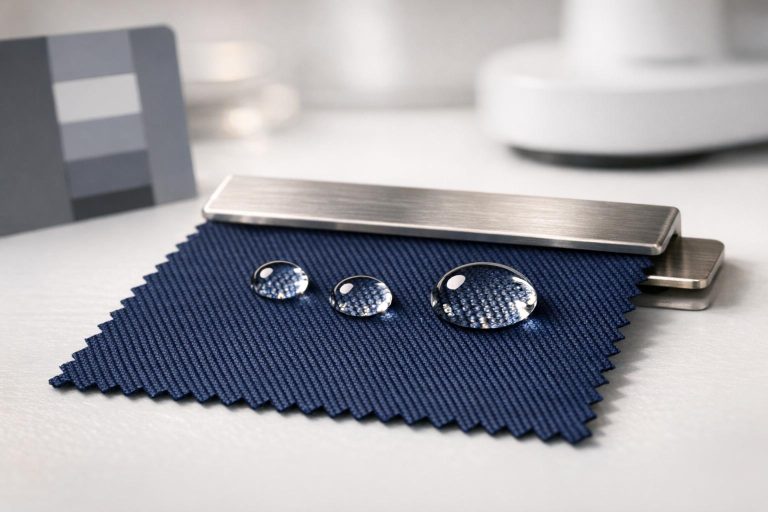
Fabric testing ensures uniforms last longer, perform better, and maintain their appearance. Skipping this step can lead to issues like poor durability, fading colors, and discomfort, which directly impact athletes’ performance and increase replacement costs. Here’s why fabric testing is necessary:
- Durability: Fabrics must withstand wear and tear, with tests like Martindale and Wyzenbeek ensuring they meet strength standards.
- Color Stability: Colorfastness tests prevent fading, bleeding, and pilling, keeping uniforms looking professional.
- Comfort and Performance: Thermal and moisture management tests ensure uniforms stay breathable, dry, and comfortable during intense activity.
- Industry Standards: Adhering to ASTM and AATCC protocols ensures quality and consistency across production.
Uniforms that pass rigorous testing last longer, perform better, and save teams money by reducing replacements. Manufacturers like Wooter Apparel use these methods to deliver reliable, high-quality uniforms.
Garment Testing and its importance
sbb-itb-4d95ad3
Problems Caused by Skipping Fabric Testing
Skipping fabric testing often leads to issues that compromise the performance, durability, and appearance of uniforms. For teams and athletes relying on these garments, such failures can create significant challenges.
Durability Problems and Early Wear
When fabrics aren’t tested for durability, they can’t withstand the physical strain of sports. Everyday friction can cause yarns to break, and according to standardized testing, the breakage of just two yarns marks the end of a fabric’s functional life. This leads to problems like seams splitting, edges fraying, and thinning in high-wear areas.
Fabrics with a Martindale score below 10,000 rubs are only suitable for decorative purposes – not for the constant wear and tear uniforms endure. For fabrics to meet commercial durability standards, they should exceed 30,000 rubs in Martindale testing or 15,000 double rubs in Wyzenbeek testing. When these tests are skipped, manufacturers have no way to gauge whether their fabric can last even a single season.
Grant Maloy Smith, writing for Dewesoft, underscores the importance of durability testing:
Durability testing is a process whereby products are pushed to their limits, to ensure that they will perform as intended under real-world operating conditions.
Without these tests, teams often find themselves replacing uniforms far more frequently than the expected 12 to 24 months. This leads to increased waste and higher costs. Additionally, as durability declines, the visual quality of the uniforms deteriorates as well.
Color Fading and Poor Appearance
Skipping colorfastness testing results in uniforms that lose their visual appeal quickly. Colorfastness measures a fabric’s resistance to fading or bleeding due to washing, light, sweat, and friction, and is rated on a scale from 1 to 5, with Grade 5 being the highest. Without testing, manufacturers have no way of knowing how their fabric will perform.
For example, lightfastness scores below 4 on an 8-point scale indicate that colors will degrade rapidly when exposed to sunlight. This is especially problematic for outdoor sports, where UV exposure speeds up fading. QIMA emphasizes the risks of skipping such tests:
Without the proper testing protocol, you risk selling items that lose their color over time.
Sweat testing is equally important for athletic uniforms. The acidic nature of sweat can cause noticeable color changes in fabrics that haven’t been tested for this condition. Additionally, skipping crocking tests can lead to color transferring onto other surfaces or even the athlete’s skin. Pilling, which makes uniforms look worn and fuzzy, can also be avoided by testing and achieving a Grade 5 rating on the pilling scale. Neglecting these tests results in uniforms that not only wear out faster but also look unprofessional.
Reduced Performance and Comfort
Skipping thermal and moisture management tests directly impacts both the comfort and safety of athletes. Without testing for thermal and evaporative resistance, uniforms can trap heat and moisture, leading to discomfort or even serious heat-related conditions like exhaustion and hyperthermia.
The Milliken Textile Protection and Comfort Center at NC State highlights this issue:
The essential requirements for protection against the penetration of environmental threats… results in a protective garment which itself contributes to the thermal discomfort, or worse, heat illness (exhaustion, hyperthermia, etc.).
Moisture management testing is equally critical. If a uniform can’t wick sweat away from the skin, it stays damp and heavy, negatively affecting an athlete’s performance. Breathability testing, such as those conducted with sweating manikins (ASTM F 1291 and ASTM F 2370), measures how well a garment allows heat to escape. Without this data, manufacturers can’t ensure that uniforms will help regulate body temperature during intense activity.
As the research center explains:
The complex interactions between fabric and garment design, climate, physiological, and psychological variables that define comfort performance make it one of the most important qualities influencing product acceptance by the end user.
Neglecting these tests compromises the uniform’s ability to keep athletes comfortable and safe during competition.
How Fabric Testing Solves Quality Problems
Fabric testing equips manufacturers with the data they need to tackle issues related to durability, appearance, and overall performance. By recreating real-world conditions, these tests provide insights into how fabrics endure stress and wear, directly addressing the challenges discussed earlier.
Physical Durability Tests
Durability tests assess how well fabrics withstand wear and tear. For example, abrasion resistance testing measures how long a fabric lasts before showing signs of damage. The Martindale Method, a global standard, involves rubbing wool or sandpaper discs against the fabric in a figure-eight motion until visible changes or breaks occur. In North America, the Wyzenbeek Test is more common, using cotton duck or wire mesh to rub the fabric’s warp and weft.
Uniforms designed for active use, such as athletic wear, need to meet specific benchmarks: over 30,000 Martindale rubs or 15,000–30,000 Wyzenbeek double rubs to qualify for commercial durability standards. Accelerated aging tests further simulate years of wear by exposing fabrics to extreme heat, humidity, and immersion, predicting their lifespan.
Chemical and Color Stability Tests
Durability is just one piece of the puzzle – color stability and chemical safety are equally critical. Colorfastness testing evaluates how dyes hold up against UV light, washing, chemicals, and sweat. Instruments like spectrophotometers and colorimeters ensure consistent color quality across production batches, reducing the risk of fading or discoloration.
Chemical analysis ensures fabrics are safe for use. Tests identify flammability risks, optical brighteners, and harmful chemicals. Additionally, pH testing confirms that fabrics are gentle on skin, even during prolonged wear. Inspectorio highlights this issue:
The lifetime of today’s garments is unduly short due to inadequate technical quality.
These tests also help pinpoint root causes of problems. For instance, if a dyeing machine isn’t heating or cooling correctly, it can lead to uneven color or fading. A 2022 study revealed that color fading and pilling are the two most common reasons garments fail.
Performance Testing Under Real Conditions
To ensure uniforms meet real-world demands, performance testing goes beyond lab conditions. Shrinkage tests, for example, predict whether fabrics will maintain their size and fit after washing or steaming. Colorfastness tests for perspiration and rubbing confirm that dyes won’t bleed onto skin or other clothing during high-intensity activities.
Advanced inspection systems, like the 4-point inspection method, evaluate defects based on size and severity, determining if a batch meets quality standards. Tests for pilling and surface fuzz ensure fabrics retain their texture, preventing discomfort and maintaining a polished look. Outdoor uniforms face additional tests for UV and pollutant resistance to ensure they hold up in harsh environments.
Inspectorio sums it up well:
Garment testing puts the quality and safety of products in quantitative terms, which provides hard data points for brands, retailers, and vendors to assess the performance of their production chain. For teams looking to ensure these standards are met in their own gear, you can get a custom quote for high-performance apparel.
Industry Standards for Fabric Quality
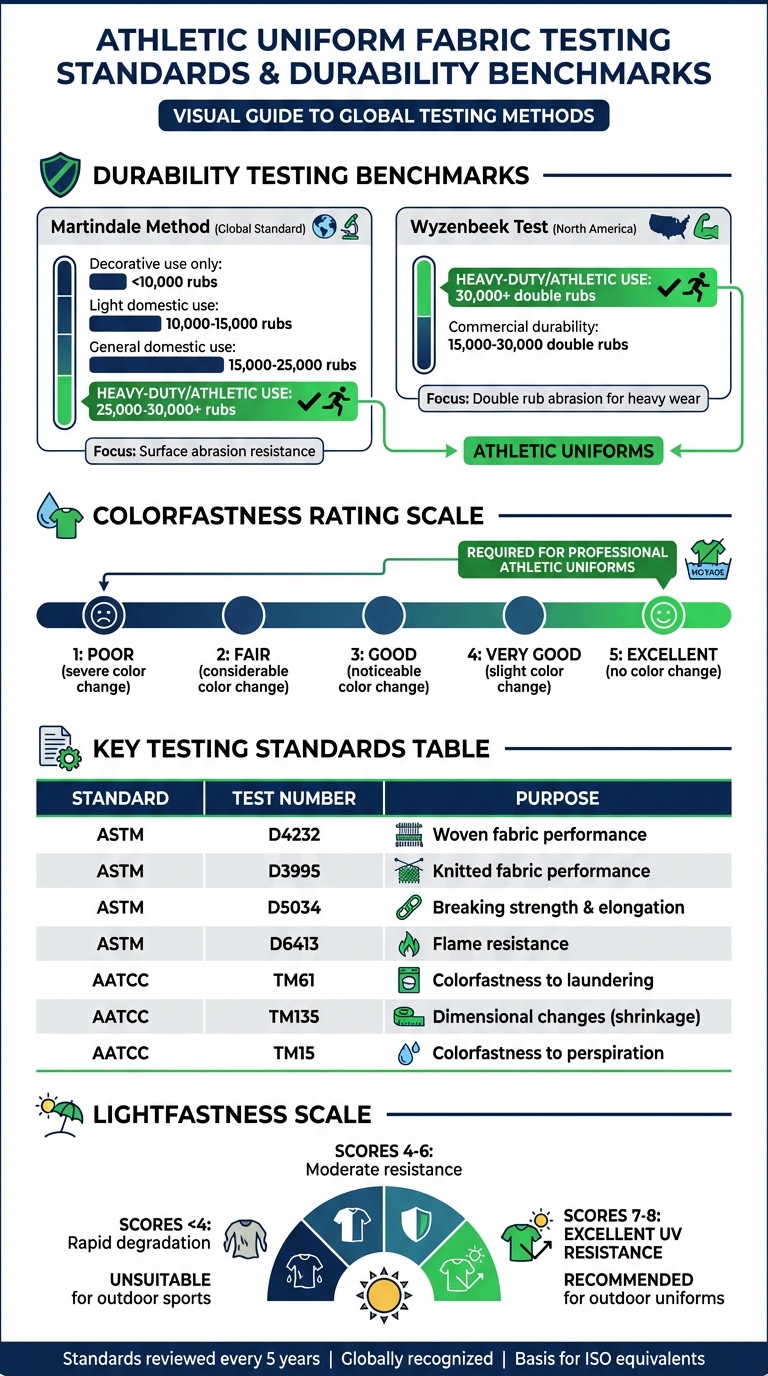
Fabric Testing Standards and Durability Requirements for Athletic Uniforms
To address common quality concerns in uniform production, it’s essential to follow established industry standards and maintain strict checks throughout the supply chain.
Using ASTM and AATCC Standards
Two key organizations set the benchmarks for fabric testing in uniform production: ASTM International and the American Association of Textile Chemists and Colorists (AATCC). Each focuses on different aspects of fabric quality. ASTM emphasizes the physical, mechanical, and chemical properties of textiles, while AATCC concentrates on biological properties, colorfastness, and wet-processing characteristics like resistance to laundering and perspiration.
For woven fabrics, ASTM D4232 outlines performance specifications, while ASTM D3995 does the same for knitted fabrics. Additional ASTM standards, like D5034 (testing breaking strength and elongation) and D6413 (measuring flame resistance), further validate fabric durability. On the colorfastness front, AATCC TM61 evaluates how well fabrics withstand repeated laundering, and AATCC TM15 tests resistance to perspiration – critical for active work uniforms.
| Standard Body | Standard Number | Focus Area for Uniforms |
|---|---|---|
| ASTM | D4232 | Performance specification for woven career apparel (dress and vocational) |
| ASTM | D3995 | Performance specification for knitted career apparel (dress and vocational) |
| ASTM | D5034 | Breaking strength and elongation of fabrics (Grab Test) |
| AATCC | TM61 | Colorfastness to laundering (accelerated test for repeated washing) |
| AATCC | TM135 | Dimensional changes after home laundering |
| AATCC | TM15 | Colorfastness to perspiration |
These standards, reviewed at least every five years, are globally recognized and often form the basis for equivalent ISO standards. When combined with a strong supply chain quality control process, they ensure consistent compliance throughout production.
Quality Control in the Supply Chain
Standardized testing protocols are essential for maintaining consistency across the entire production process. Quality control checklists, or Inspection Criteria Sheets (ICS), outline specific product standards and serve as a guide for manufacturers. These protocols are particularly useful for companies working with multiple suppliers, as they help ensure uniformity across the supply chain.
Key checkpoints should be established at various stages: incoming materials, production, and post-production. Testing raw materials – like yarns, dyes, and chemicals – before they enter production can prevent costly errors and protect a brand’s reputation. During manufacturing, automated sensors and AI-driven inspection tools can identify defects in real time, allowing for immediate corrections.
"A quality control checklist is an essential QC tool for any brand or manufacturer that cares about the quality of its products." – QIMA
To avoid miscommunication, quality control checklists should be translated into the supplier’s native language. Including precise details – such as dimensions, tolerances, material specifications, Pantone color codes, and garment weight – ensures consistency across production batches. Using standardized Pantone color systems further enhances color uniformity. Additionally, professional quality control providers like QIMA can perform on-site inspections within 48 hours, ensuring adherence to these standards.
At Wooter Apparel, we apply ASTM and AATCC standards alongside rigorous quality control protocols to produce uniforms that deliver durability, safety, and reliable performance.
Conclusion: Why Fabric Testing Is Required for Quality Uniforms
Key Takeaways
Fabric testing plays a critical role in creating uniforms that stand the test of time. Without it, teams risk dealing with issues like premature wear, color fading, and discomfort – all of which can negatively impact performance. Common problems such as pilling and fading highlight why thorough testing is non-negotiable. From durability to comfort, fabric testing ensures every aspect of uniform quality is addressed.
Studies show that fabrics designed to withstand heavy-duty use (25,000–30,000+ rubs in Martindale or Wyzenbeek tests) provide the resilience needed for intense activities. Testing also ensures that uniforms keep their shape after multiple washes and effectively wick moisture, which can make a big difference during demanding performances.
Comfort performance is one of the most important qualities influencing product acceptance by the end user.
– NC State University, Textile Protection and Comfort Center (TPACC)
Beyond functionality, fabric testing also supports sustainability by reducing waste from garments that fail prematurely. This dual benefit – enhancing performance while promoting sustainability – makes fabric testing essential. It provides concrete data to confirm that materials meet required standards.
Call to Action
The benefits of fabric testing are clear. At Wooter Apparel, we follow ASTM and AATCC standards throughout our production process to deliver custom team uniforms that excel in durability, comfort, and performance. Our fully sublimated designs, combined with rigorous fabric testing, ensure season-long reliability. Check out our custom uniform options and see how quality fabric testing can make a difference for your team.
FAQs
What tests should my team require before ordering uniforms?
Your team needs to request detailed fabric quality tests before placing any uniform orders. These tests are essential for identifying potential issues like defects, durability concerns, and whether the fabric is suitable for its intended purpose. Verifying that the fabric meets quality standards helps prevent problems such as wear and tear, color fading, or fabric failure, which could compromise both the look and functionality of the uniforms.
How do Martindale and Wyzenbeek scores relate to season-long durability?
Martindale and Wyzenbeek scores are used to evaluate a fabric’s resistance to abrasion, essentially measuring how well it can withstand wear over time. While these scores provide insight into durability for short-term or long-term use, they specifically address abrasion resistance and don’t necessarily reflect the fabric’s overall strength or performance.
When should fabrics be tested during the uniform production process?
Fabrics need to be tested at various stages of production to catch and fix quality issues early. This helps ensure the finished uniforms are long-lasting, comfortable, and function as they should.