

I’d sum it up like this: rivalries help women’s basketball grow because they give fans a simple story to follow. When the same teams or stars meet again in big games, more people watch, more people show up, and more people keep talking after the game ends.
Here’s the short version:
- Repeat matchups matter. One big game can get attention, but a rematch keeps people interested.
- Star players matter. Familiar names help fans track the story from college to the pros.
- High-stakes games matter. Title games, postseason games, and rivalry rematches pull more attention than random regular-season games.
- Media attention follows drama. When a matchup has tension, history, and known players, it gets more coverage.
- The Clark-Reese matchup shows this clearly. Their 2023 NCAA title game and 2024 rematch turned one game into a multi-year story that carried into the WNBA.
A few examples in the article make that point clear:
- Early college rivalries helped put women’s basketball in front of a national audience.
- Early WNBA matchups used star names like Ruthie Bolton to keep fan interest alive after the league launched in 1997.
- The Georgia Soul saw fan-base and local media growth over the five years before the 2020 season, with its 2017 title comeback named as a key moment.
- The WPBA re-launch in 11 cities in 2020 shows how city-by-city exposure can help a league get more attention.
| Topic | What the article shows | Why it matters |
|---|---|---|
| College rivalries | Repeat high-stakes matchups built national attention | Fans had an easy story to follow |
| Early WNBA | Known stars helped sell early matchups | Pro interest lasted past launch |
| Audience growth | Attendance, local coverage, and fan-base gains followed big games | Rivalries can help turn short-term buzz into fan habit |
| Clark vs. Reese | 2023 title game + 2024 rematch kept people talking | A college story moved into the WNBA |
My takeaway: if leagues, teams, and coaches want more fan interest, they should lean into repeat matchups, clear storylines, strong player branding, and local fan ties.
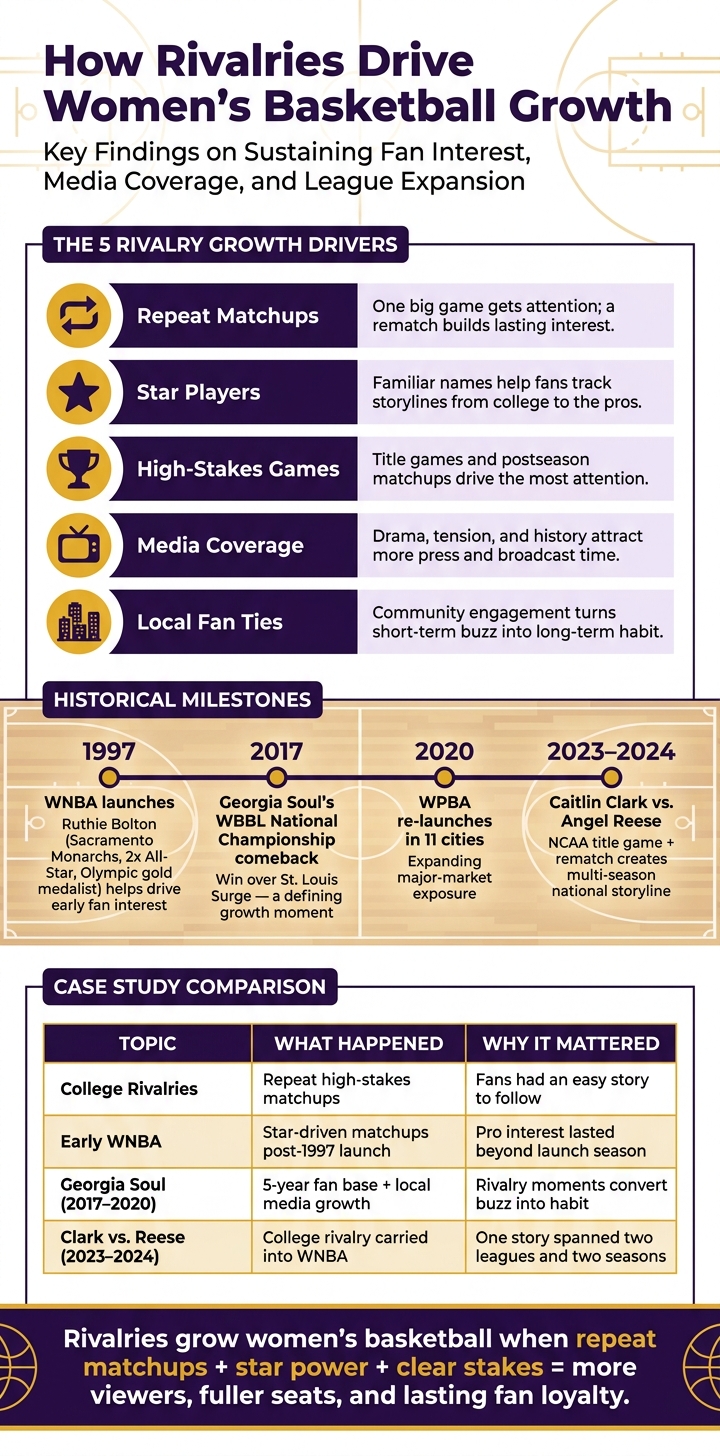
How Rivalries Drive Women’s Basketball Growth: Key Factors & Case Studies
Historical rivalries that grew the game
College rivalries that built national attention
College basketball played a big part in the early growth of women’s basketball. Big matchups that happened again and again gave fans something easy to track from season to season. When the same teams kept meeting in high-stakes games, those rivalries became events people looked for.
That repeat exposure mattered. It helped fans get to know the teams, the players, and the stakes. It also brought more media attention, which pushed women’s basketball onto the national stage.
That same pattern showed up in the WNBA, where star-driven matchups kept fan interest moving.
Early WNBA matchups that kept pro interest alive
When the WNBA launched in 1997, it leaned on familiar stars to help draw early fan interest. Ruthie Bolton, who played for the Sacramento Monarchs from 1997 to 2004, was a two-time WNBA All-Star and Olympic gold medalist. Star names like hers made early rivalries easier to promote and easier for fans to follow.
As those matchups kept showing up, fans built a stronger connection to the league. More visibility led to more familiarity, and that familiarity helped turn single games into national storylines. That momentum set up the next phase of growth: measurable audience response.
sbb-itb-4d95ad3
What research shows about audience growth
Viewership and attendance patterns
You can see this growth in the places that matter most: attendance, local coverage, and market reach. One rivalry game, or one huge postseason result, can do more than fill seats for a night. It can pull in new fans and keep them around.
A clear case is the Georgia Soul. Over the five-year stretch leading up to the 2020 season, the team reported steady growth in its fan base and local media coverage. One moment stood out in that run. In 2017, its Women’s Blue Basketball League National Championship comeback win over the St. Louis Surge became a defining part of that growth story.
Research also points to rivalry games and postseason matchups as key drivers of local fan interest and economic development.
Media coverage and market engagement
The clearest signals here are fan-base growth, local coverage, and exposure in major markets. The WPBA’s 2020 re-launch in 11 cities is a good example of how major-market exposure can expand reach.
Caitlin Clark and Angel Reese: A modern case study
How the college matchup became a national storyline
The Caitlin Clark-Angel Reese rivalry came into focus during the 2023 NCAA Championship, when LSU beat Iowa. The game had everything people latch onto: two star players, two very different styles, and a heated moment that spread far beyond sports media.
That mix turned one title game into a national story. It wasn’t just about who won. It became about personality, style, and the kind of tension that keeps people talking long after the final buzzer.
When Iowa and LSU met again in 2024, the storyline picked up right where it left off. That gave the rivalry something every sport wants: continuity.
The 2024 NCAA Tournament rematch became the second big chapter. And that shift matters. Instead of feeling like a one-off moment, the matchup started to look like a multi-season story people could follow. In women’s basketball, repeated star matchups help keep the sport in the public conversation between tournaments.
How that attention carried into the WNBA
The 2024 rematch kept public interest alive across seasons and showed how rivalries can carry momentum onto a bigger stage.
In plain terms, the attention didn’t stop when the college season ended. It followed the players forward, helping connect college storylines to the WNBA in a way that felt natural and easy for fans to track.
Conclusion: What rivalries mean for the future of women’s basketball
Key points from the research
The research here points in one clear direction: rivalries help grow women’s basketball when repeat matchups, star players, and clear stakes bring in more viewers, fill more seats, and spark more talk online.
The biggest rivalry moments tend to come from the same mix: repeat matchups, visible stars, and games that feel like they matter. What keeps those rivalries going is repetition, clear branding, and storylines fans can follow without much effort. That’s why building rivalries matters so much for both audience growth and team identity.
Why this matters for teams, coaches, and organizers
For teams, coaches, and organizers, the message is pretty direct: as women’s basketball grows, the programs that gain the most are the ones that put money and effort into strong branding and close ties with their communities.
For coaches and organizers, the takeaway is simple. Build repeatable matchups, use strong visuals, and invest in local engagement that turns short-term interest into long-term growth.
Caitlin Clark vs Angel Reese: The Rivalry That Changed Women’s Basketball Forever
FAQs
Why do rivalries help women’s basketball grow?
Rivalries help women’s basketball grow because they create buzz that lasts well past the final buzzer. A big matchup isn’t just one game on the schedule. It becomes part of a program’s story, and fans remember those moments for years.
That kind of intensity can pull teams and their communities closer together. When people feel tied to a rivalry, they often show up in bigger numbers, talk about the team more, and back local youth programs and facility upgrades with more energy.
Rivalries also put the sport’s skill and competitiveness in front of a national audience. They give fans a reason to stay invested, build deeper support around programs, and show young athletes what the game can look like at its highest level.
How do star players make rivalries more valuable?
Star players make rivalries more valuable because they give fans someone they know. Someone to cheer for. Or someone to root against. Players like Sheryl Swoopes and Lisa Leslie helped put a face to the sport and gave fans a stronger reason to stay invested.
And it goes beyond what happens during the game. When stars lead on the court or speak up off it, the connection gets deeper. That kind of pull can turn a casual viewer into a loyal fan who cares a lot more when those rivalry games show up on the schedule.
Can college rivalries boost WNBA interest?
Yes. College rivalries can boost interest in the WNBA because they build deep fan loyalty, school pride, and storylines people already care about.
When women’s basketball keeps growing, those rivalries don’t just stay on campus. They often follow players into the pro game. That gives fans a familiar reason to keep watching.
A Duke vs. North Carolina matchup, or LSU vs. South Carolina, isn’t just another game. It comes with history, emotion, and bragging rights. When players from those matchups enter the WNBA, fans often bring that energy with them.
That matters because sports interest doesn’t start from scratch. People stay connected to names, teams, and rivalries they already know. So when a college star lands in the WNBA, the pro league gets a built-in storyline instead of having to sell one from day one.
It also helps local communities stay invested. Alumni, students, and longtime fans often keep following their favorite players after college. That connection can carry over in a natural way and keep attention on the WNBA longer.