
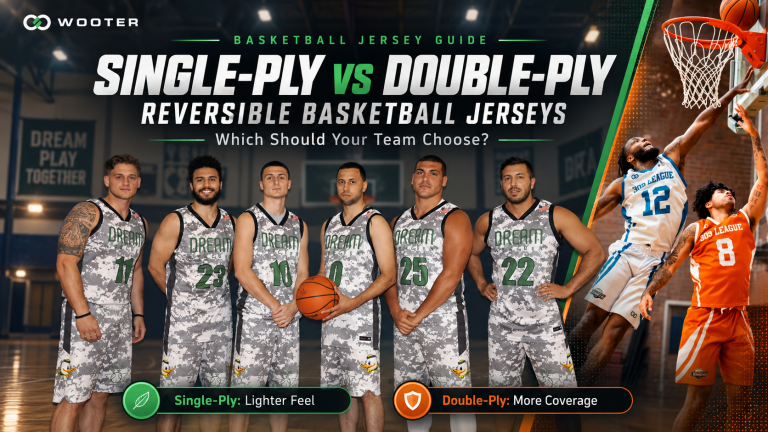
Two jerseys can look almost identical in a mockup.
Same colors. Same logo. Same numbers. Same reversible design.
Then the players put them on.
One feels noticeably lighter. The other feels more substantial. One works perfectly in dark colors but raises questions when the white side comes out.
That is where single-ply vs double-ply starts to matter.
It is not simply a manufacturing detail. The construction can change how the jersey feels, how much coverage it gives, and whether it makes sense for practice, tournaments, or a full season of games.
So which one should your team actually order?
Single-Ply vs Double-Ply: The Short Answer
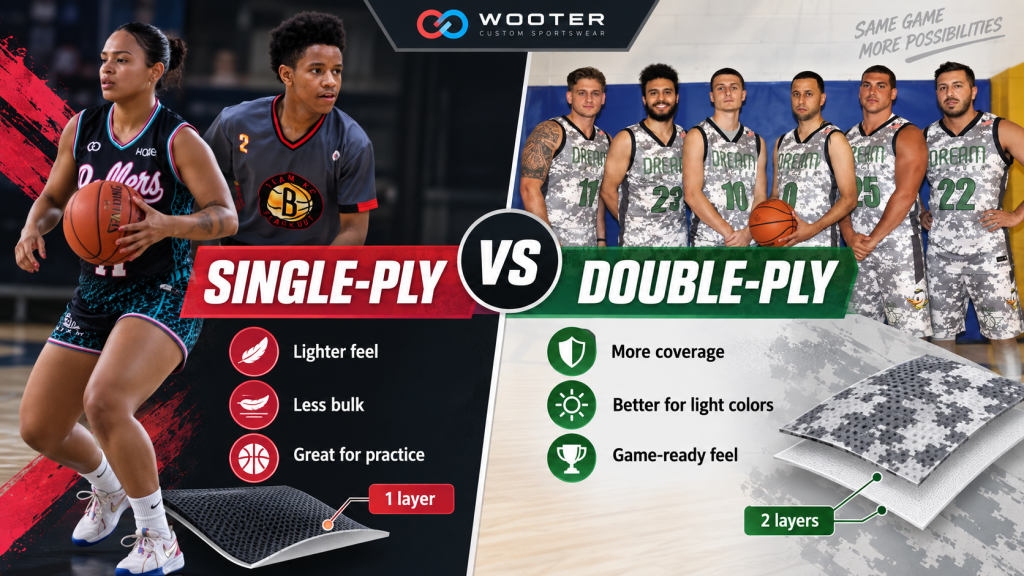
Choose single-ply when you want a reversible jersey without as much bulk.
Choose double-ply when coverage and a more traditional reversible feel matter more.
Neither option is automatically better.
The smarter question is:
What problem are you trying to solve?
Some teams spend too much time deciding between single-ply and double-ply when they do not actually need a reversible jersey in the first place.
We will get to that.
What Does “Single-Ply” Actually Mean?
A single-ply reversible jersey gives you two wearable looks without using the traditional two-layer construction.
The appeal is easy to understand once you wear one:
There is simply less jersey to carry around.
That can make a difference during long training sessions, summer camps, or tournament weekends when players spend hours in uniform.
A lightweight single-layer reversible construction can still give teams two colors while cutting down on the bulk players often associate with reversibles.
But lighter construction comes with a question teams should ask before ordering:
What happens when one side is white?
That is where the decision gets more interesting.
Why White Jerseys Change the Conversation
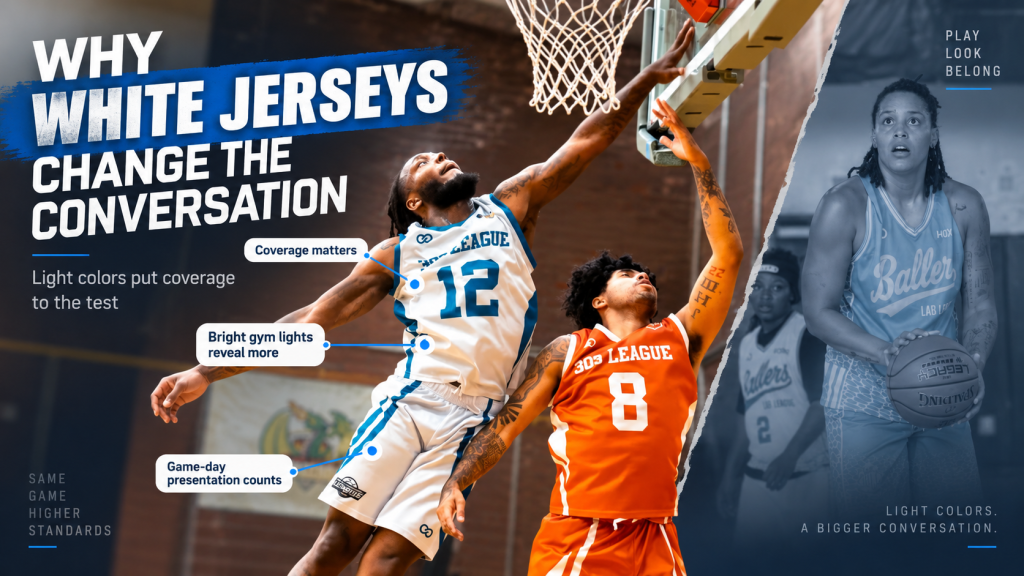
Dark colors hide a lot.
White does not.
With a lighter single-layer jersey, what players wear underneath can become more noticeable, especially with white, cream, pale gray, yellow, or other light shades.
That does not mean every single-ply jersey will look transparent.
It means the design needs more thought.
Imagine two teams ordering the exact same construction.
Team A chooses navy on one side and black on the other.
Team B chooses white and light yellow.
The experience may be completely different.
For Team A, coverage may never become a concern.
For Team B, it could be the first thing players notice.
Try the White-Jersey Test
Before choosing single-ply, ask:
- Is white or another pale color a major part of the uniform?
- Do players usually wear dark compression shirts underneath?
- Will the jersey be used mainly for official games?
- Will the team play under bright indoor lighting?
- Would better coverage matter more than reducing bulk?
If several answers are yes, double-ply becomes much more attractive.
If not, the lighter option may still make perfect sense.
So What Does Double-Ply Give You?
Double-ply is the more traditional reversible approach.
Instead of prioritizing minimum bulk, it gives the jersey a more substantial construction.
That can provide more confidence when light colors are involved and can feel closer to the reversible uniforms many players already know.
This is why double-ply often makes more sense when the reversible jersey is not just practice gear.
It is the uniform.
If your team will wear it in league games, tournaments, team photos, and travel competition, coverage and presentation may carry more weight in the decision.
You can compare that traditional reversible construction here if you want to see how it differs from a lightweight single-layer option.
Notice how the decision has already changed.
We are no longer asking:
Which construction is technically better?
We are asking:
What matters more to this particular roster?
That is the question worth answering.
5 Things Players Will Notice More Than “Ply”

Most players will never care what the product page calls the construction.
They will care about these.
1. Does It Feel Bulky?
This is where single-ply has its clearest advantage.
A reversible jersey can be incredibly practical, but some players dislike the feeling of extra material.
That becomes more noticeable during long sessions.
Practice for two hours.
Play three tournament games.
Sit through warmups.
Run again.
A few extra layers suddenly feel much more relevant than they did when the coach approved the mockup.
Single-ply reduces that problem.
But lighter does not mean faster.
It simply means some players may notice the jersey less.
And sometimes that is exactly what you want.
2. Does the Light Side Still Look Good?
A reversible uniform has to pass a harder design test than a standard jersey.
Both sides need to look intentional.
The dark side cannot be the “real” uniform while the light side looks like the emergency option.
Look at each side separately.
Can you read the number quickly?
Does the team name still stand out?
Does the logo compete with the graphics?
Does the white side still look polished?
A reversible should give you two finished jerseys, not one good jersey and one compromise.
That matters regardless of ply.
3. Does the Fabric Actually Breathe?
Single-ply sounds more breathable.
Sometimes it will feel that way.
But ply is only part of the story.
Mesh, fabric weight, side ventilation, cut, and fit all influence how comfortable a jersey feels once the game gets fast.
A poorly ventilated single-ply jersey can still feel uncomfortable.
A well-built traditional reversible can still perform perfectly well.
So do not stop at:
“How many layers does it have?”
Ask:
“What is the jersey actually made from?”
That is the more useful buying question.
4. How Often Will You Really Reverse It?
This one is easy to overlook.
Some teams genuinely need both sides.
Others love the idea of a reversible jersey and barely use the second color.
Think about a practice squad.
Coaches may switch teams every 15 minutes.
Red becomes white. White becomes red.
The reversible feature earns its place immediately.
Now think about a team that already owns separate home and away uniforms.
How often will that reversible function actually be used?
Maybe not often enough to matter.
This is why how the jersey will be used should come before construction.
Need Two Looks Without Carrying Two Jerseys?
See the different reversible builds available and compare which style makes the most sense for games, practices, or both.
5. Does It Make Sense for the Whole Roster?
A jersey decision rarely affects one player.
Multiply it by 10.
Or 15.
Or an entire camp.
That changes the conversation around price, comfort, replacement pieces, and how often the jerseys will actually be used.
For a large practice program, lightweight reversibles may make a lot of sense.
For a smaller competitive roster using the same jerseys as its main game uniform, the team may value coverage and presentation more.
There is no universal winner because the roster changes the answer.
When Single-Ply Is the Smarter Choice
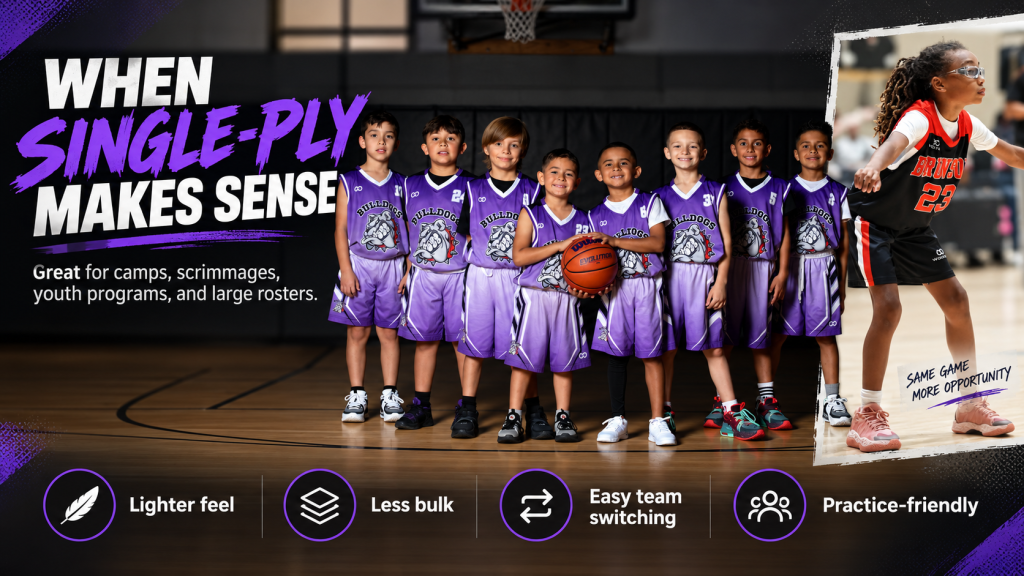
Single-ply makes the most sense when the reversible function will be used often and reducing bulk is genuinely useful.
Think:
- Practices
- Scrimmages
- Basketball camps
- Youth programs
- Rec leagues
- Training-heavy teams
- Large rosters
Imagine a coach running five-on-five drills.
Teams change every few possessions.
Instead of handing out pinnies or carrying separate tops, players simply flip the jersey.
That is exactly the kind of situation where reversibility earns its keep.
If that is your main use case, a reversible practice jersey designed for drills and quick team splits may actually be more logical than buying a heavier game-style reversible.
When Double-Ply Is the Smarter Choice
Now picture tournament day instead.
Game one: white.
Game two: dark.
Same uniform.
Different opponents.
Bright gym lights.
Team photos.
Parents recording clips from the sideline.
Suddenly presentation matters much more.
That is when double-ply becomes easier to justify.
It is especially worth considering when:
- One side is white or very light
- The reversible is your main game jersey
- You switch light/dark colors regularly
- Coverage is a priority
- Players prefer a more substantial uniform feel
For school teams, uniform color rules may also influence the decision. NFHS continues to distinguish home white and visitor dark uniforms in its current basketball guidance.
The Question Most Teams Should Ask First
Before choosing between single-ply and double-ply, ask:
Why are we buying a reversible jersey?
If you cannot answer that quickly, stop there.
Maybe you do not need one.
If you already have home and away sets, a standard jersey may give you a cleaner design and simpler buying decision.
One color system.
One uniform identity.
No second side to compromise.
For teams that only need one polished game-day look, a classic round-neck basketball jersey may be the better fit.
Frequently Asked Questions About Single-Ply vs Double-Ply Basketball Jerseys
Are single-ply reversible basketball jerseys see-through?
They can show more transparency than double-ply jerseys, especially with lighter colors.
Fabric, color choice, and what players wear underneath all affect the final result.
White deserves more attention than darker designs.
Is double-ply too heavy for basketball?
Not automatically.
Double-ply feels more substantial, but fabric, ventilation, and fit also affect comfort.
Some players prefer lightweight jerseys. Others barely notice the difference and value the extra coverage more.
Is single-ply better for practice?
It often makes sense for practice because reducing bulk can be useful during long sessions, camps, and scrimmages.
But the better option still depends on the jersey construction and what your players prefer.
Can single-ply jerseys still be fully reversible?
Yes.
Single-ply reversible jerseys are designed to provide two wearable looks from a lighter construction rather than the traditional layered approach.
Which is better for tournaments?
If the reversible is being used as the team’s primary game uniform, double-ply may be more attractive because coverage and presentation become more important.
Single-ply can still work when players strongly prefer a lighter feel.
Choose for the Court, Not the Product Page
Single-ply sounds lighter.
Double-ply sounds more substantial.
Neither description tells you what your team should buy.
Your roster does.
Think about the colors.
Think about where the jerseys will be worn.
Think about how often players will actually reverse them.
Think about whether they are practice gear or the uniform your team will wear when the game matters.
Once those answers are clear, the construction choice becomes much easier.
Ready to See Which Build Fits Your Team?
Start with your colors and how the jersey will be used. Then compare the available constructions before the final design is approved.